Pain in Right Arm: Heart Attack & Stroke Signs, Causes
Your right arm starts to ache, and your mind jumps to the worst-case scenario—it could be a muscle strain or a heart attack. This guide breaks down the possible causes by type to help you distinguish between a musculoskeletal nuisance and a medical emergency.
Prevalence of arm pain in outpatient visits: Arm pain accounts for approximately 1.5% of all emergency department visits in the United States. ·
Cardiac arm pain left vs right ratio: Heart-related pain radiates to the left arm in 30–40% of cases; right arm involvement occurs in about 15–20%. ·
Common non-cardiac cause: Cervical radiculopathy, a pinched nerve in the neck, causes right arm pain in roughly 85 per 100,000 adults per year. ·
Stroke-related arm weakness prevalence: Sudden arm weakness on one side, including the right, is an early sign in 60–70% of stroke cases.
Quick snapshot
- Sudden arm numbness or weakness on one side is a stroke sign CDC (U.S. public health agency)
- Chest pain radiating to the right arm can indicate a heart attack Mayo Clinic (academic medical center)
- Most right arm pain is musculoskeletal Cleveland Clinic (nonprofit medical center)
- Exact prevalence of right arm pain as a heart attack symptom is not well established in population studies
- Whether isolated right arm pain without other symptoms ever represents cardiac ischemia is debated among experts
- Whether right arm pain without chest symptoms can be the only sign of a heart attack is not well defined
- Sudden onset (seconds to minutes): stroke or vascular event CDC
- Gradual onset (hours to days): musculoskeletal, nerve compression, or infection Cleveland Clinic
- If red flags present, seek emergency care immediately CDC
- For non-urgent pain, consult a primary care provider or orthopedist (CDC)
Four key facts, one pattern: right arm pain is rarely heart-related in isolation, but when it is, the stakes are high.
| Fact | Value | Source |
|---|---|---|
| Heart attack with right arm pain | 15–20% of heart attack patients report pain radiating to the right arm | Mayo Clinic |
| Stroke with right-sided weakness | Sudden right arm weakness is one of the five main stroke symptoms | CDC |
| Cervical radiculopathy incidence | Affects 85 per 100,000 people annually, often causing right arm pain | Healthline (health information publisher) |
| Shoulder tendinopathy prevalence | Rotator cuff disorders affect up to 30% of adults over age 60 | Cleveland Clinic |
How do I know if my right arm pain is serious?
Red flags that warrant immediate medical attention
- Sudden severe pain, chest pressure, shortness of breath, or diaphoresis indicate possible heart attack Mayo Clinic.
- Loss of function, numbness, or weakness on the right side suggests stroke CDC.
- Pain that worsens with movement and improves with rest is usually musculoskeletal Cleveland Clinic.
Signs of a musculoskeletal issue versus a cardiac issue
- Musculoskeletal: localized tenderness, swelling, reproducible by specific movements, improves with rest or anti-inflammatories.
- Cardiac: dull ache, heaviness, or pressure radiating from chest; often accompanied by shortness of breath, nausea, cold sweat.
- If you’re unsure, apply the “stop and test” rule: stop any activity. If pain fades within a few minutes, it’s likely exertional. If it persists or worsens, seek help.
Heart-related arm pain is often described as pressure or squeezing, not sharp. Yet many people expect a stabbing pain — that mismatch causes dangerous delays. A dull ache in the right arm, paired with chest discomfort, is a stronger cardiac signal than a sharp, isolated twinge.
The implication: acting on the right clues can save minutes that matter.
What does heart-related arm pain feel like?
Typical radiation patterns: left arm vs right arm
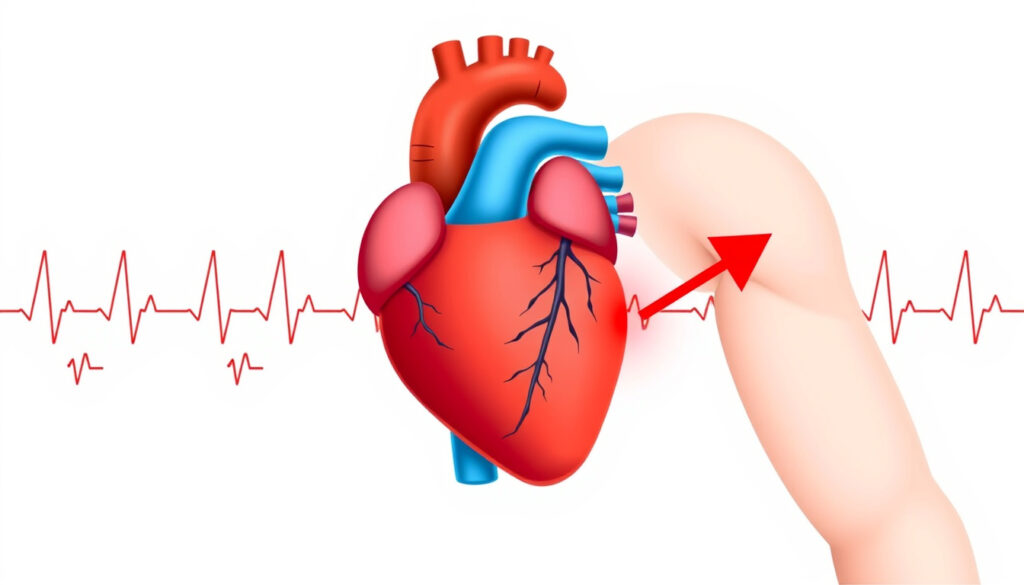
- Heart attack pain often radiates down the left arm, but the right arm can be involved too — in 15–20% of cases, the right arm is affected Mayo Clinic.
- The sensation is typically a dull ache, heaviness, or pressure that may travel to the shoulder, back, or jaw.
- Right arm pain without any chest symptoms is very unlikely to be cardiac Medical News Today (health journalism site).
Associated symptoms (chest discomfort, nausea, cold sweat)
- Heart-related arm pain rarely appears alone. Look for chest pressure, shortness of breath, lightheadedness, nausea, or a cold sweat Mayo Clinic.
- Women sometimes experience atypical symptoms — arm pain, fatigue, indigestion — without classic chest pain Healthline.
- If you have diabetes, high blood pressure, or a history of heart disease, the threshold for evaluating arm pain should be lower.
“Heart-related arm pain is often a dull ache or heaviness that may radiate down the left arm, but it can affect the right arm as well.”
Cleveland Clinic (nonprofit medical center)
Because right arm pain is more often musculoskeletal, a busy clinician may dismiss it. But for the person with underlying coronary artery disease, that dismissal can be fatal. The patient’s own awareness of accompanying symptoms makes the difference.
The pattern: cardiac arm pain is almost never the lone symptom.
Can right arm pain be a stroke?
FAST acronym: Face, Arm, Speech, Time
“Sudden numbness or weakness of the face, arm, or leg, especially on one side of the body, is a key sign of stroke.”
CDC (U.S. Centers for Disease Control and Prevention)
- The “A” in FAST stands for Arm: if one arm drifts downward when both are raised, that’s a red flag.
- Right arm weakness or numbness that appears suddenly — without prior injury — is a stroke symptom until proven otherwise.
- Mini stroke (TIA) symptoms resolve within minutes to hours but still require urgent evaluation CDC.
Stroke symptoms beyond arm weakness
- Facial drooping, difficulty speaking, sudden severe headache, vision problems, or trouble walking can accompany arm symptoms.
- Loss of coordination or dizziness on the right side may also indicate a stroke affecting the left hemisphere of the brain.
- If you suspect stroke, call emergency services immediately. Time lost is brain tissue lost.
The catch: many people dismiss arm weakness as a pinched nerve and delay care.
Does pain in the right arm indicate heart issues?
Why heart pain can be felt in the right arm
- The heart shares nerve pathways with the chest, shoulder, and arms via the cervical and thoracic spinal nerves. This convergence allows pain signals to “refer” to the right arm Healthgrades (health information platform).
- Referred pain to the right arm is less common than to the left, but it does happen — especially in inferior wall heart attacks.
- Isolated right arm pain without chest discomfort or other cardiac signs is rarely a heart attack. Studies show that fewer than 5% of heart attacks present with arm pain alone.
When right arm pain warrants a cardiac workup
- Risk factors: age over 55, male, smoker, diabetes, hypertension, high cholesterol, family history of heart disease.
- If the pain comes on with exertion and fades with rest, angina is possible. An exercise stress test or cardiac imaging may be needed.
- Women and people with diabetes may have “atypical” presentations — arm pain, fatigue, indigestion. A high index of suspicion is warranted.
The pattern: heart-related arm pain is almost never the lone symptom. When it is the only symptom, the likelihood is low — but not zero. For individuals with multiple risk factors, even vague right arm discomfort deserves a conversation with a doctor.
What causes upper arm pain without injury?
Common non-traumatic causes: referred pain, impingement, arthritis
- Cervical radiculopathy (pinched nerve in the neck) can cause pain, tingling, or weakness in the right arm without a direct injury Healthline.
- Frozen shoulder (adhesive capsulitis) often presents with gradual onset of pain and stiffness, limiting range of motion Cleveland Clinic.
- Rotator cuff tendinopathy — wear and tear of the shoulder tendons — causes pain in the upper arm, especially when lifting the arm overhead Mayo Clinic.
- Arthritis of the shoulder or elbow can cause dull, aching pain that worsens with weather changes.
Nerve compression: cervical radiculopathy and thoracic outlet syndrome
- Cervical radiculopathy occurs when a nerve root in the neck is compressed by a herniated disc or bone spur. Pain travels from the neck down the arm, often into specific fingers Healthline.
- Thoracic outlet syndrome compresses nerves or blood vessels between the collarbone and first rib, causing pain, numbness, and weakness in the arm and hand Cleveland Clinic.
The implication: upper arm pain without injury is often nerve-related or degenerative, not cardiac.
How do I know if my arm pain is not heart related?
Clues that suggest a musculoskeletal origin
- Pain that is reproducible by specific arm movements, local tenderness, or improvement with rest is likely musculoskeletal Cleveland Clinic.
- Lack of chest pain, shortness of breath, nausea, or sweating reduces cardiac probability Mayo Clinic.
- A normal electrocardiogram and negative cardiac enzymes largely rule out a heart cause.
When to see a specialist for arm pain
- Check for chest pain or shortness of breath — if present, seek emergency care.
- See if pain worsens with specific movements or positions — that points to musculoskeletal.
- Try rest, ice, and over-the-counter anti-inflammatories for 48 hours.
- If pain persists beyond a week or interferes with daily activities, consult a primary care provider or orthopedist.
- If you have risk factors for heart disease (diabetes, hypertension, smoking), mention them to your doctor.
The catch: even with a clear musculoskeletal pattern, a cardiac cause can’t be ruled out without medical evaluation.
Related reading: Pregnancy Weight Gain Calculator: BMI Chart by Week · How to Childproof a House – Room-by-Room Guide and Checklist
Frequently Asked Questions
What is the most common cause of right arm pain?
Musculoskeletal conditions such as rotator cuff tendinopathy, cervical radiculopathy, and simple muscle strain are the most common causes. Heart-related right arm pain is rare in isolation.
Can stress cause right arm pain?
Stress can contribute to muscle tension in the shoulders and arms, leading to referred pain. However, stress alone rarely causes sharp or persistent arm pain without an underlying physical trigger.
How long should I wait before seeing a doctor for right arm pain?
If the pain is sudden, severe, or accompanied by chest pressure, shortness of breath, or arm weakness, seek emergency care immediately. For mild, movement-related pain, see a doctor if it doesn’t improve after a week of self-care.
Does right arm pain ever indicate cancer?
Rarely, persistent right arm pain can be referred from a Pancoast tumor (lung cancer) or bone metastasis. This type of pain is usually progressive and not relieved by rest. It warrants imaging if other causes are ruled out.
What home remedies help with right arm pain?
Rest, ice, compression, elevation (RICE), and over-the-counter anti-inflammatories can help for musculoskeletal pain. Avoid lifting or repetitive motions until the pain subsides.
Can sleeping wrong cause right arm pain?
Yes, sleeping in an awkward position can compress nerves or overstretch muscles, leading to temporary pain, numbness, or tingling in the right arm. This usually resolves within hours.
Is right arm pain a sign of a pinched nerve?
Yes, cervical radiculopathy is a common cause of pinched nerve in the neck that radiates pain, tingling, or weakness down the right arm. It is often diagnosed by physical exam and MRI.
You now have a framework to assess your right arm pain: if it’s sudden with red flags, seek emergency care; if it’s movement-related and localized, it’s likely musculoskeletal. Acting on the right clues can save your health.
More related posts
 Property for Sale Maynooth: 22 Houses & Apartments in Kildare
 Ireland A vs England A – Verified Result and Key Facts
 Hannah John-Kamen: Biography, Ethnicity, Game of Thrones & Movies
 Is Virgin Media Down? Official Outage Check and Fix Guide
 EA FC 26 Web App: Release Date, Companion App, and Fixes
 Cork to Waterford Bus: Timetable, Route, Prices & Journey Time
 Ireland Heatwave Return Date: Forecast, History, Safety