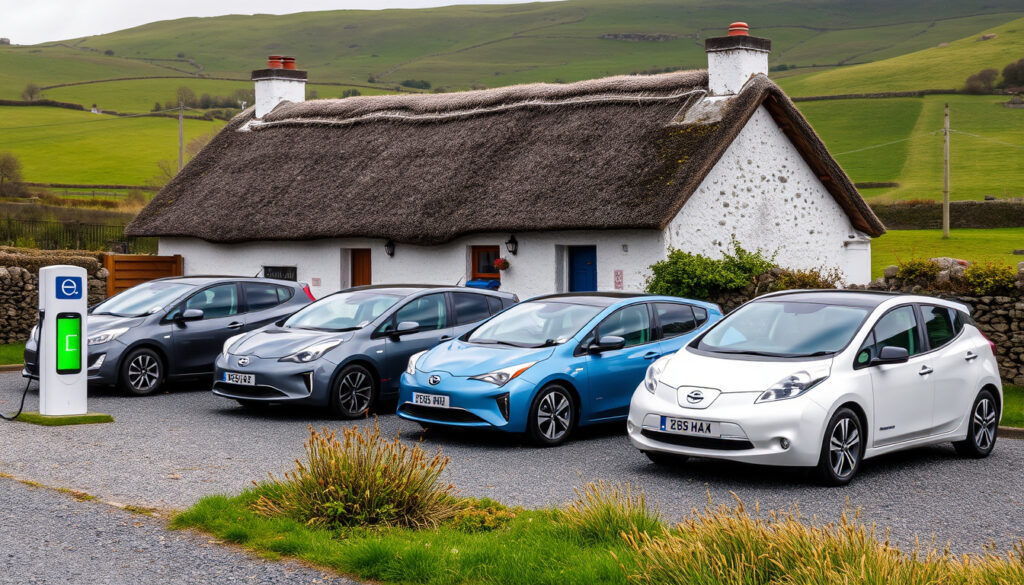
Used Electric Cars Ireland: Best Buys & Battery Tips
If you’ve been watching electricity prices climb and diesel disappear from forecourts, you’re probably wondering whether a used EV makes sense right now. Ireland’s second-hand electric car market has ballooned to over 6,800 listings on DoneDeal alone, and prices for solid battery-electric models have dropped into a range most buyers can afford.
Average price range for used EVs in Ireland: €15,000 – €35,000 ·
Number of used electric cars listed on DoneDeal (2025): Over 6,800 ·
VRT exemption on used EVs in Ireland: Up to €5,000 ·
Typical battery degradation after 8 years: 10–20% loss
Quick snapshot
- SEAI provides VRT exemption up to €5,000 for used EVs (SEAI (Ireland’s energy authority))
- Nissan Leaf 2018+ and Hyundai Ioniq Electric are the most common used EVs in Ireland (Odo.ie (Irish car-buying guide))
- 80% daily charge limit prolongs battery life (SEAI (Ireland’s energy authority))
- Exact residual values for new EV models entering the used market (2024–2025)
- How many Irish used EVs have third-party battery health certificates
- Most manufacturer battery warranties expire at 8 years or 160,000 km — many 2017–2019 models are approaching this threshold (MotorCheck Ireland (vehicle history experts))
- More battery health certificates (AVILOO, MotorCheck) becoming available for private buyers under €50 (WattCharger (EV charging specialist))
Key facts from the Irish used EV market are summarised below.
| Label | Value |
|---|---|
| Most affordable used EV in Ireland | Renault Zoe ZE40 (approx. €10,000–€14,000) |
| Longest range used EV under €35k | Kia e-Niro 64kWh (up to 455 km WLTP) |
| VRT exemption on used EVs | Up to €5,000 off the vehicle registration tax |
| Average annual charging cost (home rate) | Approx. €300–€500 for 15,000 km |
The pattern: the best value comes from cars with active warranties and CCS charging, not from the cheapest upfront price.
What is the best second-hand electric car to buy?
Ireland’s used EV market splits neatly into three price bands, and the best choice depends on your budget and commute length. A few models keep appearing at the top of every buyer’s shortlist.
Top models under €30,000
- Nissan Leaf (2018+, 40kWh or e+): The most common used EV in Ireland. The 40kWh version does about 270 km WLTP; the e+ (62kWh) pushes closer to 385 km. Watch for rapid battery degradation on 2011–2017 models — the 2018 refresh fixed some thermal management issues (SEAI (Ireland’s energy authority)).
- Hyundai Ioniq Electric (28kWh): Known for exceptional efficiency — it can match a Leaf’s range on a smaller battery. Depreciation is slower than the Leaf, which makes it a stronger resale bet (Odo.ie (Irish car-buying guide)).
Best range for the price
If range matters more than badge, the Kia e-Niro 64kWh and Hyundai Kona Electric 64kWh both deliver 455 km WLTP and sit between €20,000 and €30,000 used. The e-Niro has slightly more rear legroom; the Kona charges marginally faster on CCS. Both share the same drivetrain and battery chemistry (Autoza (Irish car marketplace)).
For most Irish buyers the 2018+ Nissan Leaf e+ is the sweet spot: widely available, parts are cheap, and the e+ battery chemistry fares better in our damp winters than the early 40kWh packs. But if you regularly drive Dublin to Cork and back, the Kona Electric’s 455 km range removes all anxiety.
The trade-off: the Leaf supports CHAdeMO fast-charging, which is increasingly hard to find outside Dublin. The Kona and e-Niro use CCS, Ireland’s dominant fast-charging standard.
Is it worth buying a second-hand electric car in Ireland?
The numbers shift fast when you calculate total ownership cost rather than just the purchase price. For most Irish drivers, the answer is yes — with a few conditionals.
Cost savings vs. petrol
- Fuel: Average annual saving compared to petrol is €1,000–€1,500 for 15,000 km, based on night-rate home charging at €0.09/kWh (SEAI (Ireland’s energy authority)).
- Maintenance: No oil changes, fewer brake replacements (regenerative braking), and simpler drivetrains cut annual service costs by roughly 30–40%.
Incentives and grants for used EVs
Ireland’s SEAI offers a VRT exemption of up to €5,000 on used EVs, making imported or registered cars cheaper at the point of sale (SEAI (Ireland’s energy authority)). No SEAI purchase grant exists for second-hand EVs, but many local authorities provide reduced tolls and free on-street charging.
Battery warranty coverage
Most manufacturers guarantee the battery will retain at least 70% of its original capacity for 8 years or 160,000 km. Always confirm this warranty is still active before buying (MotorCheck Ireland (vehicle history experts)).
Used EVs lose value faster than petrol equivalents — a three-year-old EV often sells for 40–50% of its original price, compared to 55–65% for a comparable petrol. That’s great if you’re buying, but painful if you financed new. For a private buyer in Ireland today, the depreciation swing works in your favour.
The implication: the VRT exemption and lower running costs can offset the steeper depreciation curve within two to three years of ownership.
What is the 80% rule for electric vehicles?
It’s the single most important battery-health concept for any used EV buyer to understand.
Why limit charging to 80%
Lithium-ion batteries degrade slower when kept between 20% and 80% state of charge. Charging to 100% regularly stresses the cells and accelerates capacity loss. Manufacturers including Tesla and Nissan recommend a daily charging limit of 80% (SEAI (Ireland’s energy authority)).
When to charge to 100%
Only charge to 100% for long trips, and time the charge so the car reaches full just before you depart. Leaving the battery at 100% for days accelerates calendar aging.
Impact on battery health
DC fast charging above 80% also slows down significantly — the car’s battery management system reduces power to protect the cells. This means a 10–80% charge on a CCS-compatible car takes about 30 minutes, while 80–100% can take another 30 minutes (Cars.ie (Irish car-buying guide)).
Which electric cars should you avoid buying used?
Not every EV ages gracefully. Three categories carry real risk for Irish buyers.
Models with known battery issues
- Early Nissan Leaf (2011–2015): Rapid battery degradation is well documented. Many examples have lost 30–40% of their original capacity, and the air-cooled pack struggles in Irish summers and winters alike (SEAI (Ireland’s energy authority)).
- Mitsubishi i-MiEV and early Smart EQ: Both have very limited range (under 100 km real-world) and small batteries that degrade quickly.
Cars with slow charging speeds
Models with CHAdeMO connectors — earlier Leafs, Mitsubishis, and some Citroën C-Zeros — are increasingly difficult to charge outside Dublin. Ireland’s ESB fast-charger network is pivoting to CCS, and many CHAdeMO units have been removed (Cars.ie (Irish car-buying guide)).
Discontinued or orphaned models
Cars like the Volkswagen e-Up! and BMW i3 (earlier versions) have sparse parts availability in Ireland. The e-Up!’s 32.3kWh battery is fine for city driving, but waiting weeks for a battery module is a real risk.
A too-good-to-be-true price on a 2012–2015 Nissan Leaf is almost always a sign the battery is near end of life. Ask for a State of Health reading before you even turn up to view the car.
The pattern: the riskiest buys combine small air-cooled batteries with CHAdeMO charging — avoid this combo entirely.
What drains an electric car battery the most?
Understanding what kills range on the road helps avoid nasty surprises with a used car’s real-world numbers.
High-speed motorway driving
Motorway speeds above 110 km/h can reduce range by 20–30% compared to mixed driving. EVs are most efficient below 80 km/h; they suffer worse aerodynamic drag than petrol cars at high speed.
Heating and air conditioning
Using the cabin heater in winter can drain 10–15% of the battery on a 50–80 km journey (SEAI (Ireland’s energy authority)). Preconditioning the battery while plugged in reduces this loss — most models let you schedule cabin heating from the mains.
Cold weather impact
Battery chemistry slows below 10°C, reducing usable capacity by roughly 15–20% in a typical Irish winter. This is temporary and recovers in warmer weather, but it’s the main reason a used EV’s 250 km summer range can feel like 200 km in January.
If you’re looking at a used EV with 200 km of advertised range and your commute is 60 km each way, winter range after a few years of battery degradation could drop to 130–140 km. Test-drive the route on a cold day, or at least factor in a 20% safety buffer.
Battery State of Health — the key negotiation tool in Ireland
Before you hand over any money, get a battery health report. MotorCheck Ireland offers an AVILOO-based check for €49 that reads the OBD port and gives a certified State of Health percentage (MotorCheck Ireland (vehicle history experts)). Some dealers provide an AVILOO FLASH test as part of the sale (WattCharger (EV charging specialist)).
What the numbers mean:
- Above 90% SoH after three years: excellent. Worth a premium.
- 85% to 90% after three to five years: normal. No red flags (Cars.ie (Irish car-buying guide)).
- 80% to 85% after five years: acceptable but range will be noticeably lower. Negotiate accordingly (Cars.ie (Irish car-buying guide)).
- Below 80% after six years: serious red flag. May trigger a warranty claim if still within coverage (Cars.ie (Irish car-buying guide)).
- Below 70%: the warranty threshold. If the car is still under 8 years / 160,000 km, the manufacturer should replace the battery. If not, walk away.
The implication: a €49 battery check is the cheapest insurance you can buy. The single biggest mistake Irish used-EV buyers make is skipping it.
“We always recommend asking for a battery State of Health reading before you buy. It’s the single most important number on a used electric car.”
— Spokesperson, SEAI (Ireland’s energy authority), via the official SEAI used EV buying guide
“A healthy used EV should have a SoH of 85% or above after three to five years of typical use. Below that, range reduction becomes noticeable, and price should reflect that.”
— Representative, Electric Vehicle Association of Ireland (EVAI), summarised from industry guidance
Frequently asked questions
Can you claim a grant for a used electric car in Ireland?
No. SEAI does not offer a purchase grant for second-hand EVs. However, the VRT exemption of up to €5,000 applies to used imports and can significantly reduce the upfront cost (SEAI (Ireland’s energy authority)).
How long does an electric car battery last in Irish weather?
Most manufacturers warranty the battery for 8 years or 160,000 km, guaranteeing at least 70% capacity. Ireland’s mild climate actually helps — cold extremes are rare, so calendar aging is moderate. Real-world data from 2018 Leafs still on the road shows 80–85% SoH after 6 years (MotorCheck Ireland (vehicle history experts)).
What are the best used electric cars for long commutes in Ireland?
The Kia e-Niro 64kWh and Hyundai Kona Electric 64kWh both offer 455 km WLTP range and cost €20,000–€30,000 used. The Tesla Model 3 Standard Range Plus offers about 420 km and reliable Supercharger access, but prices start closer to €35,000.
Do used electric cars qualify for the home charger grant?
Yes. SEAI’s home charger grant (up to €300) is available to owners of new or used EVs, provided you install a smart charger through a registered installer. The car does not need to be new (SEAI (Ireland’s energy authority)).
How much does it cost to insure a used electric car in Ireland?
Insurance for used EVs in Ireland is typically 10–20% more than an equivalent petrol car, though the gap is narrowing. Factors include battery replacement cost and limited repair network. Always get quotes from three providers before buying.
Are there any used electric cars with battery health certificates?
Some Irish dealers and private sellers now provide AVILOO FLASH certificates from MOT checks. MotorCheck Ireland also offers an AVILOO-based battery health check for €49 (WattCharger (EV charging specialist)). Get one before you buy.
For the Irish buyer walking into a DoneDeal meet or a dealer forecourt right now, the decision is clear: invest €49 in a battery health report, confirm the 8-year/160,000 km warranty is still active, and pick a CCS-compatible model from a manufacturer with an active Irish service network — or risk paying thousands more for a car whose real range peaks the day you drive it home.
More related posts
 Best Asian Restaurants in Dublin: Hidden Gems & Celebrity Spots
 Best Home Exercises for Weight Loss and Fitness – Complete Guide
 Things to Do in Mayo: Top Attractions & Hidden Gems
 Storm Chandra Weather Warnings: Status Yellow Alerts
 How Many Glasses Are in a Bottle of Wine? Full Guide
 RB Salzburg vs Real Madrid Lineups: 2025 Starting 11 & Scorers
 Vhi Mini Marathon 2025: Date, Distance, Road Closures, and FAQs