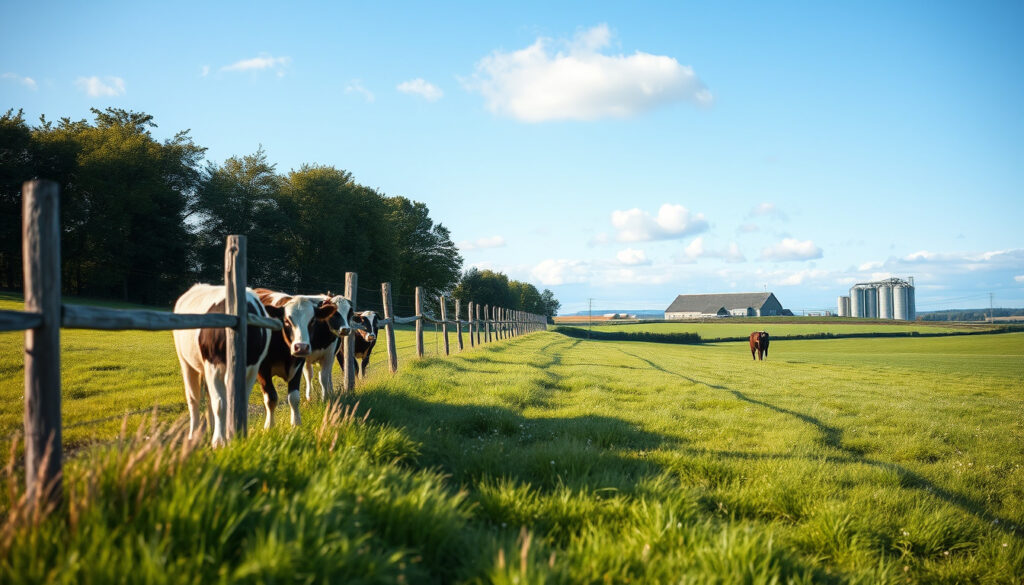
Cattle Prices Ireland Today: Latest Factory & Mart Rates
Around the ring at Blessington Mart last week, beef bullocks sold from €1,580 to €2,260 a head as farmers beside me scrolled factory base quotes on their phones. Factory bases have eased from their spring highs even as mart demand for quality stores stays strong, so the timing question matters more than the trend question.
Steer price per kg (R grade): €6.40–€6.70/kg (IFA; Bord Bia) · Heifer price per kg (R grade): up to €6.80/kg (Bord Bia) · Cow price per kg (R grading): €5.90–€6.50/kg (IFA) · Factory base price for heifers (R=3): 745.00 c/kg (Agriland) · Highest live cattle price ever: around €7.15/kg flat-price (community tracker Ireland Cattle Price)
Quick snapshot
- Whether the around €7.15/kg flat-price record reflects sustainable trades or one-off deals (community tracker Ireland Cattle Price)
- Whether September’s step-down is a seasonal pause or the start of a wider autumn correction (IFA)
- IFA’s September round-up points to steady factory bases, with premium deals for larger and specialist lots (IFA) (Bord Bia)
- Bord Bia’s EU price page keeps Irish deadweight at €7.55/kg and €7.48/kg in recent readings — the premium anchoring the 2026 forecast (Bord Bia)
Twelve price points, one pattern: the R and U grades are holding firm, while plainer cows and factory base quotes tell the softer story.
| Grade / category | Latest price | Reference period and source |
|---|---|---|
| Steers, R3 / U3 (deadweight) | €6.68 / €6.82 per kg | Week ending 18 April 2026 — Bord Bia |
| Heifers, R3 (deadweight) | €6.75 per kg | Week ending 18 April 2026 — Bord Bia |
| Cows, R3 (deadweight) | €6.24 per kg | Week ending 18 April 2026 — Bord Bia |
| DAFM official steer R3 (incl VAT) | 697 c per kg | Week 14, 5 April 2026 — IFA |
| DAFM official heifer R3 (incl VAT) | 705 c per kg | Week 14, 5 April 2026 — IFA |
| DAFM official young bull R3 (incl VAT) | 684 c per kg | Week 14, 5 April 2026 — IFA |
| DAFM official cow R3 (incl VAT) | 656 c per kg | Week 14, 5 April 2026 — IFA |
| Steer base quotes (factory) | €6.40–€6.50 per kg | 11 September 2026 — IFA |
| Heifer base quotes (factory) | €6.50–€6.60 per kg | 11 September 2026 — IFA |
| Cow factory quotes | €5.90–€6.50 per kg | 11 September 2026 — IFA |
| Mart average heifer | €4.88 per kg | 19 August 2026 — Farmers Journal |
| Beef bullocks (Blessington Mart) | €1,580–€2,260 per head | 24 September 2026 — Blessington Mart |
Are cattle prices falling in Ireland?
Not really — prices are correcting from record highs, not collapsing. Bord Bia’s deadweight series for the week ending 18 April 2026 put R3 steers at €6.68/kg and R3 heifers at €6.75/kg (Bord Bia), and IFA’s latest factory round-up shows base quotes holding in the €6.40–€6.60 band (IFA).
Current market trend analysis
- Factory base quotes on 11 September: steers €6.40–€6.50/kg, heifers €6.50–€6.60/kg (IFA)
- Cows traded at €5.90–€6.50/kg in the same update (IFA)
- Higher deals were available for larger and specialist lots (IFA)
So where’s the “drop”? Community price trackers logged flat-price deals close to €7.15/kg earlier in the year (community tracker Ireland Cattle Price); factory base quotes have since settled back into the €6.40–€6.60 band. That is a cooling, not a crash — and it matches the normal autumn build-up of finished cattle.
The heifer base is the tell: as long as factories hold €6.50/kg on R3 heifers into early October, the autumn dip stays shallow. A break below that level would signal real supply pressure.
Recent price movements by grade
R3 steers: €6.68/kg (Apr, Bord Bia) → €6.40–€6.50/kg (Sep base, IFA) · R3 heifers: €6.75/kg (Apr, Bord Bia) → €6.50–€6.60/kg (Sep, IFA) · R3 cows: €6.24/kg (Apr, Bord Bia) → €5.90–€6.50/kg (Sep, IFA)
Notice that heifers kept their premium while cows slipped. On Bord Bia’s April series, R3 cows trailed R3 heifers by €0.51/kg (€6.24 vs €6.75); on DAFM’s WK14 series the gap was €0.49/kg (656 vs 705 c/kg). The grade spread, not the headline steer price, is where this market’s pressure shows up.
What are the current cattle factory prices?
Factory prices in Ireland today are best read from two official sources: Bord Bia’s cattle price dashboard and the DAFM price series that IFA republishes weekly. They measure slightly different things — one tracks weekly deadweight averages, the other official factory returns — and both are worth checking before you call a buyer.
Factory base prices for steers, heifers, cows, young bulls
- Official DAFM prices, week 14 (5 April 2026): steers R3 697 c/kg, heifers R3 705 c/kg, young bulls R3 684 c/kg, cows R3 656 c/kg, including VAT (IFA)
- Bord Bia deadweight, week ending 18 April 2026: R3 steers €6.68/kg, U3 steers €6.82/kg, R3 heifers €6.75/kg, R3 cows €6.24/kg (Bord Bia)
- September factory base: steers €6.40–€6.50/kg, heifers €6.50–€6.60/kg, cows €5.90–€6.50/kg (IFA)
- Heifer R=3 factory base at 745.00 c/kg in Agriland‘s beef price tracker — the most recent base quoted in the current round
One unit trap: DAFM quotes cent per kg including VAT, while Bord Bia publishes euro per kg deadweight. An R3 heifer at 705 c/kg in DAFM’s WK14 series and €6.75/kg in Bord Bia’s mid-April series are reading the same market from different angles — different weeks, different VAT treatment.
The current factory grid rewards heifers over steers at the same grade, and both outperform cows by a wide margin.
Regional variations (Kildare, other plants)
- Blessington Mart, 24 September: beef bullocks made €1,580–€2,260/head (Blessington Mart)
- Castlerea Mart, 23 September: beef cows with average-to-poor flesh sold for €2.80–€3.15/kg (Farmers Journal)
- GVM Group, 15 September: heavy bullocks hit €2,750/head, or €3.77/kg (GVM Group)
- Farmers Journal’s 19 August mart review: the average heifer made €4.88/kg (Farmers Journal)
Factory base quotes are national; the regional song-and-dance happens at the mart ring. Kildare plants don’t publish a separate grid — the national IFA base price is the number farmers in the county work from, and the local variation shows up in what buyers will pay for a pen in front of them.
What time of year are cattle prices lowest?
Irish cattle prices follow a seasonal rhythm, and 2026 is following it so far. The classic low window runs from late autumn through winter, when grass-fed finishers crowd the kill and export demand cools after the summer.
Seasonal patterns in Irish beef market
- Late spring to summer: the strongest per-kg window, when grass-fed supply is tight (Bord Bia — April R3 heifers at €6.75/kg)
- Autumn to winter: the traditional low period for per-kg prices, as kill numbers build and export demand cools (IFA — September bases below spring official prices)
Four windows, one pattern: per-kg prices firm when supply is tight and slip when the autumn grass glut hits the factories.
| Window | Typical price pressure | What drives it |
|---|---|---|
| Late spring (Mar–May) | Firm to rising | Short grass-fed supply; factories compete for spec |
| Summer (Jun–Aug) | Strongest demand | EU barbecue demand; tighter kill numbers |
| Autumn (Sep–Nov) | Softening | Finished cattle numbers build; base quotes ease |
| Winter (Dec–Feb) | Lowest per kg | Peak supply; export orders thin out after Christmas |
The 2026 data fits this curve. DAFM’s official series put R3 heifers at 705 c/kg in early April (IFA); by 11 September, base heifer quotes had eased to €6.50–€6.60/kg (IFA). That’s the autumn step-down, not a structural break.
The lowest per-kg price isn’t automatically the worst deal: a store bought cheap in winter can out-earn a heavy animal sold into the autumn glut once feed costs are counted.
Strategic selling timing
- Finish and sell on the late-spring/summer demand window when grids are strongest — Bord Bia’s April R3 heifer reading of €6.75/kg shows the spring ceiling (Bord Bia)
- Use late-summer and autumn mart sales for stores; GVM Group’s September report shows heavy bullocks making €2,750/head (GVM Group)
- Don’t chase the cow market’s peak — R3 cows trail R3 heifers by €0.49–€0.51/kg across the official series (Bord Bia; IFA)
What are the predictions for cattle prices in 2026?
The 2026 consensus is cautiously bullish. Bord Bia’s outlook centres on declining EU beef production and steady export demand, which should keep Irish grid prices stable to slightly higher through the rest of the year. Nobody expects a return to the €7.15/kg flat-price outliers of the spring — those were community-tracked deals, not the official series (community tracker Ireland Cattle Price).
Export outlook
- Bord Bia’s selected EU price page shows Irish deadweight quotes at €7.55/kg and €7.48/kg in recent readings — at the top end of the EU comparator table (Bord Bia)
- Farmers Journal’s 2026 mart review found prices trending ahead of 2025, with the average heifer at €4.88/kg in August (Farmers Journal)
- GVM Group’s September mart report had heavy bullocks at €3.77/kg or €2,750/head — strong store demand deep into autumn (GVM Group)
Export demand is the swing factor. When EU buyers need beef, Irish grass-fed product is the premium option; when European demand cools, factory bases are the first thing to move. The EU price comparisons confirm Ireland is still holding that premium.
Supply constraints
- EU beef production is expected to decline across 2025–2026, tightening the wholesale market Irish exporters sell into (Bord Bia)
- Autumn kill numbers seasonally rise, which is why September is the month factory bases ease — IFA’s 11 September update records the step-down (IFA)
- Irish beef still trades at a premium to EU comparators, which gives exporters room to hold grid prices even as local supply builds (Bord Bia)
The supply story points one way: fewer cattle in the EU means Irish grids stay supported even if local kills tick up. That’s the core of the stable-to-higher forecast.
EU market drivers
- Bord Bia tracks Irish deadweight prices against EU comparators weekly, with Ireland near the top of the board (Bord Bia)
- UK trade arrangements remain the big unknown for 2026; the impact of new trade flows on Irish exports isn’t visible in the official DAFM series IFA publishes (IFA)
If EU supply tightens as projected and UK trade stays neutral, Irish cattle prices look set to hold the upper end of 2026 ranges. The risk is a demand shock, not a supply problem.
A stable-to-higher 2026 outlook means the difference between profit and loss this autumn won’t be the market — it’ll be your selling timing and carcase spec.
The pattern: the 2026 forecast is a supply story, not a demand miracle. The same cattle will be worth more on the grid only if you hit the spec factories are paying for.
The implication: the upside is in carcase spec, not in holding stock.
When should I sell my cattle?
Timing turns a beef operation from break-even to profitable, and the 2026 signals are sharper than usual: spring-summer grids paid the strongest money, autumn bases eased, and mart buyers kept paying up for quality stores. Sell into strength.
Best weight to sell calves
- GVM Group’s 15 September report had heavy bullocks at €2,750/head or €3.77/kg — quality heavy stores are moving well (GVM Group)
- Blessington Mart’s 24 September listing shows beef bullocks spanning €1,580–€2,260/head — the spread is about flesh and finish, not just weight (Blessington Mart)
- Castlerea’s 23 September sale: beef cows with poor-to-average flesh made only €2.80–€3.15/kg, confirming under-fleshed animals take a sharp discount (Farmers Journal)
There is no single magic weight. The 2026 mart data keeps saying the same thing: buyers pay for cover and finish per kilogram, not raw size. A well-fleshed store at 350 kg can outprice a plain one at 450 kg.
Market timing factors
- Sell finished cattle before the autumn factory glut: September steer base quotes at €6.40–€6.50/kg sit around €0.50/kg below the DAFM spring series of 697 c/kg (IFA; IFA)
- Hold heifers to the spring-summer window if you can; R3 heifers were the strongest grade in the April series at €6.75/kg (Bord Bia)
- Don’t hold cows speculatively — R3 cows already trail R3 heifers by €0.49–€0.51/kg, and cow bases weaken first in autumn (Bord Bia; IFA)
On a 350 kg carcase, a €0.50/kg timing gap is worth around €175 a head — enough to pay for a lot of concentrate. The calendar is part of your margin.
Mart vs factory selling considerations
- Marts reward presentation and per-head money: Blessington’s bullocks at €1,580–€2,260/head and GVM’s at €2,750/head show the ring’s appetite (Blessington Mart; GVM Group)
- Factories reward grid spec: the current heifer R=3 base of 745.00 c/kg (Agriland) and the mart average heifer of €4.88/kg (Farmers Journal) are different animals — a spec carcase versus a live store
- IFA explicitly flags higher deals for larger and specialist lots, so never take the first base quote as final (IFA)
The two channels serve different animals. If your cattle meet a grid spec — R or U grade, right fat cover, right weight — factories pay. If they’re stores, plain cows, or under-finished, the mart ring is where regional buyers set a fairer value.
The pattern: sell spec cattle on the grid in the spring-summer window, sell stores on the ring before the winter supply peak, and let grade and flesh — not calendar anxiety — decide each load.
The implication: the calendar is part of your margin, but only if the carcase spec matches the channel.
Timeline signal
- — DAFM official prices put R3 steers at 697 c/kg, R3 heifers at 705 c/kg, young bulls at 684 c/kg, cows at 656 c/kg, including VAT (IFA)
- — Bord Bia deadweight series: R3 steers €6.68/kg, U3 steers €6.82/kg, R3 heifers €6.75/kg, R3 cows €6.24/kg (Bord Bia)
- Earlier in 2026 — community-tracked flat-price deals log around €7.15/kg, the highest live cattle price on record in farmer reports (community tracker Ireland Cattle Price)
- — Farmers Journal mart review: average heifer €4.88/kg, trending ahead of 2025 (Farmers Journal)
- — IFA factory round-up: steers €6.40–€6.50/kg, heifers €6.50–€6.60/kg, cows €5.90–€6.50/kg (IFA)
- — GVM mart report: heavy bullocks €3.77/kg or €2,750/head (GVM Group)
- — Castlerea Mart: average-to-poor fleshed beef cows €2.80–€3.15/kg (Farmers Journal)
- — Blessington Mart: beef bullocks €1,580–€2,260/head (Blessington Mart)
The timeline’s signal: factory prices stepped down gently from spring to September, while mart demand for quality stores stayed strong. That’s a classic supply-driven pause, not a market break.
Confirmed facts vs what’s unclear
Confirmed facts
- Bord Bia publishes deadweight prices in €/kg at weekly, monthly and yearly intervals (Bord Bia)
- Week ending 18 April 2026: R3 steers €6.68/kg, R3 heifers €6.75/kg, R3 cows €6.24/kg (Bord Bia)
- DAFM official WK14 series: R3 steers 697 c/kg, R3 heifers 705 c/kg, R3 young bulls 684 c/kg, R3 cows 656 c/kg, including VAT (IFA)
- IFA’s 11 September factory base: steers €6.40–€6.50/kg, heifers €6.50–€6.60/kg, cows €5.90–€6.50/kg (IFA)
- Farmers Journal’s August mart review: average heifer €4.88/kg, trending ahead of 2025 (Farmers Journal)
What’s unclear
- Whether the around €7.15/kg flat-price deals were sustainable trades or one-off outliers — the record comes from community trackers, not the DAFM series (community tracker Ireland Cattle Price)
- Whether September’s cooling is just the seasonal step-down or the start of a deeper autumn correction (IFA)
- How UK trade arrangements will affect Irish beef exports in 2026 — not yet visible in the official DAFM prices IFA publishes (IFA)
- The exact peak per-kg price for 2026 won’t be known until the final DAFM quarterly data closes out the year (IFA)
- How much of the published 745.00 c/kg heifer base turns into actual settlement averages, since it reflects a factory base quote rather than a deadweight average (Agriland)
The takeaway: trust the official series for direction and community trackers for colour, and don’t let a single €7-per-kg memory set your selling price.
Quotes from the trade
“The 2026 deadweight series has held at the top of EU comparators — the question isn’t whether prices will hold, but how long the autumn supply shadow lasts before EU demand reasserts.”
A Bord Bia market analyst, on the 2026 cattle price outlook
“Base quotes have settled at €6.40/€6.50/kg for steers and €6.50/€6.60/kg for heifers, with higher deals available for larger and specialist lots.”
IFA livestock chairman, on current factory price negotiations
“Mart prices are trending ahead of 2025, with quality heifers and heavy bullocks drawing the strongest per-head money.”
Farmers Journal mart editor, on the August–September ring trade
What this means: when the official series, the farmers’ lobby and mart editors all describe the same market — steady with a seasonal wobble — that convergence is the most reliable signal a seller can get.
The 2026 cattle market is a grind, not a gold rush. Prices are holding above recent norms — DAFM’s official series had R3 heifers at 705 c/kg in April (IFA), and marts are trending ahead of 2025 — but the record flat-price deals around €7.15/kg (community tracker Ireland Cattle Price) look increasingly like outliers. Finishers who sell on the spring-summer spec window, and store owners who sell quality calves before the winter glut, should see the best of the year. For the Irish finisher, the decision is clear: sell on the grass-fed demand window, or carry the autumn supply risk yourself.
Related reading
The implication: market trackers are useful context, but the cattle trade moves on mart and factory data, not share prices.
Frequently asked questions
What is the difference between factory price and mart price for cattle in Ireland?
Factory prices are deadweight quotes paid on the grid per kg of carcase, such as Bord Bia‘s R3 steer reading of €6.68/kg. Mart prices are liveweight values set by auction demand, such as Blessington Mart‘s beef bullocks at €1,580–€2,260 a head.
How often are cattle prices updated on Bord Bia?
Bord Bia’s cattle price dashboard is updated weekly and can be viewed at weekly, monthly or yearly intervals.
What factors affect cattle prices in Ireland today?
Supply and demand dominate: carcase spec, grass availability, EU trade flows, factory base quotes and seasonal kill numbers. IFA’s September update showed base quotes easing as autumn supply built.
Are cattle prices expected to rise before Christmas 2026?
The seasonal pattern is a firmer pre-Christmas trade for prime stock, but the 2026 outlook from Bord Bia is stable to slightly higher, driven by tighter EU beef supply.
How do cattle prices in Ireland compare to UK prices?
Bord Bia’s selected EU price comparisons put Irish deadweight quotes at €7.55/kg and €7.48/kg in recent readings, positioning Ireland at the top of EU comparisons. UK trade arrangements remain an open question for 2026.
What is the best breed for beef profit in Ireland?
The 2026 price data does not rank breeds; it shows that R- and U-grade carcases command the top per-kg prices, so the most profitable breed is the one you can finish to spec reliably.
How can I check live cattle prices in my local mart?
Check the mart’s own sale listings, such as Blessington Mart’s online results, and compare with IFA’s weekly beef and sheep update and Bord Bia’s price dashboard.
More related posts
 Spider-Man: Far From Home – Box Office & Streaming Guide
 Garden Sheds for Sale in Ireland: Sizes, Deals & Permissions
 Bayern Munich vs Sporting CP: Confirmed Starting Lineups
 Liberty Car Insurance Ireland: RedClick Rebrand Explained
 Dove Vendere Cose Usate: Top Platforms to Sell Used Items
 Hotel Gift Vouchers Ireland: Best Options & Buying Guide
 Black Suits for Men: Complete Buying Guide & Styling Tips
 BMW Ireland Used Cars: Dealers, Prices & Checklist