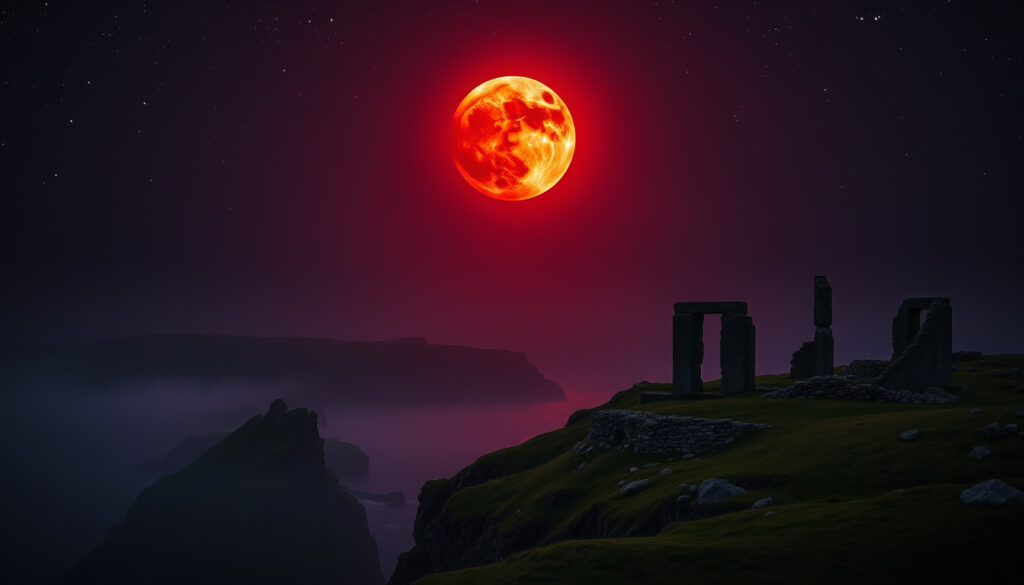
Blood Moon Total Lunar Eclipse Ireland – March 14 2025 Guide
Blood Moon Total Lunar Eclipse Over Ireland: March 14, 2025 Guide
The total lunar eclipse on March 14, 2025 brought a striking “Blood Moon” to Irish skies in the early morning hours. The event unfolded across approximately six hours globally, with the Moon turning a deep reddish hue during the totality phase. For observers in Ireland, the eclipse began around 5:09am local time, with the partial phases visible until the Moon dipped toward the western horizon just before sunrise. The event marked the first total lunar eclipse visible from Ireland since November 2022.
Western regions of the country offered the best vantage point, as the Moon sat low in the sky when fully eclipsed. Astronomy Ireland urged skywatchers to head outdoors if skies were clear, noting that cloud cover frequently obscures such events in March. The eclipse remained safe to view with the naked eye throughout all phases, requiring no special equipment beyond a clear view toward the west.
When Is the Blood Moon Total Lunar Eclipse Visible in Ireland?
March 14, 2025
5:09 AM Local Time
6:26 AM Local Time
Western Ireland Preferred
- First total lunar eclipse visible in Ireland since November 2022
- The Moon appeared reddish during totality due to sunlight filtering through Earth’s atmosphere
- Safe to view with the naked eye throughout all phases
- Western Ireland experienced slightly better visibility than the east coast
- The next total lunar eclipse visible from Ireland will not occur until December 31, 2028
| Phase | Universal Time (UTC) | Ireland Time (Local) | Description |
|---|---|---|---|
| Penumbral Eclipse Begins | 03:57 UTC | 03:57 | Subtle shadowing begins on the lunar surface |
| Partial Eclipse Starts | 04:10 UTC | 05:09 | First visible “bite” taken out of the Moon |
| Totality Begins | 05:26 UTC | 06:26 | Moon fully within Earth’s umbra, turning red |
| Maximum Eclipse | 05:58 UTC | 06:58 | Deepest red coloration visible |
| Totality Ends | ~07:30 UTC | ~07:30 | Moon exits the umbra, brightening gradually |
| Penumbral Eclipse Ends | 10:00 UTC | — | Final shadow fades as eclipse concludes globally |
Is the Blood Moon Eclipse Visible from Ireland and Where to Watch?
Visibility Across Ireland
Ireland fell within the western Europe visibility zone for this eclipse. The Moon sat low in the western sky during the totality phase, which meant observers in the west had a clearer line of sight than those on the east coast. According to NASA’s eclipse division, western Ireland had a slight advantage in catching the reddened Moon before it disappeared toward the horizon. Eastern areas experienced progressively lower altitude views as dawn approached.
The penumbral phase began at 03:57 local time, though this subtle stage was difficult to detect without experience. The partial phase started at 5:09am, when the first distinct darkening became visible to the naked eye. Totality commenced at 6:26am, but the Moon had already descended significantly in the sky by that point.
Best Places to Watch in Ireland
Dark sky locations along Ireland’s western seaboard provided the optimal conditions for this event. The Wild Atlantic Way coastline, particularly areas with an unobstructed western horizon, allowed viewers to follow the eclipse from its early stages through the onset of totality.
- Cliffs of Moher and the Connemara National Park area — low western horizons and minimal light pollution
- Kerry International Dark Sky Reserve — Gold-tier designated viewing site
- Mayo Dark Skies — another Gold-tier location in the west
- The Isle of Skye vicinity for viewers with access to Scotland’s western islands
Urban centres such as Dublin and the east coast carried the disadvantage of significant light pollution. Astronomy Ireland specifically recommended travelling west for the clearest views. Those planning to travel from the east coast were encouraged to account for early morning road conditions, particularly on routes linking rural viewing areas.
Binoculars or a small telescope enhanced the experience during the partial phases, when the shadow progression across the lunar surface became most apparent. For the earliest stages around 5am, the naked eye was sufficient when the sky remained dark enough.
Why Is It Called a Blood Moon and What Causes the Red Color?
The Science Behind the Red Hue
During a total lunar eclipse, Earth passes directly between the Sun and the Moon. Sunlight does not vanish entirely — instead, our planet’s atmosphere acts as a filter, scattering shorter wavelengths of light and allowing longer wavelengths, primarily red and orange, to reach the lunar surface. This process, known as Rayleigh scattering, paints the Moon in shades ranging from bright copper to deep crimson, depending on atmospheric conditions at the time.
The exact shade observed in any given eclipse depends on factors including global cloud cover, volcanic activity, and airborne particles. Dust and moisture in Earth’s atmosphere can intensify the red coloration. In Ireland, the low position of the Moon during totality and the encroaching dawn light combined to produce a subtler effect than what observers in the Americas experienced during the same event.
Supermoon Status
This eclipse was not classified as a supermoon event. A supermoon occurs when the full Moon reaches perigee — its closest point to Earth — making the lunar disc appear roughly 14 percent larger and noticeably brighter than average. The March 2025 full Moon reached its closest approach to Earth on a different date, and the eclipse occurred when the Moon was at a more average distance.
The term “Blood Moon” itself is not a scientific designation. It has roots in various cultural and folk traditions and is used colloquially to describe the striking red appearance of a fully eclipsed Moon. The more precise astronomical term is a total lunar eclipse.
Blood Moon is a descriptive nickname, not a scientific classification. Astronomers refer to this event simply as a total lunar eclipse. The redness stems from sunlight refracting through Earth’s atmosphere, the same mechanism that creates red sunsets.
Will Weather or Other Factors Affect Viewing in Ireland?
Weather Conditions in March
March weather in Ireland is notoriously variable. Clear skies are far from guaranteed at any point in the month, and early morning observations pose additional challenges. Astronomy Ireland issued guidance urging people to step outside and look up if clouds permitted, noting that Irish skies frequently obscure astronomical events during this season.
Historically, western coastal areas tend to experience clearer conditions than eastern regions during spring mornings, which aligned favourably with the eclipse’s visibility pattern. Met Éireann, Ireland’s national meteorological service, is the primary source for up-to-date forecasts in the hours leading up to an early morning event of this kind.
What Could Interfere With the View
- Cloud cover remains the most common obstacle to eclipse viewing in Ireland during March
- Low altitude of the Moon meant trees, buildings, or hills on the western horizon could obstruct the view
- Dawn light beginning around 7am progressively washed out the Moon as it descended
- No safety hazards exist — lunar eclipses are completely safe to observe with the naked eye
The Viewing Timeline in Ireland
The sequence of the eclipse unfolded over the early morning hours of March 14, 2025. Below is the order of key moments as observed from Ireland, listed in local time.
- Evening of March 13 — The full Moon rises, already complete before eclipse contact begins
- 03:57 — Penumbral eclipse commences; subtle darkening begins but may not be visible to the untrained eye
- 05:09 — Partial eclipse begins; the first dark “bite” becomes visible against the Moon’s face
- 06:26 — Totality commences; the Moon enters full eclipse and begins to display its characteristic red colour
- 06:58 — Maximum eclipse; deepest colour and most dramatic visual moment
- ~07:30 — Totality ends; the Moon begins to brighten as it exits Earth’s shadow
- 08:00 — The eclipse concludes as dawn light fully illuminates the sky and the Moon becomes indistinguishable
The penumbral start time is given in UTC and converted directly to local time for Ireland. Specific confirmation of the penumbral phase visibility from Irish locations remained limited prior to the event. Observers were advised to begin watching from the 5:09am partial phase start for the most reliable visual experience.
Visibility, Uncertainties, and What We Know With Confidence
Much about this event was well established through NASA data and astronomical records. However, certain aspects of the viewing experience carried uncertainty that observers needed to be aware of before heading out.
| What We Know | What Remains Uncertain |
|---|---|
| Partial eclipse started at 5:09am Irish time | Whether the penumbral phase was visually detectable from Ireland without instruments |
| Totality began at 6:26am local time | Exact shade and intensity of the red colour visible from specific Irish locations |
| The Moon sat low in the western sky during totality | Precise local weather conditions on the morning of March 14 across different regions |
| Western Ireland had the clearest view of the event | Whether eastern coastal areas could observe totality at all before moonset |
| The eclipse was safe to view with the naked eye | Level of public turnout and actual observer counts across the country |
| No health or safety risks were associated with viewing the eclipse | Specific details on atmospheric conditions affecting colour intensity |
What Makes This Blood Moon Special for Ireland?
Total lunar eclipses visible from Ireland are uncommon. The gap between this event on March 14, 2025 and the next observable total lunar eclipse on December 31, 2028 spans nearly four years, making this a relatively rare opportunity for Irish skywatchers.
The event also arrived as part of a notable double in 2025: a deep partial solar eclipse took place just under two weeks later, on March 29, offering those who missed the lunar event a second chance to witness an eclipse in Irish skies. Astronomy Ireland described the combination as an exceptional start to the astronomical year for observers on the island.
For photographers, the early morning setting introduced a distinctive challenge. Capturing the Moon above a landscape required shooting toward the west before the sky brightened too much. Long exposures of between one and thirty seconds at ISO settings ranging from 400 to 1600, using apertures between f/2.8 and f/5.6, were recommended to capture the characteristic red tones along the eclipsed limb.
Including foreground landmarks such as cliffs or coastal features along the western horizon can produce striking compositions. Astronomy Ireland invited observers to submit their images for publication following the event.
Expert Sources and Commentary
Astronomical organisations and scientific authorities provided the core data underpinning coverage of this event. Key sources included NASA, whose eclipse division published detailed maps and timing data used by observatories and media outlets worldwide, and The Journal, which reported on the event’s visibility from Irish locations and referenced commentary from Astronomy Ireland.
Astronomy Ireland, the country’s principal amateur astronomy organisation, encouraged the public to observe the eclipse if weather permitted and offered guidance to first-time eclipse watchers. NASA maintained publicly accessible eclipse resources including animated visibility maps and technical data sheets that confirmed the timeline and geographic reach of the event.
Upcoming Astronomy Events in Ireland
The March 14 lunar eclipse was the first of two eclipses visible from Ireland in 2025. A partial solar eclipse followed on March 29, offering observers another opportunity to witness an astronomical event within weeks. The next total lunar eclipse visible from Ireland is not expected until the end of 2028.
Those interested in tracking future events were advised to monitor resources from NASA’s eclipse division and organisations such as the Astronomical Association of Ireland for updated schedules and viewing guidance.
Summary
The total lunar eclipse of March 14, 2025 brought a Blood Moon to Irish skies in the early morning hours. The event began with a partial phase at 5:09am and reached totality at 6:26am, though the Moon sat low in the western sky as dawn approached. Western Ireland provided the clearest views, and dark sky reserves such as Kerry and Mayo offered optimal locations. The red coloration resulted from Rayleigh scattering as sunlight passed through Earth’s atmosphere. No supermoon conditions were present, but the eclipse remained a notable astronomical occasion, being the first visible from Ireland since 2022 and preceded by a partial solar eclipse just weeks later.
When is the next blood moon after 2025 visible from Ireland?
The next total lunar eclipse visible from Ireland is scheduled for December 31, 2028. A partial solar eclipse on March 29, 2025 offered a second eclipse viewing opportunity in the same year.
Is this a supermoon eclipse?
No. This event was a standard total lunar eclipse, not a supermoon. The full Moon was at an average distance from Earth during the eclipse, not at perigee.
What causes the red color in a blood moon?
The red colour comes from Rayleigh scattering. Earth’s atmosphere scatters shorter wavelengths of sunlight, allowing longer red and orange wavelengths to reach the Moon during totality.
Is it safe to look at a lunar eclipse?
Yes. Unlike solar eclipses, lunar eclipses are completely safe to observe with the naked eye. No special eye protection is required.
How long did the totality phase last?
Globally, the totality phase lasted approximately 65 minutes. Observers in Ireland saw the Moon only in the early part of totality due to its low altitude and the approaching dawn.
What is the best location in Ireland to watch a lunar eclipse?
Dark sky areas along Ireland’s western seaboard, including the Kerry Dark Skies Reserve and Mayo Dark Skies, offer the best conditions due to minimal light pollution and clear western horizons.
Can you see a lunar eclipse through clouds?
Light cloud cover may allow the brighter phases of a lunar eclipse to remain visible, though heavy cloud will obscure it entirely. This is a common challenge for Irish observers in March.
What equipment is needed to watch a lunar eclipse?
No special equipment is required. The naked eye suffices for all phases. Binoculars or a small telescope enhance detail during the partial phases when shadow progression is most visible.
More related posts
 Gmail Passwords Exposed in Data Leak: Act Now
 Merlin Park Hospital Galway: Visiting, Directions & Contacts
 When Can I Claim Tax Back for 2025
 What to Wear to a Funeral: Dress Code for Men & Women
 Ireland World Cup Draw 2026: Playoffs, Pots & Groups
 Ireland 2025 Payment Reform: Budget & Welfare Changes
 What Is People Data Labs (PDL)? Data, Pricing & Reviews
 Manchester United vs Lyon: Europa League Result & FAQs