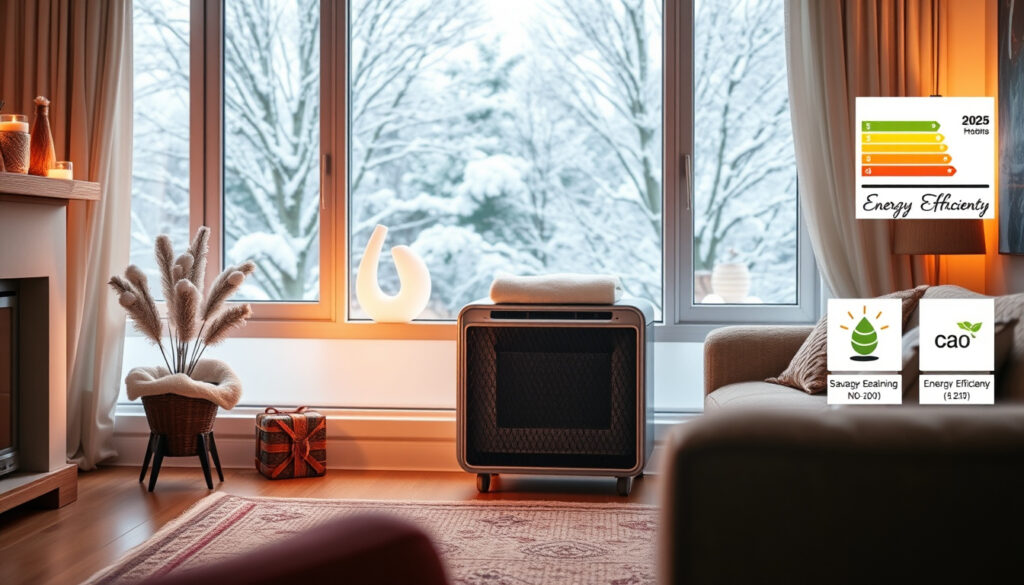
Electric Heaters Energy Efficient: 2025 Best & Cheapest to Run
A cheap fan heater looks like a bargain until you see the electricity bill at the end of the month. That gap between purchase price and running cost is where most Irish buyers get caught—and it’s exactly where the 2025 energy efficient electric heater market has become surprisingly nuanced. All electric radiators convert 100% of their power to heat at the point of use, according to Electric Radiators Direct, but what you pay per hour depends heavily on which type you choose and Ireland’s current unit rate of 34.75c/kWh. This guide cuts through the marketing to give you actual running costs, real model comparisons, and the specific choices that work best for Irish homes.
Point-of-use efficiency: 100% for all electric radiators · Common wattage: 1500W · Freestanding convector starting price: €35 · Recommended efficient model: Mill WiFi Max 1500W · Wall-mounted option: Infrared panels
Quick snapshot
- All electric radiators are 100% efficient at point of use (Electric Radiators Direct)
- Ireland unit rate sits at 34.75c/kWh in 2025 (Switcher.ie)
- Tube heaters at 190W are cheapest per hour in UK comparisons (Morris Direct)
- Exact running costs without knowing your local electricity tariff
- Which specific model ranks best for asthma patients—no universal standard exists
- 2026 Ireland electricity price forecasts not yet available from official sources
- Ofgem Price Cap sets UK electricity rate at 24.67p/kWh from 1st April 2026 (Daewoo Electricals)
- Tube heater comparisons published October 2025 for winter guidance (Morris Direct)
- Compare infrared, convector, and smart WiFi-enabled models side by side
- Calculate your specific hourly and monthly costs based on Irish rates
- Find the right heater type for your room size and usage pattern
| Specification | Value |
|---|---|
| Efficiency rating | 100% at point of use |
| Top model | Mill WiFi Max 1500W |
| Entry price | €35 convectors |
| Common size | Portable or wall-mounted |
| Infrared hourly cost (Ireland) | 0.35c at 34.75c/kWh |
| Fan heater hourly cost (Ireland) | 0.78c at 34.75c/kWh |
| Cheapest monthly (Ireland) | Electric blanket at €9.33 |
What electric heater is the most energy efficient?
When evaluating energy efficiency, the first thing to understand is that every electric heater converts 100% of its electricity into heat at the element itself. That basic fact comes from Electric Radiators Direct (an Irish specialist retailer), and it means the efficiency debate isn’t really about conversion—it’s about how evenly that heat distributes across your space and how much power each type requires to maintain warmth.
Infrared panels
Infrared heating panels like Ekosen are among the most efficient options for Irish homes, using less energy than traditional convection systems according to Infrared Heat IE (an Irish infrared supplier). These panels heat objects directly rather than warming air, which means you feel warmth almost immediately after turning them on. A 500W-1500W infrared heater costs just 0.35c per hour at Ireland’s 34.75c/kWh rate, as calculated by Switcher.ie (an Irish energy comparison site). Ekosen panels also carry a lifespan of 15+ years with minimal maintenance, per Infrared Heat IE. The trade-off is that infrared heats what’s directly in front of the panel—shadows and corners stay cool.
WiFi-enabled models like Mill Max 1500W
Smart heaters with WiFi connectivity and app control let you schedule heating sessions precisely, which cuts waste significantly. The Mill WiFi Max 1500W has earned recognition as a top efficient portable heater, offering precise usage tracking through its companion app. The key advantage is that you can warm a room just before you arrive and shut it off the moment you leave—no more running heaters in empty rooms. Heavins.ie notes that heaters with thermostats, timers, and eco-modes reduce energy use in Irish homes (a home retailer with Ireland-specific data).
Wall-mounted options
Wall-mounted panel heaters cost 0.43c per hour in Ireland at standard rates, as reported by Switcher.ie. These permanently installed units eliminate the storage hassle of portable heaters and can be wired directly into your home’s electrical system. Oil-filled radiators and ceramic heaters are among the most energy-efficient types available in Ireland, according to DID.ie (an Irish electrical retailer). The monthly cost for panel heaters comes to approximately €26.64, as calculated by Heavins.ie.
The implication: infrared panels win on hourly cost if you need spot heating in a small area, while smart WiFi-enabled radiators win on total energy waste across a full day of variable use.
What’s the cheapest type of electric heater to run?
Running costs in Ireland depend on two variables: the heater’s wattage and Ireland’s electricity rate of 34.75c/kWh, as confirmed by Switcher.ie. Multiply watts by hours used by the unit rate, then divide by 1,000 to get your cost. Here’s how the main types stack up per hour at Irish rates.
Convector heaters
Freestanding convector heaters distribute warmth by heating air that rises and circulates naturally. These units start at approximately €35, making them the most affordable entry point among portable electric heaters. At 1500W typical output, a convector heater costs 0.87c per hour in Ireland, per Switcher.ie. They warm a room relatively quickly but don’t retain heat once switched off.
Infrared vs convector
Comparing these two technologies at Irish electricity rates reveals a meaningful gap: infrared costs 0.35c per hour versus 0.87c for a standard convector, as calculated from Switcher.ie data. However, infrared only heats what’s in its path, while convectors gradually warm entire rooms. For a small home office used for eight hours daily, infrared might cost €2.80 per day while a convector runs to €6.96—significant over a full heating season.
Factors affecting running costs
Beyond heater type, three factors determine your actual bill impact. First, room insulation quality—the same heater burns harder in a draughty box room than in a well-sealed space. Second, thermostat accuracy—cheaper models cycle on and off less precisely, wasting energy. Third, usage patterns—a heater running 24/7 costs 24 times what one running for one hour does. Heaters with thermostats, timers, and eco-modes reduce energy use by preventing wasted runtime, as noted by Outdoor Living IE (an Irish retailer).
What this means: the cheapest heater per hour isn’t always the cheapest heater per month. Tube heaters at 190W cost just 5.0p per hour in UK comparisons from Morris Direct (a UK heater retailer), but that low wattage only works in tiny spaces like bathrooms or small cupboards.
For spot heating a single person in a small room, infrared wins at 0.35c/hr. For heating a full living space through the evening, a convector with a thermostat and timer is more practical even at higher per-hour cost.
How much does it cost to run a 1500 watt electric heater for 24 hours?
A 1500W heater running continuously draws 36kWh per day. At Ireland’s rate of 34.75c/kWh, that equals €12.51 per day for constant operation, as calculated by Switcher.ie. Gas central heating averages €8-€15 per day, making electric heaters pricier for whole-home heating, but competitive for supplemental room heating, per Switcher.ie.
US cost estimates as reference
US electricity rates vary dramatically by state, ranging from approximately 10c/kWh in Idaho to over 30c/kWh in Hawaii. At a mid-range 15c/kWh, a 1500W heater running 24 hours costs $5.40. Ireland’s 34.75c/kWh rate sits toward the higher end internationally, which magnifies the running cost gap between heater types.
Ireland electricity rates impact
Ireland’s unit rate of 34.75c/kWh including VAT directly multiplies every watt you use. To estimate your own bill, use an electricity cost calculator with your specific tariff. Outdoor Living IE (an Irish retailer) notes that running costs depend on heater power rating and local electricity rates. If you’re on a night-saver or peak/off-peak tariff, running heaters during off-peak hours cuts costs significantly.
Calculation methods
The formula is straightforward: (Wattage × Hours) ÷ 1,000 × Cost per kWh = Total cost. For a 1500W heater running 8 hours at Irish rates: (1500 × 8) ÷ 1,000 × 0.3475 = €4.17 per day. Over a 30-day month of evening use, that’s approximately €125 for one heater running four hours daily. This is where smart heaters with timers earn their keep—they only run when you actually need warmth.
The catch: 1500W is the most common output for portable heaters, which means most buyers automatically opt into this power level regardless of room size. A small bathroom doesn’t need 1500W—the math shows infrared at 500W handles a typical bathroom adequately for roughly a third of the cost.
What is the cheapest heater to run in a small room?
For small rooms under 10 square metres, matching heater wattage to space is critical. Oversized heaters waste energy; undersized ones strain to maintain warmth. The cheapest per-hour options for compact spaces are infrared panels, which cost just 0.35c per hour at Irish rates per Switcher.ie.
Portable options
Portable electric heaters range from compact 500W units to full-size 2000W models. Fan heaters are cheapest to buy, with basic models available under £20, but their higher running costs make them poor value over time, per Geepas UK (a UK appliance retailer). Oil-filled radiators at 1500W cost 0.61c per hour in Ireland, as reported by Switcher.ie, and retain heat longer after switching off—useful for small rooms where you want residual warmth.
Small room specifics
In a typical small bedroom or home office, a 750W-1000W ceramic heater or a 500W-800W infrared panel handles heating adequately. Ceramic heaters cost 0.39c per hour in Ireland per Switcher.ie. Oil-filled radiators and ceramic heaters are among the most energy-efficient for small Irish rooms, per DID.ie. The key is choosing a heater with an adjustable thermostat so it can throttle down once the room reaches your target temperature.
Energy-saving features
Heaters with thermostats, timers, and eco-modes reduce energy use by preventing unnecessary heating cycles, as Outdoor Living IE confirms. Eco-mode typically reduces output to 60-70% once the target temperature is reached, trimming running costs by 20-30% compared to non-thermostatic models running full blast. WiFi-enabled heaters like the Mill WiFi Max let you set schedules that align heating with your actual presence in the room.
The pattern: for a small room, spend more on the heater upfront to get a thermostat and timer, then recoup the difference across a heating season through lower electricity waste.
How much does it cost to run a 2000W heater for 1 hour?
A 2000W heater running for one hour consumes 2kWh. At Ireland’s rate of 34.75c/kWh, that’s €0.695 per hour—or roughly 70 cents. At UK 2026 rates of 24.67p/kWh under the Ofgem Price Cap, the same heater costs approximately 49.3p per hour, as calculated by Daewoo Electricals (a UK appliance brand). The gap illustrates why Ireland’s higher unit rate makes the choice of heater type more consequential.
Hourly cost breakdown
Fan heaters average 2000W, which makes them expensive to run compared to lower-wattage alternatives. At Irish rates, a 2000W fan heater costs 0.78c per hour, as reported by Switcher.ie. Halogen heaters at 1200W cost 29.6p per hour at UK 2026 rates, according to Daewoo Electricals. For one hour of heating, the practical choice is a 1200W halogen over a 2000W fan heater—less than half the wattage delivers comparable warmth for spot heating.
Comparison to 1500W
Halogen heaters are cheapest to run for spot heating per hour in 2025 UK analysis, according to Geepas UK. The 1500W convector and fan heater cost 49.3p per hour at UK rates versus 29.6p for a 1200W halogen, as confirmed by Daewoo Electricals. In Ireland with its higher rates, the same gap in euro cents follows the same proportional relationship.
Efficiency tips
To minimise hourly costs: use the lowest wattage heater adequate for your space, always run heaters with a thermostat rather than on full blast, and run heating during off-peak tariff hours where available. Oil-filled radiators offer the best long-term value for steady warmth because they retain heat after switching off, as Geepas UK notes.
The trade-off: halogens and fan heaters are cheaper to buy but cost more per hour, while oil-filled radiators cost more upfront but save money across sustained use because they require less runtime to maintain warmth.
| Heater type | Typical wattage | Hourly cost (Ireland) | Monthly cost estimate |
|---|---|---|---|
| Infrared panel | 500W-1500W | 0.35c | €2.78 per day |
| Ceramic heater | 750W-1500W | 0.39c | Varies |
| Freestanding convector | 1500W | 0.87c | Varies |
| Wall-mounted panel | 1000W-2000W | 0.43c | €26.64/month |
| Oil-filled radiator | 1500W | 0.61c | €124.80/month (full-time) |
| Fan heater | 2000W | 0.78c | Varies |
| Feature | Infrared panel | Convector | Oil-filled radiator | Fan heater |
|---|---|---|---|---|
| Wattage range | 500W-1500W | 1000W-2500W | 700W-2500W | 750W-2500W |
| Heat-up time | Immediate | 10-20 minutes | 20-30 minutes | 2-5 minutes |
| Heat retention | Minimal (instant off) | Low | High (stays warm) | Minimal |
| Noise level | Silent | Silent | Silent | Moderate |
| Thermostat available | Yes (some models) | Yes (most models) | Yes (most models) | Yes (some models) |
| WiFi/smart option | Limited | Yes (premium models) | Yes (premium models) | Limited |
| Portability | Wall-mounted or portable | Portable or wall-mounted | Usually portable | Portable |
| Entry price | €80-€200 | €35+ | €50+ | €15+ |
Upsides
- All electric heaters convert 100% of power to heat—no energy wasted in conversion
- Low upfront costs starting at €35 for basic convectors
- Infrared heaters cost just 0.35c per hour in Ireland, the cheapest per-hour rate
- Smart WiFi heaters like Mill WiFi Max let you schedule and track usage precisely
- Portable options work in any room without installation
- No maintenance or servicing required unlike gas systems
Downsides
- Electricity costs more per unit than gas—€12-€18/day versus €8-€15/day for gas central heating
- Oil-filled radiators and fan heaters cost €124.80/month running full-time in Ireland
- 2000W fan heaters are expensive to run continuously at 0.78c per hour
- Infrared panels only heat what’s directly in front of them—poor room coverage
- No Irish government incentives currently available specifically for efficient electric heaters
- Higher electricity rates (34.75c/kWh) mean Irish running costs exceed UK equivalents
“Tubular heaters are the cheapest electric heater to run this winter, offering efficient heating at low operational costs.”
— Morris Direct (UK Heater Retailer)
“Gas central heating averages out between €8.00 and €15.00 per day, the cheapest method overall for whole-home heating.”
— Switcher.ie (Irish Energy Comparison Site)
“Their panels are not only among the most efficient electric heating solutions available, but also some of the most reliable.”
— Infrared Heat IE (Irish Infrared Supplier)
Related reading: Electric Ireland contact number
To truly minimize running costs for these efficient electric heaters in Ireland, shoppers should also compare cheapest gas and electric suppliers alongside model wattage and features.
Frequently asked questions
What type of electric heater uses the least energy?
Infrared panels use the least energy per hour at Irish rates—approximately 0.35c per hour for a 500W-1500W unit, according to Switcher.ie. They heat objects directly rather than warming air, making them highly efficient for spot heating. However, for whole-room heating, an oil-filled radiator with a thermostat may use less total energy overall because it retains warmth after cycling off.
What is the best heater for asthma patients?
No single heater type is universally recommended for asthma sufferers. Infrared panels heat without moving air, which may reduce dust circulation compared to fan heaters. Oil-filled radiators also avoid blowing air. However, specific model certifications and filter systems vary widely—consult the manufacturer’s documentation for any air quality claims before purchasing.
What is the cheapest type of heater to run on electricity?
Per hour, infrared panels are cheapest at 0.35c in Ireland, followed by ceramic heaters at 0.39c and convectors at 0.87c, per Switcher.ie. For whole-room use across a full heating season, an oil-filled radiator with a good thermostat often proves most economical despite higher per-hour cost, because it retains warmth and requires less runtime. Electric blankets remain the absolute cheapest option for personal warmth at just €9.33 per month, according to Heavins.ie.
What is the cheapest heater to run per hour?
Infrared panels cost 0.35c per hour in Ireland, making them the cheapest per-hour option among mainstream heater types. Tube heaters at 190W cost just 5.0p per hour in UK comparisons (roughly 0.35p in euro cents), but their very low wattage limits them to tiny spaces, per Morris Direct.
Are electric heaters energy efficient for large rooms?
Electric heaters can heat large rooms, but the cost adds up quickly. A 2000W heater running 8 hours costs approximately €5.56 per day in Ireland. Gas central heating remains cheaper at €8-€15 per day for whole-home coverage, per Switcher.ie. For large rooms, consider wall-mounted panel heaters or multiple infrared panels positioned strategically to cover the full space efficiently.
What are the best portable electric heaters energy efficient?
The Mill WiFi Max 1500W ranks among the top portable electric heaters for efficiency in 2025-2026, combining 1500W output with smart scheduling capabilities. Oil-filled radiators like the Cecotec Ready Warm 6750 Crystal have also earned recognition as top energy-efficient radiators in Europe for 2026, according to recent European heating guides. Look for models with thermostats, eco-modes, and timers to minimise unnecessary running time.
Do electric heaters energy efficient reviews recommend smart models?
Reviews consistently highlight smart WiFi-enabled heaters like the Mill WiFi Max for their ability to track and schedule usage precisely, which directly reduces wasted energy. Heaters with thermostats, timers, and eco-modes reduce energy use according to Outdoor Living IE. The combination of smart scheduling and precise thermostat control makes WiFi-enabled models the most cost-effective choice over a full heating season.
More related posts
 Donegal v Mayo 2026: Time, TV, Tickets, and Match Result
 Next Castlebar Opening Hours | Lannagh Road Store Times
 10 Best Movies on Netflix Right Now: Top Picks by Genre
 Texas Children’s Houston Open 2026: Payout & Guide
 Dunnes Stores Weekly Wonders: Wednesday Offers & Grocery Deals
 Volkswagen Amarok for Sale in Ireland: Prices, Trims & Where to Buy
 Repossessed Houses for Sale in Ireland: Buy at Auction
 Manchester United New Stadium: Capacity, Cost & Latest