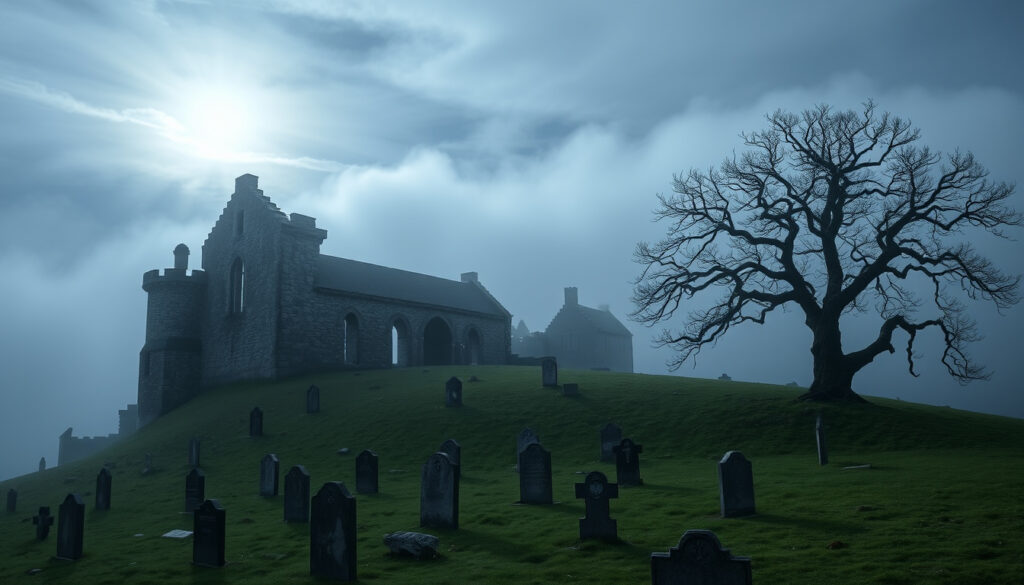
Haunted Places in Ireland: Top 5 Most Haunted Locations to Visit
There’s something about Ireland that makes you feel like you’re never quite alone. From ancient castles to abandoned prisons, the island is packed with locations that have been drawing ghost hunters and curious travelers for decades, and this guide pulls together the most well-documented haunted places, mixing official tourism guides with local lore and visitor accounts so you can decide which ones are worth a visit.
Official tourism site lists: 9 haunted places · Most cited haunted location: Loftus Hall · Oldest haunted castle: Leap Castle (13th century) · Most haunted county (by mentions): County Wexford
Quick snapshot
- Loftus Hall is widely cited as Ireland’s most haunted house (Discover Ireland – national tourism authority)
- Leap Castle dates back to the 13th century and claims to be the world’s most haunted castle (Wikipedia – general reference)
- Kilmainham Gaol sees over 1 million visitors a year and is a hotbed of paranormal claims (Wikipedia – general reference)
- No one knows the exact number of haunted locations across Ireland (Spirited Isle – community ghost‑lore archive lists over 1,100, but the count is fluid)
- Some legends, like the Hellfire Club’s black mass, may have been embellished over time (Ireland.com – official tourism board)
- The origin of ghost stories at many sites is debated between historical fact and folklore (BeyondHaunted.com – paranormal database)
- 13th century: Leap Castle built (Wikipedia – general reference)
- 1650s: Loftus Hall constructed (Discover Ireland – national tourism authority)
- 1725: Hellfire Club founded (Wikipedia – general reference)
- 1924: Kilmainham Gaol closes (Ireland.com – official tourism board)
- Ghost tours are expanding – more than 10 operate across Ireland (Discover Ireland – national tourism authority)
- Overnight stays at haunted castles and hotels are growing in popularity (Ireland.com – official tourism board)
- Community‑sourced databases like Spirited Isle continue to add new locations (Spirited Isle – paranormal archive)
Key details at a glance:
| Label | Value |
|---|---|
| Most haunted county | County Wexford |
| Oldest haunted location | Leap Castle (13th century) |
| Most visited haunted site | Kilmainham Gaol (over 1 million visitors annually) |
| Number of ghost tours available | 10+ across Ireland |
What is the most haunted house in Ireland?
Loftus Hall: The most famous haunted house
- Loftus Hall in County Wexford is consistently named the most haunted house in Ireland (Discover Ireland – national tourism authority).
- The legend: a mysterious stranger arrived during a storm and, when the family noticed his cloven hoof, he vanished through the ceiling, leaving a hole that can still be seen (Ireland.com – official tourism board).
- Visitors and staff report cold spots, footsteps, and even the ghost of a woman in a blue dress (Ireland.com – official tourism board).
“Loftus Hall is often cited as Ireland’s most haunted house, with a history of strange occurrences and a tragic legend.”
— Autoglass.ie (travel feature on haunted sites)
Other haunted houses in Ireland
- Leap Castle in County Offaly bills itself as the world’s most haunted castle, with a ghost called the Elemental (Discover Ireland – national tourism authority).
- Wicklow Gaol is known as one of the most haunted places in Ireland, with tales of a former prison guard who still walks the cells (Spirited Isle – paranormal archive).
- Grace Neill’s pub in County Down, Ireland’s oldest licensed pub, is also described as one of the country’s most haunted (The Culture Trip – travel media).
Visitor information for Loftus Hall
- Loftus Hall is open for daytime tours and overnight ghost hunts. Booking is essential (Discover Ireland – national tourism authority).
- Located in County Wexford, it’s about a 2‑hour drive from Dublin.
Loftus Hall isn’t just the most famous haunted house in Ireland – it’s the one with the most documented visitor accounts, making it the safest bet for a true paranormal experience. Casual tourists will get a solid story; dedicated ghost hunters should book the overnight session.
What is the most haunted hotel in Ireland?
Top haunted hotels in Ireland
- Ballygally Castle on the Antrim coast is one of the most haunted places in Ireland, with a resident ghost named Lady Isobel (Wikipedia – general reference).
- Kinnitty Castle in County Offaly offers ghost tours and overnight stays, with reports of a spectral monk (Discover Ireland – national tourism authority).
- The Shelbourne Hotel in Dublin has a resident ghost named Mary Masters, a former housekeeper who reportedly still tends to guests (Wikipedia – general reference).
The Shelbourne Hotel ghost stories
- Mary Masters is said to appear in the early hours, often in the hotel’s main staircase area (Ireland.com – scary experiences guide).
- Staff have reported doors opening by themselves and the smell of lavender perfume where Mary once worked.
Booking tips for haunted hotel stays
- Book directly with the hotel and ask for a “haunted room” – some properties offer special packages.
- Check seasonal availability: October is peak season for ghost tours, so rooms fill fast.
Haunted hotel stays are often marketed as “spooky chic,” but the reality is that many rooms are standard hotel rooms with a backstory. If you’re after genuine paranormal activity, go for a dedicated ghost hunt at a location like Loftus Hall rather than a hotel that wears its haunting as a gimmick.
The implication: for travelers who want comfort plus a story, the Shelbourne and Ballygally Castle deliver. But the most intense experiences usually come from purpose‑built ghost attractions, not hotels that happen to have a resident spirit.
What is the most mystical place in Ireland?
Hill of Tara: seat of ancient kings
- The Hill of Tara in County Meath was the seat of the High Kings of Ireland and is steeped in mythology (Wikipedia – general reference).
- It’s said to be a portal to the Otherworld, and many visitors report a strong sense of history and energy.
Newgrange: a prehistoric passage tomb
- Newgrange, built around 3,200 BCE, is older than Stonehenge and aligned with the winter solstice (Wikipedia – general reference).
- Its mystical reputation comes from its precise astronomical alignment and the ancient artwork inside.
The Burren: a mystical landscape
- The Burren in County Clare is a unique karst landscape dotted with ancient ruins, dolmens, and folklore (Discover Ireland – national tourism authority).
- Local legends speak of fairy forts and hidden paths, making it a favorite for those seeking a spiritual connection.
“The Burren is a place where the veil between worlds is thin, especially at dawn and dusk.”
— Ireland.com travel guide (mystical Ireland feature)
Why this matters: mystical sites often get overshadowed by ghost stories, but they offer a different kind of allure – one rooted in pre‑Christian spirituality and natural wonder. For visitors who want history without the gore, these are the places to visit.
What are some hidden places to visit in Ireland?
Hidden castles and ruins
- The ‘Hellfire Club’ on Montpelier Hill near Dublin is a hidden haunted spot where 18th‑century aristocrats reportedly held black masses (Spirited Isle – paranormal archive).
- Sharon Rectory in County Donegal, built in 1775, is a lesser‑known haunted site with reports of a ghostly woman in white (IrishCentral – Irish diaspora media).
Secret beaches and cliffs
- The Skellig Islands, off the coast of Kerry, are remote but offer a mystical beauty that has attracted monks and filmmakers alike (Wikipedia – general reference).
- While not explicitly haunted, the islands’ isolation gives them an eerie, timeless feel.
Lesser‑known haunted sites
- Spirited Isle, a community‑driven archive, lists over 1,100 haunted locations across all 32 counties, including many that never make mainstream lists (Spirited Isle – paranormal archive).
- BeyondHaunted.com covers country houses, prisons, and lonely roads where ghost stories are still told (BeyondHaunted.com – paranormal database).
Hidden places are hidden for a reason – many are on private land or require a hike to reach. The Hellfire Club, for example, is a popular walking trail but the ruins themselves are fenced off. Always check access before you go.
The trade‑off: you get a more authentic, less crowded experience, but you’ll need to do your homework. The best hidden spots are often the ones that aren’t on any official tourism list.
Are there any ghost towns in Ireland?
Ghost towns of the Great Famine
- Yes, Ireland has several ghost towns, most dating from the Great Famine of the 1840s (IrishCentral – Irish diaspora media).
- The abandoned village of Slievemore on Achill Island is a well‑preserved famine village with rows of stone cottages left to ruin (Wikipedia – general reference).
Abandoned villages in the west of Ireland
- The village of Relick in County Mayo was abandoned after the famine and now stands as a silent memorial.
- Dunfanaghy in County Donegal has a deserted settlement that was once a thriving fishing community.
Modern ghost towns due to economic decline
- Some modern ghost towns exist, such as the housing estates left unfinished after the 2008 financial crisis, but they lack the haunting atmosphere of the famine villages.
“Leap Castle is known for the ‘Elemental’, a ghostly entity that is said to inhabit the castle.”
— Wikipedia (general reference)
What this means: ghost towns in Ireland are almost always linked to the famine, not modern decay. They offer a sobering historical experience rather than a spooky one, but the eerie silence of an abandoned village is hard to beat for atmosphere.
Confirmed facts
- Loftus Hall is reportedly haunted with multiple documented accounts (Discover Ireland – national tourism authority)
- Leap Castle has a ghost called the Elemental, recorded in local lore (Wikipedia – general reference)
- Kilmainham Gaol is a site of many paranormal claims (Spirited Isle – community ghost‑lore archive)
What’s unclear
- The exact number of haunted locations in Ireland is unknown (Spirited Isle – community ghost‑lore archive lists over 1,100 but the count is fluid)
- Some legends may be embellished or exaggerated (Ireland.com – official tourism board)
- The origin of the Hellfire Club’s ghost stories is debated (Wikipedia – general reference)
“The Hellfire Club is one of the most haunted places in Ireland, with tales of a black mass and a ghostly coach.”
— Ireland.com travel guide (haunted hotspots)
The verdict: for anyone planning a trip to Ireland’s haunted sites, the evidence is clear – the most reliable experiences come from official tourism‑listed locations like Loftus Hall and Kilmainham Gaol. For the adventurous, community databases offer a deeper, albeit less verified, pool of spooky spots.
ireland.com, spiritedisle.ie, lisney.com, hauntedrooms.co.uk
Frequently asked questions
What is the best time of year to visit haunted places in Ireland?
Late autumn (October–November) is peak season for ghost tours, but spring and early summer offer milder weather and fewer crowds.
Are children allowed on ghost tours at haunted sites?
Most sites allow children, but some may have age restrictions for overnight ghost hunts. Check with the venue beforehand.
How can I book a tour of Loftus Hall?
Bookings can be made through the official Loftus Hall website or via Discover Ireland’s tour listings.
What should I bring when visiting a haunted location?
A flashlight, comfortable shoes, a camera, and an open mind. Some sites also recommend warm clothing, even in summer.
Is there a haunted place in Ireland that is free to enter?
Yes, Hellfire Club on Montpelier Hill is free to access, as it’s on public walkways. However, the ruins are fenced off for safety. For dining options near haunted sites, see our guide to The Old Orchard Inn.
Do any haunted places in Ireland offer overnight stays?
Yes, Loftus Hall, Ballygally Castle, and Kinnitty Castle all offer overnight stays or ghost hunts.
What is the oldest ghost story in Ireland?
The oldest recorded ghost story is often traced to the 13th‑century Leap Castle, where the “Elemental” has been part of local lore for centuries.
For a luxurious stay near Dublin’s haunted sites, consider the Powerscourt Hotel & Spa.
More related posts
 How Many Days Till June 4th – Exact Countdown Calculator
 Best Restaurants in Killarney: Local Picks & Pub Food
 Ozempic Side Effects: What You Need to Know
 Grand Central Station Belfast: Location, Access, Facilities
 Cattle Prices Ireland Today: Latest Factory & Mart Rates
 Ireland 2025 Payment Reform: Budget & Welfare Changes