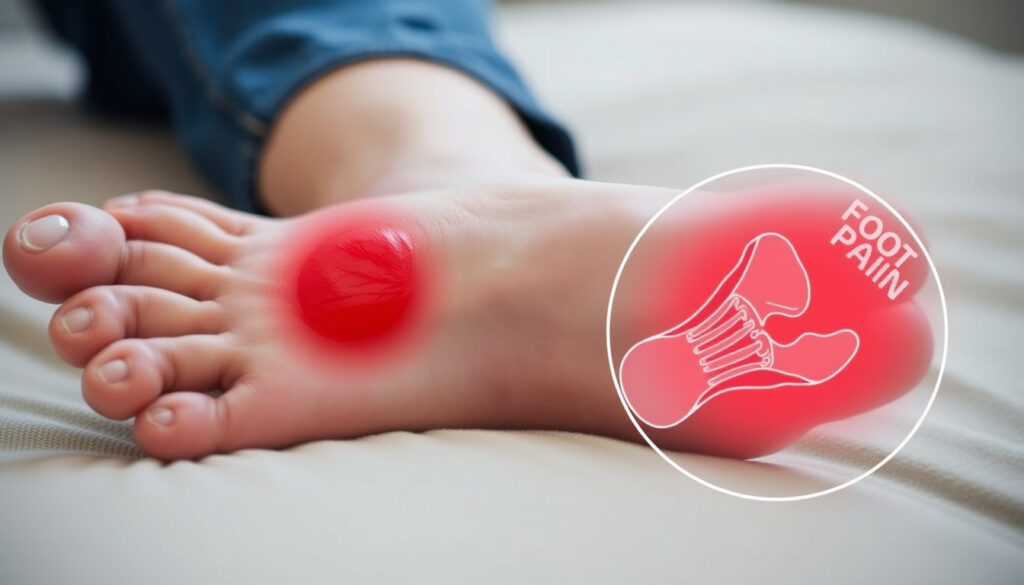
Pain on Top of Foot: Causes, Relief, and When to See a Doctor
That sharp, aching pain on the top of your foot can stop you mid-step. It’s a common complaint that usually stems from overuse, tight shoes, or a sudden change in activity. In this guide, we’ll walk through the most likely causes, how to tell them apart, and when you should see a doctor.
Common causes: Extensor tendonitis, stress fractures, arthritis, tight footwear ·
Typical onset: Gradual or sudden after activity ·
Self-care timeline: Usually resolves within 1–2 weeks with rest and ice ·
When to see a doctor: Pain persists >2 weeks, swelling, redness, or fever
Quick snapshot
- Extensor tendonitis (NHS (UK health authority))
- Stress fracture (Mayo Clinic (leading US hospital))
- Arthritis (NHS)
- Tight shoes (NHS)
- Pain on top of foot
- Swelling
- Bruising
- Pain with movement
- Rest and ice (Mayo Clinic)
- Proper footwear (NHS)
- Stretching (Mayo Clinic)
- OTC pain relievers (Mayo Clinic)
- Pain persists >2 weeks
- Swelling or redness
- Fever
- Inability to bear weight
Among the common causes of top-of-foot pain, four patterns stand out:
| Label | Value |
|---|---|
| Most common cause | Extensor tendonitis from overuse or tight shoes |
| Typical recovery time | 1-2 weeks with rest and activity modification |
| Risk factor | Sudden increase in activity or wearing high heels |
| Red flag | Pain with rest or night pain may indicate stress fracture |
| Primary self-care | RICE protocol (rest, ice, compression, elevation) |
| When to seek urgent care | Signs of infection (fever, warmth, redness) or inability to walk |
The implication: distinguishing between a soft-tissue injury and a bone stress injury early can save weeks of recovery.
What would cause the top of my foot to be in pain?
Extensor tendonitis
- Overuse and tight shoes are the most common causes of pain on top of the foot (NHS (UK health authority)).
- Pain is typically a dull ache along the top of the foot that worsens when pointing the toes or walking uphill.
The catch: extensor tendonitis can mimic a stress fracture, but it lacks point tenderness directly on the bone.
Stress fractures
- Stress fractures often present with pain that gets worse during activity and improves with rest (Mayo Clinic (leading US hospital)).
- Night pain or pain at rest is a red flag that may indicate a fracture rather than tendonitis.
What this means: if you have a pinpoint spot that hurts even when you stop walking, imaging (X-ray or MRI) is often needed.
Arthritis
- Arthritis in the midfoot joints can cause pain on the top of the foot, often accompanied by swelling and stiffness.
- Gout, a form of inflammatory arthritis, is listed by the NHS as a possible cause of top-of-foot pain (NHS).
The pattern: arthritis-related pain is usually gradual and may be worse in the morning.
Tight footwear
- Tight shoes can compress the top of the foot, leading to pain and irritation (NHS).
- Lacing techniques and wider shoes can often resolve the issue quickly.
The trade-off: a simple switch to shoes with a roomy toe box and low heel can eliminate the pain in days.
Most top-of-foot pain is mechanical and reversible. The key is identifying whether the problem is in the tendon, the bone, or the joint—because each path to recovery is different.
Why does the top of my foot hurt all of a sudden?
Sudden injury vs. stress fracture
- Sudden onset often indicates an acute injury, such as a ligament sprain or a direct blow.
- Stress fractures can present suddenly after a period of repetitive loading (e.g., increasing running mileage too quickly) (Mayo Clinic).
Why this matters: if the pain came on with a specific twist or fall, it’s more likely a sprain; if it emerged after a week of intense training, suspect a stress fracture.
Ligament sprain
- Sprains of the midfoot ligaments (Lisfranc injury) can cause sharp pain on the top of the foot and difficulty bearing weight.
- Swelling and bruising are common signs.
The catch: Lisfranc injuries are often misdiagnosed as a simple sprain but can lead to long-term arthritis if untreated.
Gout flare
- Gout attacks come on rapidly, often at night, with intense pain, redness, and swelling (NHS).
- The top of the foot can be affected, though the big toe is more common.
The pattern: a gout flare is unmistakable—it’s excruciating and the skin over the joint looks shiny and red.
If the pain woke you up and the area is hot to the touch, gout is high on the list. A simple blood test (uric acid level) can confirm it.
How to relieve top of foot pain?
Rest and ice
- The Mayo Clinic recommends ice for 15 to 20 minutes several times a day for foot pain self-care (Mayo Clinic).
- Rest from the aggravating activity for at least 48 hours.
Footwear adjustments
- The NHS advises using soft insoles or pads, shoes with plenty of room, a low heel, and a soft sole (NHS).
- Avoid high heels and narrow toe boxes during recovery.
Stretching and strengthening exercises
- Gentle calf stretches and toe flexor stretches reduce tension on the extensor tendons.
- Towel curls and ankle alphabet exercises can help maintain mobility.
Over-the-counter pain relief
- The Mayo Clinic says over-the-counter ibuprofen, naproxen sodium, or acetaminophen can help ease foot pain (Mayo Clinic).
- Use as directed and avoid prolonged use without medical advice.
The trade-off: self-care works for most mechanical causes, but if there’s no improvement after a week, it’s time to stop guessing and get a professional opinion.
Should I go to the doctor if the top of my foot hurts?
Red flags: swelling, redness, fever, inability to bear weight
- See a doctor immediately if you have signs of infection (fever, warmth, redness spreading) or cannot put weight on the foot.
- The Mayo Clinic advises seeing a healthcare professional before trying home remedies if the cause is unknown (Mayo Clinic).
Duration longer than 2 weeks
- The NHS advises seeing a GP if pain has not improved after home treatment (NHS).
- The Mayo Clinic recommends scheduling an office visit if pain does not improve after several weeks (Mayo Clinic).
History of diabetes or circulation problems
- People with diabetes should monitor foot pain closely because nerve damage can mask serious injuries.
- The Mayo Clinic advises seeing a doctor if pain is in both feet (Mayo Clinic).
The implication: for most people, a two-week trial of self-care is safe. But if you have diabetes, poor circulation, or persistent swelling, don’t wait.
What does tendonitis on top of the foot feel like?
Dull ache or sharp pain with movement
- Pain is localized to the top of the foot and is reproducible with specific movements (pointing toes, walking uphill).
Tenderness along the tendon
- You can feel a tender spot along the extensor tendon when you press on the top of the foot.
Worsens with pointing toes or walking uphill
- Activities that stretch or load the extensor tendons increase pain.
- Often confused with stress fracture but lacks point tenderness on the bone.
The catch: if you can reproduce the pain by bending your foot downward against resistance, it’s almost certainly tendonitis, not a fracture.
Step-by-step self-care routine
- Stop the aggravating activity for 48 hours.
- Apply ice wrapped in a towel for 15–20 minutes every 3–4 hours (Mayo Clinic).
- Switch to wide, low-heel shoes with soft insoles (NHS).
- Take over-the-counter ibuprofen or acetaminophen as needed (Mayo Clinic).
- After 48 hours, gently stretch the calves and toes.
- If pain hasn’t improved after 1 week, consult a healthcare provider.
The pattern: most people who follow this routine see significant improvement within 5–7 days. If not, imaging is the next step.
Confirmed facts and what’s unclear
Confirmed facts
- Overuse and tight footwear are common causes of top of foot pain (NHS).
- Rest and ice help reduce symptoms (Mayo Clinic).
- Persistent pain warrants medical evaluation (NHS).
What’s unclear
- Exact prevalence of top of foot pain in the general population.
- Long-term outcomes of untreated tendonitis vs. stress fracture without imaging.
Expert perspectives
“Pain in the top of the foot is often caused by exercising too much or wearing shoes that are too tight.”
“Pain in the top of your foot is often caused by exercising, especially if it involves running, kicking or jumping.”
— NHS (UK health authority)
Both experts agree: activity and footwear are the main drivers. The treatment path is straightforward for most—but when it’s not, imaging can make the difference between a quick recovery and a chronic problem.
Summary
Pain on the top of your foot is almost always a mechanical issue—tendonitis, a stress fracture, or a footwear problem. Self-care with rest, ice, and better shoes resolves the majority of cases within two weeks. The catch is that stress fractures and tendonitis can feel nearly identical, and without imaging, you’re guessing. For the average person, the decision is clear: try conservative care for a week, and if the pain persists, see a GP or podiatrist for an X-ray. Delaying imaging for a stress fracture can turn a three-week recovery into a three-month one.
footdoctorjonesboro.com, 111.wales.nhs.uk, directorthocare.com, healthline.com, nhs.uk, drgarydriver.com, utahfootspecialists.com, cls.health, precisionorthopaedic.com, youtube.com
For a detailed breakdown of common triggers and home remedies, see this guide on pain on top of foot causes.
Frequently asked questions
Can walking on the top of my foot make it worse?
Yes, walking can aggravate extensor tendonitis or a stress fracture because it repeatedly loads the tendons and bones. If walking increases pain, rest and use crutches if needed.
Is pain on top of foot a sign of arthritis?
It can be. Midfoot arthritis and gout are known causes of dorsal foot pain. The NHS lists arthritis as a possible cause (NHS).
How long does top of foot tendonitis take to heal?
With rest and activity modification, most cases improve within 1–2 weeks. Full recovery may take 4–6 weeks if the tendon was severely irritated.
What shoes are best for top of foot pain?
The NHS recommends shoes with plenty of room in the toe box, a low heel, and a soft sole (NHS). Avoid high heels and tight lacing.
Can top of foot pain be related to a vitamin deficiency?
There is no strong evidence directly linking a specific vitamin deficiency to top-of-foot pain. However, vitamin D deficiency can contribute to bone stress injuries and general muscle pain.
Does top of foot pain ever go away on its own?
Yes, many cases resolve with simple home care. The NHS advises seeing a GP if pain is getting worse or hasn’t improved after home treatment (NHS).
What does a stress fracture on top of the foot feel like?
A stress fracture usually causes a sharp, localized pain that worsens with activity and improves with rest. There may be swelling and tenderness directly over the bone. Night pain is a red flag.
More related posts
 What to Wear to a Funeral: Dress Code for Men & Women
 News of the World: Newspaper Shutdown, Scandal & Tom Hanks Film
 Rayo Vallecano vs Real Betis: H2H, Prediction, Stats
 Cafe de Paris Butter: What It Is, How to Make, Where to Buy
 Cay Beach Meloneras Bungalows: Reviews, Prices & Location
 What Is Palliative Care? Definition, Duration, and Hospice
 261 Bus Timetable Cork: Schedules, PDF & Updates
 What Time is The Traitors on Tonight? Schedule & Finale