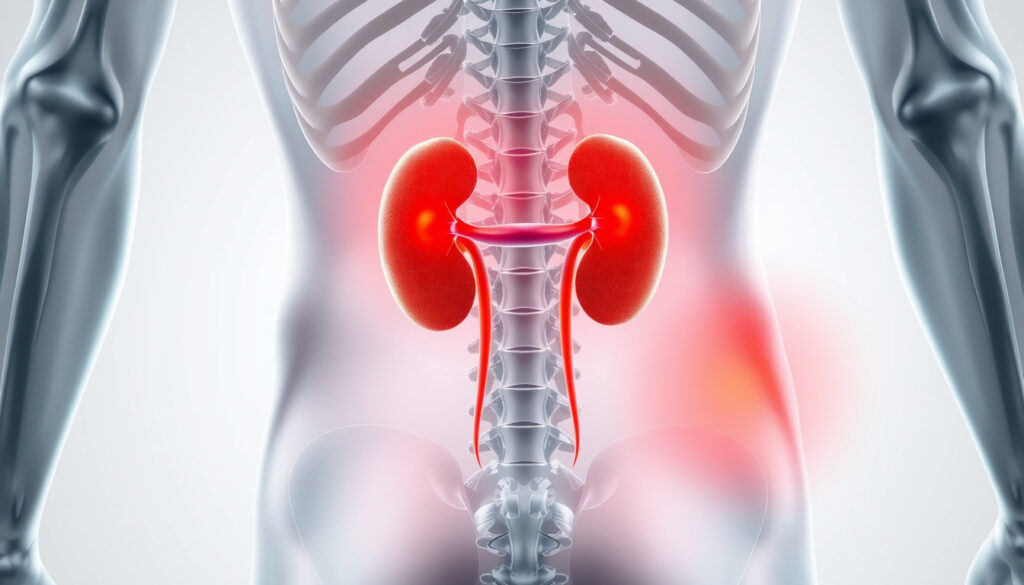
Where Are Your Kidneys? Location, Pain, and Early Warning Signs
You’ve probably felt a twinge in your lower back and wondered if it’s just a pulled muscle or something more. Your kidneys, those fist-sized organs tucked beneath your rib cage, can send confusing pain signals that are easy to misinterpret.
Number of kidneys: Two (left and right) ·
Typical size: About the size of an adult fist ·
Location: Just below the rib cage, one on each side of the spine ·
Function: Filter about 120–150 quarts of blood daily ·
Chronic kidney disease: Affects an estimated 1 in 7 U.S. adults
Quick snapshot
- Kidneys are bean-shaped, located high in the back of the abdomen (Keck Medicine of USC)
- Kidney pain is felt deep and constant in the flank area (Cleveland Clinic)
- Kidney stones cause pain that radiates to the groin (Keck Medicine of USC)
- Exact cause of pain in some cases without stones or infection (National Kidney Partners)
- Effectiveness of “kidney flush” diets and herbal detoxes (National Kidney Partners)
- Whether foamy urine alone indicates kidney trouble (National Kidney Partners)
- Low back pain from muscle strain improves with rest within days (American Kidney Fund)
- Kidney pain lasts longer and is constant without positional relief (American Kidney Fund)
- Kidney stone pain escalates quickly, radiating down the ureter (Keck Medicine of USC)
- See a doctor if you have fever alongside flank pain (Harvard Health)
- Blood in urine requires immediate evaluation (NHS)
- A simple urine test can check for signs of infection or damage (Harvard Health)
Five key facts about your kidneys, one pattern: their location offers a reliable starting point for telling kidney pain apart from other common causes.
| Attribute | Value |
|---|---|
| Size | Fist-sized (about 10–12 cm long) |
| Weight | About 150 grams each |
| Blood filtered per day | 120–150 quarts |
| Common cause of pain | Kidney stones |
| Chronic kidney disease prevalence | 1 in 7 U.S. adults |
The pattern across these specs: kidney anatomy is well-documented, making it possible to trace pain to its source when you know what to look for.
Where are your kidneys located in your back?
Your kidneys sit just below the rib cage, one on each side of your spine, protected by the lower ribs. As the Cleveland Clinic (leading U.S. hospital system) explains, they are positioned in the back of the abdomen — your flanks — which makes the pain they produce easy to confuse with back muscle or spinal issues.
- The right kidney sits slightly lower than the left because the liver takes up space above it.
- They are about 10–12 cm long and bean-shaped (National Institute of Diabetes and Digestive and Kidney Diseases (NIDDK)).
- Pain from the kidneys is felt in the mid-back, under the ribs, typically on one side (Cleveland Clinic (leading U.S. hospital system)).
Location in males vs females
The anatomical position of the kidneys is identical between males and females. The confusion often arises because women may attribute pelvic pain to the kidneys, while men may mistake prostate or hernia pain for kidney issues. The universal reference point remains: if the pain is in your upper-to-mid back under the ribs, it’s likely kidney territory.
How to feel your kidneys
- Place your hands on your lower back just below the rib cage.
- Press gently inward — you’ll feel a firm area on each side of the spine.
- Your kidneys sit about 2–3 inches deep, so direct palpation won’t reveal them unless there’s swelling or inflammation.
- A sharp pain on pressing could indicate infection or a kidney stone (American Kidney Fund (patient support organization)).
The kidney’s position under the ribs is the single most practical clue for self-diagnosis. Most people with back pain from muscle strain feel it lower down, in the lumbar region. If your pain is high and under the ribs, your kidneys are the more likely culprit.
Bottom line: Your kidneys sit under the ribs on either side of your spine — the right slightly lower than the left. If the pain is in that upper-back zone, it’s worth checking with a doctor rather than assuming it’s a muscle pull.
How can I tell if it’s my kidneys that hurt?
This is the million-dollar question for anyone with back pain. The Harvard Health (Harvard Medical School’s consumer health site) notes that most low back pain is actually caused by muscle strain or spine problems, not kidneys. But the quality and pattern of the pain hold the clues.
Kidney pain vs back pain
The American Kidney Fund (patient support organization) draws this distinction: kidney pain feels deep and constant, while muscle back pain is typically sharp and positional — it worsens with movement and improves with rest.
- Kidney pain: Dull, constant ache that doesn’t change when you shift positions.
- Muscle back pain: Localized, sharp, worse with bending or lifting, better with lying down.
- Kidney stone pain: Severe, sharp waves that can radiate to the lower abdomen and groin (Keck Medicine of USC (academic medical center)).
Location of kidney pain (front, back, side)
While primarily felt in the back under the ribs, kidney pain can also present:
- On the flank (side) between the ribs and hip
- In the upper abdomen if radiating forward
- In the groin or lower abdomen if a kidney stone is moving through the ureter (Cleveland Clinic (leading U.S. hospital system))
Radiating pain patterns
The pain doesn’t stay put. As Keck Medicine of USC explains, kidney stone pain typically starts in the flank and moves toward the abdomen and groin as the stone travels. This migratory pattern is a hallmark sign.
Common causes of kidney pain
- Kidney stones (most common cause of severe pain)
- Urinary tract infection that reaches the kidney (pyelonephritis)
- Swelling or inflammation from an injury or blockage
- Polycystic kidney disease
- Blood clot in the kidney (rare but serious)
Relying only on pain location is risky. Kidney pain shares its address with several other conditions. The PubMed Central review (U.S. National Library of Medicine) emphasizes that fever and painful urination alongside back pain are the red flags that shift the odds toward a kidney issue.
Bottom line: If your back pain is deep, constant, and doesn’t change with position — and especially if you have fever, nausea, or blood in your urine — it’s time to think kidneys, not muscles.
What are the first signs of kidney trouble?
Kidney disease often creeps in silently. The Centers for Disease Control and Prevention (CDC) (U.S. federal health agency) reports that 1 in 7 U.S. adults have chronic kidney disease, yet many don’t know it until it’s advanced. The early signs are subtle but identifiable.
Early warning signs
- Changes in urination — frequency, color, foamy appearance
- Swelling in legs, ankles, feet, or around the eyes (NHS (UK national health service))
- Persistent fatigue and weakness
- Dry, itchy skin
- Metallic taste in the mouth (ammonia-like breath)
- Nausea and vomiting
5 signs of kidney failure
The National Kidney Foundation (leading patient advocacy group) lists these five symptoms as significant warning signals:
- Decreased urine output despite normal fluid intake
- Trouble concentrating or brain fog from toxin buildup
- Persistent swelling in hands and feet
- Shortness of breath from fluid buildup in the lungs
- Severe fatigue that doesn’t improve with rest
7 signs of kidney failure
- All the five above, plus:
- Nausea and vomiting
- Chest pain or pressure
Four warning signs of damaged kidney
- Blood in urine (hematuria) — often the first visible sign
- Foamy urine (protein leakage) — indicates filters are damaged
- High blood pressure that resists treatment
- Unexplained lower back or flank pain
Many of these signs don’t appear until kidney function has dropped by 30–50%. That’s why the Mayo Clinic (major U.S. medical research center) recommends regular blood and urine testing for people with diabetes, high blood pressure, or a family history of kidney disease — not waiting for symptoms.
Bottom line: The earliest signs of kidney trouble are urination changes, swelling, and fatigue. But the real risk is silent progression. Routine lab work catches kidney disease long before symptoms appear.
What gets mistaken for kidney pain?
Several conditions can masquerade as kidney pain, making diagnosis tricky. According to the Harvard Health (Harvard Medical School’s consumer health site), it’s far more common for people to assume back pain is kidney-related when it’s actually musculoskeletal.
Conditions mimicking kidney pain
- Lumbar muscle strain — sharp, movement-dependent
- Herniated or bulging spinal disc
- Pancreatitis — upper abdominal pain that radiates to the back
- Pneumonia — especially lower lobe infections, which can cause flank pain
- Shingles — before the rash appears, nerve pain can mimic kidney pain
Back pain vs kidney pain
The American Kidney Fund (patient support organization) makes this practical distinction:
- Moves with changes in position → muscle or spine
- Doesn’t change whether you stand or lie down → kidney
- Sharp, shooting, travels down leg → likely spine-related
- Accompanied by fever or chills → likely kidney infection (American Kidney Fund)
Muscle strain vs kidney stone
Muscle strain improves with rest, ice, and anti-inflammatory medication within 48–72 hours. A kidney stone will typically get worse, not better, and may come with waves of excruciating pain, nausea, and blood in the urine (Keck Medicine of USC).
The most common misdiagnosis: someone treats what they think is a pulled back muscle for weeks, while an underlying kidney infection spreads. If your “back pain” comes with any change in how your urine looks or smells, get a simple urine test.
Bottom line: Muscle strain improves with rest and changes position; kidney pain stays constant. A fever or blood in urine alongside back pain all but confirms the source is your kidneys.
What is the fastest way to flush your kidneys?
If you’ve searched for this question, you’re not alone. The internet is full of “kidney detox” promises — but the National Kidney Foundation (leading patient advocacy group) is clear: your kidneys self-cleanse. They don’t need special cleanses.
Hydration and kidney health
Drinking enough water supports kidney function, but it doesn’t “flush” toxins in the dramatic way some detox claims suggest. The NIDDK (U.S. federal research institute) recommends 6–8 cups of fluid daily for healthy adults, more if you’re active or live in a hot climate.
Dietary factors
- Limit salt intake — excess sodium forces kidneys to work harder
- Reduce processed foods — phosphorus additives strain kidney function
- Include antioxidant-rich foods (berries, leafy greens) — but don’t expect rapid detox
- Avoid high-dose supplements and unregulated herbal products
Immediate pain relief strategies
- Rest and apply a heating pad to the painful area
- Drink plain water — stay hydrated but don’t overdo it
- Over-the-counter pain relievers like ibuprofen can help, but check with a doctor first — they can affect kidney function if used too often
- For severe pain, especially if nausea is present, seek medical evaluation
Medical treatments for kidney stones
If pain is from kidney stones, options include:
- Watchful waiting and hydration for small stones (< 5 mm)
- Prescription pain relievers and alpha blockers to help pass stones
- Non-invasive shockwave lithotripsy (ESWL) — breaks up stones using sound waves
- Ureteroscopy or surgical removal for larger or stuck stones
Fad detoxes and “kidney flush” supplements don’t work and can cause harm — some herbal products contain oxalates that actually increase stone risk. The only evidence-based kidney “flush” is a sufficient water intake, moderate salt, and avoiding nephrotoxic substances like NSAIDs in excess.
Bottom line: Your kidneys are self-cleaning. No juice cleanse or supplement outperforms plain water, a low-salt diet, and avoiding kidney-damaging medications. For pain, see a doctor rather than searching for a quick fix.
“Your kidneys sit just below your rib cage and in your lower back. Typically, one kidney sits on either side of your spine.”
Cleveland Clinic (leading U.S. hospital system)
“The kidneys are two bean-shaped organs, each about the size of a fist. They are located just below the rib cage, one on each side of your spine.”
The pattern across these expert sources is consistent: location is the single most reliable clue. If your pain is under the ribs, persistent, and accompanied by fever, nausea, or changes in urine, trust that combination and see a doctor. For the 1 in 7 U.S. adults who may have chronic kidney disease without knowing it, the cost of waiting is measured in lost kidney function that never returns.
For readers in the U.S. health system, the choice is clear: get routine labs if you have risk factors like diabetes or hypertension, or see a primary care physician for a simple creatinine and urine test. For everyone else, the implication is equally straightforward — your kidneys don’t ask for much, but they do ask that you don’t mistake their signals for a common backache.
Can kidney pain go away on its own?
Yes, if caused by a small kidney stone passing or mild infection, but it’s risky to wait and see. Any flank pain with fever, chills, or blood in the urine needs evaluation within 24 hours (Cleveland Clinic).
Is kidney pain always serious?
Not always, but it warrants attention. Kidney pain from a minor urinary tract infection may resolve with antibiotics, while pain from a large stone or infection can become a medical emergency. The constant, deep quality of kidney pain means it should not be ignored (American Kidney Fund).
What should I do if I suspect kidney pain?
See a primary care physician or visit an urgent care center. A simple urine dipstick can detect blood, protein, or signs of infection within minutes. Blood tests for creatinine and BUN run in hours. Timely diagnosis preserves kidney function (NHS).
Are there home remedies for kidney pain?
Rest, hydration, and heating pads can offer temporary relief, but they treat symptoms, not the cause. Avoid taking ibuprofen or aspirin daily without a doctor’s supervision — these can worsen kidney function if taken in excess (Harvard Health).
How are kidney problems diagnosed?
Doctors use urine analysis (for blood, protein, white blood cells), blood tests (creatinine, BUN, GFR), imaging (ultrasound, CT scan), and sometimes a kidney biopsy. The Mayo Clinic (major U.S. medical research center) recommends annual screening if you have diabetes, high blood pressure, or a family history of kidney disease.
What does kidney pain feel like exactly?
Patients often describe it as a constant, dull ache in the back or side that doesn’t change with movement. Kidney stone pain is sharp, intermittent, and waves of intense discomfort that may come and go (Cleveland Clinic).
Can dehydration cause kidney pain?
Chronic dehydration can concentrate urine and increase the risk of kidney stones, which then cause pain. But dehydration alone without stones or infection is less likely to produce significant pain. Proper hydration supports kidney function (NIDDK).
When should I go to the ER for kidney pain?
Go to the emergency room if you have kidney pain with: fever over 101°F, chills, inability to urinate, severe nausea or vomiting, blood in your urine, or pain that is unbearable (PubMed Central).
For a more detailed breakdown of kidney position and gender differences, see this guide on kidney location anatomy.
More related posts
 How to Proofread Effectively: Proven Techniques and Tips
 Houses for Sale in Ballyfermot – Prices & Listings
 How to Use Jump Leads Correctly: Step-by-Step Guide
 Haunted Places in Ireland: Top 5 Most Haunted Locations to Visit
 Wood Taylor Swift Lyrics: Meaning, Travis Kelce, and Controversy
 Patrick Horgan Retires from Cork Hurling After 18 Seasons
 Clothing Stores Near Me: Best Places to Shop in Dublin & Ireland
 Europcar Ireland Phone Number and Customer Service Contacts