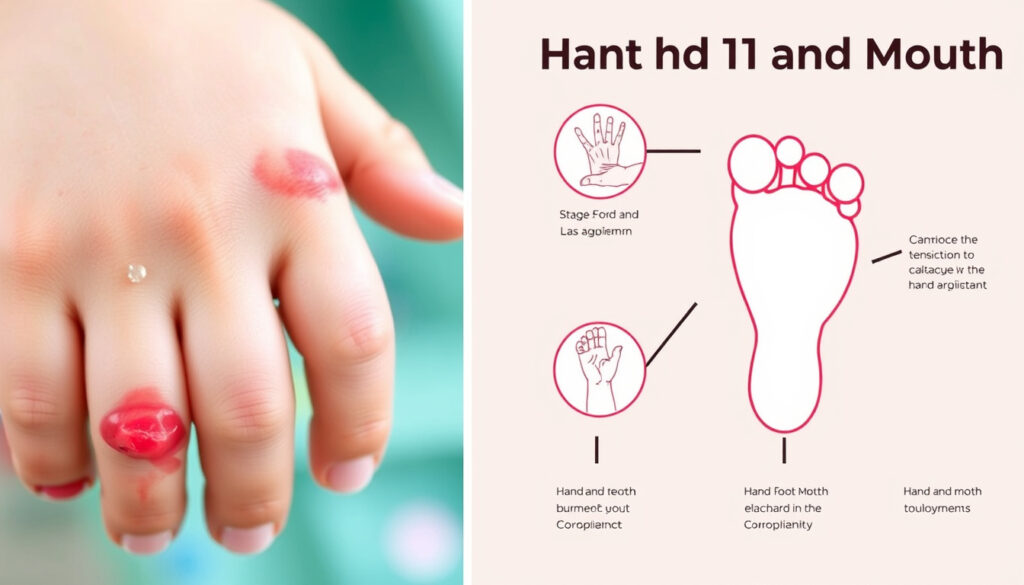
Is Hand Foot and Mouth Contagious? Transmission Guide
Watching your child come down with a fever and tiny blisters can send any parent into a spiral of worry—especially when you’re not sure if you or your other kids might catch it next. Hand, foot and mouth disease (HFMD) is one of the most common viral illnesses in young children, and it’s also one of the most contagious.
Incubation period: 3–6 days ·
Contagious period: From 1 day before symptoms to 7+ days after ·
Typical duration: 7–10 days ·
Transmission routes: Respiratory droplets, fecal-oral, blister fluid ·
Adult infection rate: Low but possible; most cases in children under 5
Quick snapshot
- HFMD is highly contagious via respiratory droplets, fecal-oral route, and blister fluid (CDC (U.S. public health agency))
- Incubation period is 3–6 days (CDC)
- Most cases resolve in 7–10 days without treatment (CDC (U.S. public health agency))
- Exact duration of contagiousness after symptoms resolve (HealthLink BC (provincial health authority))
- Risk of transmission from asymptomatic individuals (HealthLink BC (provincial health authority))
- Effectiveness of hand sanitizers vs. soap and water (HealthLink BC (provincial health authority))
- Virus can shed in stool for weeks after recovery (HealthLink BC (provincial health authority))
- Contagious from 1 day before rash appears (Children’s Hospital of Philadelphia (pediatric hospital))
- Virus can shed in stool for weeks after recovery (HealthLink BC (provincial health authority))
- Monitor for symptoms for 3–6 days after exposure
- Practice good hand hygiene
- No need for quarantine unless symptomatic
Six key facts about HFMD, one pattern: the contagious window is longer than most parents expect.
| Fact | Value |
|---|---|
| Incubation period | 3–6 days |
| Contagious before symptoms | 1 day before rash appears |
| Contagious after symptoms | Up to 7 days or longer |
| Typical duration of illness | 7–10 days |
| Most common age group | Children under 5 years |
| Adult infection rate | Low but possible |
Is hand, foot and mouth contagious?
Yes—and the short answer is that HFMD is very contagious. According to the CDC (U.S. public health agency), the disease spreads easily from person to person, especially in childcare settings and households with young children.
How is HFMD spread?
- Respiratory droplets from coughs and sneezes (HealthLink BC)
- Fecal-oral route – tiny particles of stool from an infected child can contaminate hands, toys, and surfaces (CDC)
- Blister fluid – fluid from the rash can contain the virus (TRICARE / Defense Health Agency (U.S. military health system))
- Contaminated surfaces – doorknobs, tabletops, toys, and shared utensils can harbor the virus (Children’s Hospital of Philadelphia)
The implication: HFMD spreads through everyday close contact—kissing, sharing cups, or simply breathing the same air—making it nearly impossible to avoid entirely in a household with a sick child.
How long is the contagious period?
The CDC (U.S. public health agency) states that people with HFMD are usually most contagious during the first week they are sick. But the virus can linger: HealthLink BC (provincial health authority) notes that a person may remain contagious for weeks after symptoms resolve because the virus can persist in the body. The key timeline:
- Contagious from 1 day before symptoms appear
- Most contagious in the first week of illness
- Can still spread for days to weeks after blisters heal
The catch: even children who look fully recovered may shed the virus in their stool for several weeks, so hand hygiene after diaper changes or bathroom trips remains critical.
Parents face a paradox: the child feels fine and wants to return to normal life, but public health guidance (from the Children’s Hospital of Philadelphia) says the most common reason to keep a child home isn’t the rash—it’s fever and pain. The virus itself may still be contagious, but the risk to others drops significantly once fever is gone and blisters are dry.
How contagious are foot and mouth from child to adult?
Adults can definitely catch HFMD, though the risk is lower than for children. Cleveland Clinic (healthcare system) explains that adult cases are often milder and may not show the classic blisters, making diagnosis trickier.
Can adults catch HFMD from children?
- Yes – adults are susceptible, especially parents and caregivers who have close contact (CDC)
- Adults may only have a fever or sore throat without the tell-tale rash, so the infection can go unrecognized (Cleveland Clinic)
- Transmission happens through the same routes: saliva, mucus, and blister fluid (HealthLink BC)
What is the risk for parents?
Parents are at higher risk simply because they are the ones changing diapers, wiping noses, and cleaning up after a sick child. Cleveland Clinic emphasizes that good hand hygiene is the best defence—especially after changing nappies or using the bathroom. The virus can survive on surfaces for hours, so cleaning toys and high-touch areas matters.
Why this matters: a parent who catches HFMD may need to take time off work, but the illness is usually mild and resolves without complications. The real risk is unknowingly carrying the virus to other settings, such as a workplace or a pregnancy.
Do parents need to quarantine if child has hand, foot, and mouth?
No official health authority recommends that healthy parents quarantine themselves. The CDC and Children’s Hospital of Philadelphia both advise that children stay home while they are symptomatic, but do not ask caregivers to isolate unless they develop symptoms themselves.
Is there a quarantine period for hand, foot, and mouth?
- For children: stay home until fever has resolved for 24 hours (without fever-reducers) and blisters have dried or crusted over (Children’s Hospital of Philadelphia)
- For parents and other adults: no mandatory quarantine – simply monitor for symptoms and practice rigorous hand hygiene (Cleveland Clinic)
When can a child return to school or daycare?
The Children’s Hospital of Philadelphia (CHOP) advises that the decision should be based on fever and comfort, not on the rash itself. Once the child is fever-free for 24 hours and feels well enough to participate, they can return. Many schools and daycares may require a doctor’s note if the rash is still present.
The trade-off: parents often feel pressure to keep children home until every blister is gone, but CHOP’s guidance suggests that is unnecessary. The virus may still be present, but the risk of transmission is low when the child is no longer coughing, drooling, or having diarrhoea.
For parents in Ireland, the practical message: you do not need to quarantine yourself. Your child should stay home while feverish and uncomfortable, but once they’re back to normal, normal life can resume—with good hand washing and surface cleaning as the main precautions.
The implication: Parents can continue normal life while monitoring symptoms in the child.
How long is hand, foot, and mouth disease considered contagious?
The contagious period for HFMD typically spans 7–10 days, but can be longer because the virus may be shed in stool for weeks after symptoms end (HealthLink BC).
Can HFMD go away in 3 days?
It is possible for symptoms to improve in 3 days, but the illness usually lasts 7–10 days. The CDC notes that fever typically resolves in 1–2 days, mouth sores in 1 week, and the rash can persist for 10 days. Even if the child feels better quickly, they may still be contagious.
- Fever usually ends within 2 days
- Mouth and throat sores can make eating painful for up to 7 days
- Rash on hands and feet may last up to 10 days
When is it safe to be around others?
The safest approach is to wait until the child is fever-free for 24 hours and the blisters have dried or crusted. CHOP emphasizes that the rash itself is not a reason for exclusion, but if the child has a fever, they should stay home. For adults who have been exposed, no special precautions are needed unless symptoms develop.
The pattern: contagiousness decreases sharply after the first week, but because the virus can still be shed in stool, hygiene is important even after recovery—especially if there are babies or immunocompromised individuals in the home.
Is hand, foot and mouth dangerous?
For the vast majority of children and adults, HFMD is a mild, self-limiting illness. The CDC states that serious complications are rare. However, it can cause significant discomfort and, in very rare cases, lead to viral meningitis or encephalitis.
What are the stages of hand, foot and mouth disease?
- Exposure and incubation (days 0–6): no symptoms, but virus is multiplying
- Prodrome (day 3–6): fever, sore throat, loss of appetite, irritability
- Mouth sores and rash (day 1–2 of symptoms): painful blisters appear on tongue, gums, and inside cheeks; rash on palms, soles, and sometimes buttocks
- Recovery (day 7–10): fever resolves, sores and rash begin to heal
CHOP notes that the rash may peel as it heals, which is normal and not contagious.
What is the treatment for hand, foot and mouth?
There is no specific antiviral treatment for HFMD. Management focuses on symptom relief (CDC):
- Pain and fever: acetaminophen or ibuprofen (avoid aspirin in children)
- Mouth pain: cool foods, avoid acidic or spicy foods, oral numbing gels (check age guidelines)
- Hydration: encourage fluids; watch for signs of dehydration if mouth sores make drinking painful
What this means: most families manage HFMD at home without medical intervention. The rare cases that require a doctor involve high fever lasting more than 3 days, inability to swallow, or signs of dehydration.
Steps to take if your child has hand, foot and mouth disease
- Isolate your child while symptomatic: keep them home from school, daycare, and playdates until fever has been gone for 24 hours and blisters have dried (CHOP)
- Practice strict hand hygiene: wash hands with soap and water after changing diapers, wiping noses, or touching blisters (Cleveland Clinic)
- Disinfect surfaces daily: clean toys, doorknobs, countertops, and bathroom fixtures with a bleach-based cleaner (TRICARE)
- Manage fever and pain: use over-the-counter fever reducers and offer cold, soft foods (CDC)
- Watch for dehydration: if your child refuses to drink because of mouth sores, offer popsicles, ice cream, or a straw; seek medical advice if urine output drops (CHOP)
- Notify close contacts: let other parents at daycare or school know so they can watch for symptoms
- Return to normal activities: once fever is gone for 24 hours and your child feels well enough, they can go back—even if some rash remains (CHOP)
The pattern: Following these steps reduces transmission risk and speeds return to normal.
Timeline: hand, foot and mouth disease day by day
Five milestones, one pattern: HFMD is most contagious before you even know it’s there.
| Period | What happens |
|---|---|
| Day 0–1 | Exposure; virus enters body. No symptoms yet. |
| Day 3–6 | Incubation period ends; first symptoms appear (fever, sore throat) |
| Day 1–2 of symptoms | Mouth sores and rash on hands/feet develop |
| Day 7–10 | Most symptoms resolve; contagiousness decreases |
| Weeks after recovery | Virus may still be shed in stool |
The implication: because you can spread the virus a day before any rash appears, HFMD often moves through households before anyone realises what’s happening. Good hygiene is the only reliable protection.
Clarity: what we know and what’s still uncertain
Confirmed facts
- HFMD is highly contagious (CDC)
- Spread via respiratory droplets, fecal-oral route, and blister fluid (CDC)
- Incubation period is 3–6 days (CDC)
- Most cases resolve in 7–10 days without treatment (CDC)
What’s unclear
- Exact duration of contagiousness after symptoms resolve
- Risk of transmission from asymptomatic individuals
- Effectiveness of hand sanitizers compared to soap and water
- Whether different strains (coxsackievirus vs. enterovirus) affect contagiousness length
- Virus can shed in stool for weeks after recovery (HealthLink BC)
The consensus: Most parents can manage HFMD with home care, but caution about prolonged contagiousness is warranted.
Expert perspectives on HFMD
“HFMD is very contagious and spreads easily”
— CDC (U.S. public health agency)
“Hand, foot and mouth disease is easily passed on to other people”
“Viruses that cause HFMD are extremely contagious”
— Cleveland Clinic (healthcare system)
The consensus is clear: HFMD is one of the most contagious common childhood illnesses. But the severity is low, and most families can manage it with simple home care.
Summary
Hand, foot and mouth disease is a highly contagious viral illness that spreads through everyday contact—coughs, nappies, shared toys. The contagious window starts a day before symptoms and can extend for weeks after recovery because the virus can hide in stool. Public health guidance does not require quarantine for healthy parents, but children should stay home while they have fever and mouth pain. For parents in Ireland, the implication is clear: focus on hand hygiene, surface cleaning, and watching the fever rather than the rash—and don’t feel guilty about letting a well-looking child return to school once the fever is gone. The virus will run its course, and with a few simple steps, you can keep the rest of the household safe.
ovivio.com, reddit.com, healthline.com, bcbsm.mibluedaily.com, webmd.com, facebook.com
Understanding the contagious period of HFMD is essential for preventing spread to other family members and deciding when it is safe to return to school or daycare.
Frequently asked questions
Can you get hand, foot and mouth more than once?
Yes. While most people develop immunity to the specific virus they were infected with, there are multiple viruses (coxsackievirus A16, enterovirus 71, and others) that cause HFMD. A child can get it again from a different strain (CDC).
Is hand, foot and mouth the same as foot and mouth disease in animals?
No. HFMD is a human illness caused by enteroviruses. Foot-and-mouth disease is a different virus that infects cattle, pigs, and sheep. They are not related and cannot be transmitted between humans and livestock (CDC).
How can I prevent spreading HFMD at home?
Wash hands frequently with soap and water, especially after diaper changes and before meals. Disinfect frequently touched surfaces and avoid sharing cups or utensils. The virus can survive on surfaces for days (HealthLink BC).
What should I do if my child has a fever from HFMD?
Give age-appropriate doses of acetaminophen or ibuprofen. Never give aspirin to children. Offer plenty of fluids. If fever lasts more than 3 days or your child seems very unwell, contact your GP (CDC).
Can adults get hand, foot and mouth from a child?
Yes. Adults can catch HFMD through close contact with a sick child. Symptoms are often milder and may not include the classic rash. Hand hygiene is the best prevention (Cleveland Clinic).
Is hand, foot and mouth contagious to pregnant women?
Pregnant women can catch HFMD, though the risk of severe illness is low. If a pregnant woman develops symptoms shortly before delivery, the baby may be born with mild symptoms, but serious outcomes are rare. The CDC advises pregnant women to avoid close contact with infected individuals when possible and to practice strict hygiene.
How long should a child stay home from school with HFMD?
The Children’s Hospital of Philadelphia recommends staying home until the fever has been gone for 24 hours (without fever-reducing medicine) and the child feels well enough to participate in school activities. The rash itself is not a reason for exclusion.
More related posts
 Best 1 on 1 Video Call Platforms Compared
 20 Knock Knock Jokes for Kids (Ages 4-9): Clean & Funny
 What Time is the Rugby on Today? Live TV Schedule & Kickoff Times
 Cast of People We Meet on Vacation: Actors and Roles
 Cadbury Christmas Hamper Giveaway – WhatsApp Scam Warning
 Best Movies to Watch: Top 10, Ratings & Rewatchable Picks
 Apartments Close to Grand Canal Dock: Prices & Tips
 What Time Was It 8 Hours Ago? Time Calculator & More