How to Cook a Boned and Rolled Turkey: Cooking Times & Tips
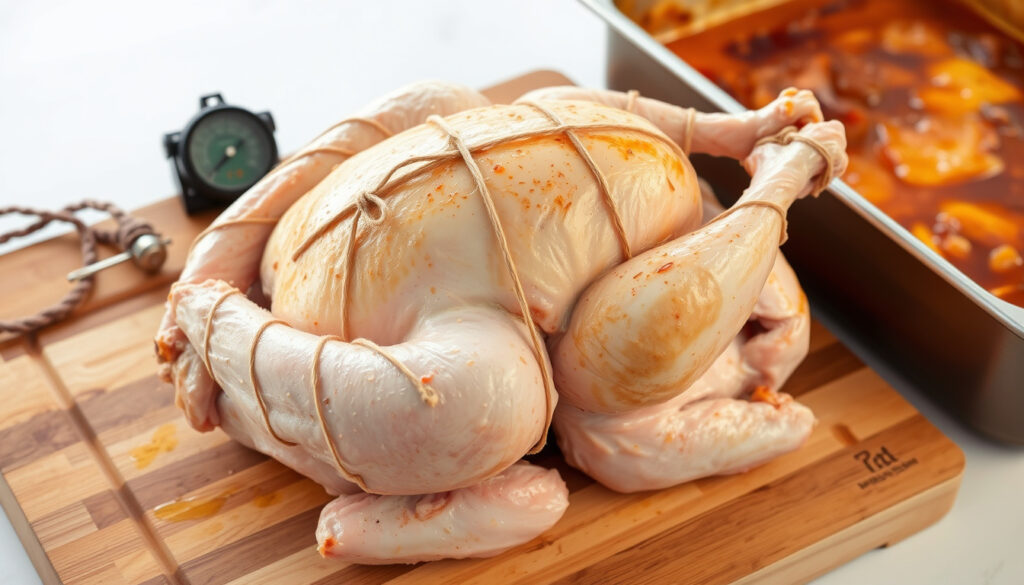
There’s something about a perfectly carved turkey that feels like a small victory, especially when you don’t have to wrestle with bones and sinew. A boned and rolled turkey takes the stress out of Christmas or Sunday lunch by giving you a compact, even-cooking joint that’s a dream to carve.
Average cooking time for a 3 kg joint: 2 hours 20 minutes ·
Recommended oven temperature: 180°C (350°F) after initial sear ·
Typical weight range: 1.5 kg – 4 kg ·
Servings per kilogram: 3–4 servings ·
Average price per kg (Ireland): €12 – €18 ·
Resting time after cooking: 20–30 minutes
Quick snapshot
- Cooking formula: 18–20 minutes per 450g plus 20 minutes (Nigella Lawson, British cooking authority)
- Internal temperature should reach 74°C–75°C after resting (Nigella Lawson)
- Irish retailer SuperValu recommends 15 minutes per 450g plus 20 minutes, starting at 220°C (SuperValu, Irish supermarket)
- Optimal resting time varies: Nigella says 20 minutes, SuperValu says 10 minutes, Ballyknocken says longer for larger joints
- Best stuffing recipe and placement (inside the roll vs separate) is not standardised
- Moisture retention techniques differ between recipes: basting frequency, foil timing, and resting method
- Resting time recommendations differ between sources (Nigella 20 min, SuperValu 10 min, Ballyknocken 30 min for larger joints)
- Bring joint to room temperature 1–2 hours before roasting (Nigella Lawson, British cooking authority)
- Sear 20 min at high heat, then reduce oven and cover with foil (Nigella Lawson, British cooking authority)
- Rest 20–30 minutes after cooking before carving (Nigella Lawson, British cooking authority)
- After resting, carve across the roll into even slices
- Use leftovers for sandwiches, soups, or pies within 3–4 days
- Reheat gently in stock or gravy to avoid drying out
Six quick specs that define a boned and rolled turkey joint.
| Specification | Value |
|---|---|
| Type of cut | Whole turkey, deboned and rolled |
| Common weight range | 1.5 kg – 4 kg |
| Oven temperature (after sear) | 180°C (350°F) |
| Cooking time per 500g | 20 minutes plus 20 minutes extra |
| Internal safe temperature | 74°C (165°F) |
| Resting time | 20–30 minutes |
What is a boned and rolled turkey?
How is a boned and rolled turkey prepared?
- A whole turkey (breast and leg meat) is deboned, seasoned, and rolled tightly into a cylinder shape.
- The roll is tied with kitchen string to keep its form during cooking.
- It is often sold netted or in a roasting bag for convenience.
A boned and rolled turkey starts as a whole bird that’s been deboned — usually both breast and leg meat are included — then seasoned and rolled into a compact joint and tied securely. The result is a uniform shape that cooks more evenly than a whole turkey and is far easier to carve. Irish butchers often prepare these joints fresh; Ballyknocken, an Irish cookbook source, describes a version using a whole breast rolled with lemon and cranberry stuffing (Ballyknocken, Irish cookbook publisher). The central convenience: no bones to navigate, and every slice is identical.
A home cook buying a boned and rolled joint pays a premium (€12–€18 per kg in Ireland) for the labour of deboning and rolling. The trade-off: near-zero carving skill needed and much faster cooking than a whole bird.
What cuts of meat are included?
- Both white breast meat and dark leg meat are typically included, giving variety in texture and flavour.
- Some retailers sell boned and rolled turkey breast only (also called a turkey roll).
- The inclusion of leg meat means the joint has more moisture than a plain breast roast.
Most boned and rolled turkey joints contain a mix of breast and leg meat, which keeps the roast moist because the darker meat has a higher fat content. A turkey crown, by contrast, is just the breast portion. SuperValu’s rolled and boned turkey breast product is a breast-only version, but traditional Irish butchers like McLoughlin Butchers recommend the whole-bird roll for richer flavour (McLoughlin Butchers, butcher shop).
How long do you cook a boned and rolled turkey for?
What is the cooking time per kg for boned and rolled turkey?
- Nigella Lawson: 18 minutes per 450g plus an extra 20 minutes (Nigella.com, British cooking authority)
- SuperValu (Irish supermarket): 15 minutes per 450g plus 20 minutes (SuperValu, Irish supermarket)
- McLoughlin Butchers: 45 minutes per kg under foil, then 20 minutes uncovered (McLoughlin Butchers, butcher shop)
The two most common formulas come from Nigella Lawson and SuperValu. Nigella’s rule — 18 minutes per 450g plus 20 minutes — works out to roughly 20 minutes per 500g (1lb) with the extra padding. SuperValu’s 15 minutes per 450g plus 20 is slightly faster, reflecting that a breast-only roll may cook quicker. For a 3 kg joint, Nigella’s method gives about 2 hours 20 minutes total; SuperValu’s gives about 2 hours.
How long to cook a 3 kg boned and rolled turkey?
- At 180°C (350°F) after searing, plan for 2 hours 20 minutes using Nigella’s formula.
- SuperValu’s method (starting at 220°C, then 200°C) yields about 2 hours.
- Internal temperature must reach 74°C (165°F) at the centre (Nigella Lawson, British cooking authority)
For a 3 kg joint, you’re looking at roughly 2 hours to 2 hours 20 minutes in the oven, plus a 20–30 minute rest. The variation comes from the starting temperature and whether you cover the joint with foil. Ballyknocken’s recipe for a 2.2 kg rolled turkey breast uses 30 minutes at 190°C for browning, then 1 hour 40 minutes at 180°C — total cooking time 2 hours 10 minutes (Ballyknocken, Irish cookbook publisher).
What size boned and rolled turkey for 10 adults?
- Recommend 3–4 servings per kg, so a 3 kg joint serves 9–12 adults.
- For 10 adults, a 3 kg roll is ideal. A 2.5 kg roll also works if side dishes are generous.
Most Irish recipes suggest 3–4 servings per kilogram. A 3 kg boned and rolled turkey will comfortably feed 10 adults, with leftovers for sandwiches the next day. If you prefer smaller portions or have heavy sides, a 2.5 kg joint is still enough.
How to cook boned and rolled turkey in the oven BBC?
What temperature to roast a boned and rolled turkey?
- Preheat oven to 200°C–220°C for the initial sear.
- After 20 minutes, reduce to 180°C (350°F) for the remainder.
- Fan ovens: reduce temperature by 20°C.
The most common method among Irish recipes starts with a hot oven to brown the surface. SuperValu preheats to 220°C/gas mark 7, roasts uncovered for 20 minutes, then reduces to 200°C/gas mark 6 and covers with foil (SuperValu, Irish supermarket). Nigella recommends 200°C/400°F (fan 180°C) for the whole roast, with the joint covered under foil for most of the time (Nigella.com, British cooking authority).
How to cook a boneless rolled turkey?
A boneless rolled turkey—whether breast-only or whole bird—follows the same method: sear, cover, and cook low. The key difference is that a breast-only roll cooks faster and requires more careful moisture retention. Cover with foil after searing and baste regularly.
How to cook a boneless turkey breast and keep it moist?
To keep a boneless turkey breast moist, always cover with foil after the initial browning. Basting with butter or stock helps, and resting for 20–30 minutes before slicing allows juices to redistribute. Using a meat thermometer to avoid overcooking is essential.
How to keep the turkey moist during cooking?
- Cover with foil after the initial 20-minute sear.
- Baste once or twice during cooking.
- Let the joint rest for 20–30 minutes before carving.
The number one fear with boned and rolled turkey is dry meat. The key is to trap moisture: after the initial browning, cover the joint loosely with foil for the bulk of the cooking time. Nigella recommends basting once or twice, then removing the foil for the last 20–30 minutes to crisp the skin. Ballyknocken’s method bakes the joint uncovered for 30 minutes at 190°C, then reduces to 180°C and covers with foil for the remaining time (Ballyknocken, Irish cookbook publisher).
If you skip the foil, the outside may dry before the centre reaches safe temperature. That’s why every trusted Irish source — SuperValu, Ballyknocken, McLoughlin Butchers — insists on covering the joint.
Should you cover boned and rolled turkey with foil?
- Yes, after the initial browning (first 20 minutes), cover with foil to prevent drying.
- Uncover for the final 20–30 minutes to brown and crisp the skin.
- Some recipes use a roasting bag instead of foil for the same effect.
The consensus is clear: cover with foil for most of the cooking, then uncover at the end. This two-stage approach gives you a moist interior and a golden-brown exterior. SuperValu says to uncover for the last 15–20 minutes (SuperValu, Irish supermarket).
What is the difference between a boned and rolled turkey and a turkey crown?
Which is better for a small gathering?
- Turkey crown: cooks faster, easier to carve, less waste for small groups of 4–6.
- Boned and rolled: better for 8–12 people; includes dark meat for richer flavour.
For a small gathering of four to six, a turkey crown — which is just the breast — is the simpler choice. It cooks in roughly half the time and doesn’t need complex carving. But if you’re cooking for eight or more, a boned and rolled joint offers more meat variety (both white and dark) and yields more servings per kilogram. The price per kg is typically higher for boned and rolled, but the cost per serving can be competitive when you use leftovers.
Does a boned and rolled turkey include dark meat?
- Yes, most boned and rolled turkeys include both breast and leg meat.
- A turkey crown contains only breast meat.
- The dark meat adds moisture and flavour to the roast.
The main distinction is that a boned and rolled turkey is the whole bird, deboned and rolled, while a turkey crown is strictly the breast (bone-in or boneless). That means if you love the rich taste of thigh meat, you want boned and rolled. A crown is leaner, dries out faster, and suits those who prefer all-white meat.
The pattern: choose boned and rolled for flavour diversity and larger gatherings; choose a crown for speed and simplicity.
| Feature | Boned & Rolled Turkey | Turkey Crown |
|---|---|---|
| Meat included | Breast and leg (both white and dark) | Breast only |
| Bones | Fully deboned | May be bone-in or boneless |
| Cooking time per kg | ~30–40 minutes per kg (after sear) | ~25–30 minutes per kg |
| Ease of carving | Very easy — uniform slices | Easy, but may need to remove bones |
| Moisture retention | Higher (dark meat helps) | Lower — needs careful cooking |
| Best for group size | 8–12 people | 4–6 people |
| Cost per kg (Ireland) | €12 – €18 | €10 – €15 |
The boned and rolled joint gives you more flavour options and forgiving moisture, but costs more and takes longer to cook. For a Christmas dinner with family, that’s often a worthwhile swap.
Is boned and rolled turkey good?
What are the advantages of a boned and rolled turkey?
- Uniform shape cooks evenly — no overcooked dry wings or undercooked legs.
- Easier to carve: just slice across the roll for identical pieces.
- Less waste: bones are removed, so almost all the meat ends up on the plate.
- Can be stuffed (though most recipes advise stuffing separately).
Are there any downsides?
- Higher price per kg due to butchery labour.
- Less crispy skin because the joint is covered with foil for most of the cooking.
- Longer total cooking time than a crown, especially for larger rolls.
Can you stuff a boned and rolled turkey?
Yes, but food safety authorities recommend cooking stuffing separately. If you stuff the roll, ensure the stuffing reaches 74°C (165°F). Many Irish cooks prefer to stuff the cavity before rolling, but the risk of undercooked stuffing is higher.
Upsides
- Even, trouble-free cooking
- Effortless carving
- Minimal waste
- Includes dark meat for moisture
Downsides
- Costs more per kilogram
- Skin stays soft unless broiled at the end
- Longer cooking time than a crown
- Stuffing inside the roll can be tricky to execute safely
The pattern: the advantages outweigh the downsides for most home cooks hosting a large celebration, especially when dark meat is valued.
Step-by-step: Cooking a boned and rolled turkey
- Bring to room temperature. Remove the joint from the fridge 1–2 hours before cooking (Nigella Lawson, British cooking authority).
- Preheat oven. Heat to 200°C–220°C (fan reduce 20°C).
- Sear. Place joint on a rack in a roasting tin. Roast uncovered for 20 minutes.
- Cover and reduce. Reduce oven to 180°C (350°F). Cover the joint loosely with foil. Continue roasting for the calculated time (20 minutes per 500g + 20 minutes extra).
- Baste. Baste once or twice during cooking to keep the surface moist.
- Check doneness. Insert a skewer into the centre — juices should run clear. For accuracy, use a probe thermometer: internal temperature must reach 74°C (165°F) (Nigella Lawson).
- Uncover and brown. Remove foil for the last 20–30 minutes to crisp the skin.
- Rest. Remove from oven, tent loosely with foil, and rest for 20–30 minutes before carving.
- Carve. Slice across the roll into rounds, about 1–2 cm thick.
How do you carve a boned and rolled turkey?
Place the rested joint on a cutting board. Slice perpendicular to the string ties into even rounds, 1–2 cm thick. Remove the string as you go. Each slice will contain both white and dark meat if the joint is a whole-bird roll.
If you own a meat thermometer, use it. No other method is as reliable for a bone-free roll where temperature climbs fast.
The catch: without a thermometer, you risk overcooking or undercooking. Measuring internal temperature removes guesswork.
Confirmed facts vs. what’s unclear
Confirmed facts
- Nigella’s formula: 18 min per 450g + 20 min (Nigella)
- SuperValu formula: 15 min per 450g + 20 min, starting at 220°C (SuperValu)
- Safe internal temperature: 74°C (USDA guideline, cited by Nigella)
- Bringing to room temperature improves even cooking (Nigella)
What’s unclear
- Optimal resting duration: Nigella says 20 min, SuperValu says 10 min, Ballyknocken says 30 min for larger joints.
- Stuffing inside the roll: some recipes stuff the roll, but food safety agencies advise cooking stuffing separately.
- Ideal basting schedule: no universal agreement on frequency or timing.
- Skin crispiness methods: broiling at the end works but risks burning if unattended.
- Resting time recommendations differ between sources (Nigella 20 min, SuperValu 10 min, Ballyknocken 30 min for larger joints)
The pattern: the core cooking time formulas are well established, but resting duration and stuffing methods remain matters of personal preference.
What experts say
“Let the turkey come to cool room temperature for 1 to 2 hours before roasting. Rest the cooked joint for about 20 minutes; the internal temperature should be around 75°C.”
Nigella Lawson, via Nigella.com (Nigella.com recipe advice)
“Roast for 20 minutes at 220°C/gas mark 7, then reduce oven to 200°C/gas mark 6, cover with foil and continue roasting. Allow 15 minutes per 450g plus 20 minutes.”
SuperValu, Irish retailer (SuperValu recipe page)
“For a 2.2kg rolled turkey breast, brown at 190°C for 30 minutes, then reduce to 180°C for 1 hour 40 minutes. Rest before carving.”
Ballyknocken, Irish cookbook site (Ballyknocken cookbook site)
“Cook the turkey roll for 45 minutes per kilo under loose foil, then remove foil and cook for another 20 minutes to brown the skin.”
McLoughlin Butchers, butcher shop (McLoughlin Butchers recipe)
Summary
A boned and rolled turkey delivers the convenience of no bones and easy carving, but it demands attention to cooking time and moisture. The formulas from Nigella Lawson and SuperValu both work, with Nigella’s being slightly more conservative and SuperValu’s slightly faster. For Irish home cooks who want a moist, evenly cooked centrepiece, the method is clear: sear hot, cover with foil, baste, check the internal temperature, and rest well. For anyone planning a big family meal, the boned and rolled joint is the practical choice — it’s forgiving, includes dark meat for flavour, and makes leftovers a joy rather than a chore.
For Irish shoppers, the choice between a boned and rolled turkey and a turkey crown comes down to occasion: feed a crowd with variety, or feed a small group with speed. Either way, the real investment is a good meat thermometer — or risk serving dry slices.
Related reading: Cooking boned and rolled turkey joints · Rolled and boned turkey breast recipe
For those who prefer a whole bird, general turkey cooking times can help you adjust the timing accordingly.
Frequently asked questions
Can you cook a boned and rolled turkey from frozen?
No. Always thaw completely in the refrigerator before cooking. Cooking from frozen leads to uneven doneness and unsafe temperature gradients.
What stuffing goes well with a boned and rolled turkey?
Traditional sage and onion, or a fruit-based stuffing like cranberry and apple, complements the mild turkey flavour. Stuffing is best cooked separately to avoid food safety risks.
How do you store leftover boned and rolled turkey?
Cool completely, wrap tightly, and refrigerate for up to 3–4 days. For longer storage, freeze slices in airtight bags for up to 3 months.
Can you cook a boned and rolled turkey in a slow cooker?
Yes, but the skin will not crisp. Sear the joint first, then cook on low for 6–8 hours with a little stock. Finish under the grill for browning.
How to carve a boned and rolled turkey?
Place the rested joint on a carving board. Slice across the grain (perpendicular to the string ties) into even rounds, about 1–2 cm thick. Remove string as you go.
Is boned and rolled turkey gluten-free?
Plain boned and rolled turkey is naturally gluten-free. Check the label for any added seasonings or coatings that may contain gluten.
What internal temperature should the meat reach?
The centre must reach 74°C (165°F) for food safety. Carryover cooking will raise it another 2–3°C during resting.
Can you reheat a boned and rolled turkey without drying it out?
Yes. Slice the meat, place in a baking dish, add a splash of stock or gravy, cover with foil, and warm in a 160°C oven for 10–15 minutes.
More related posts
 Shane Lowry Tee Time Today – Round 3 Open Championship Schedule
 Wunmi Mosaku Movies and TV Shows: Complete Filmography
 What to Wear to an Interview: Ireland Guide for Men & Women
 Restaurants in Dún Laoghaire: Harbour Views & Italian Picks
 BMW Ireland Used Cars: Dealers, Prices & Checklist
 Houses for Sale Sixmilebridge: Current Listings & Buyer Guide
 Dove Vendere Cose Usate: Top Platforms to Sell Used Items
 Sharon Osbourne Weight Loss: Ozempic, Face Changes & Regain Risks