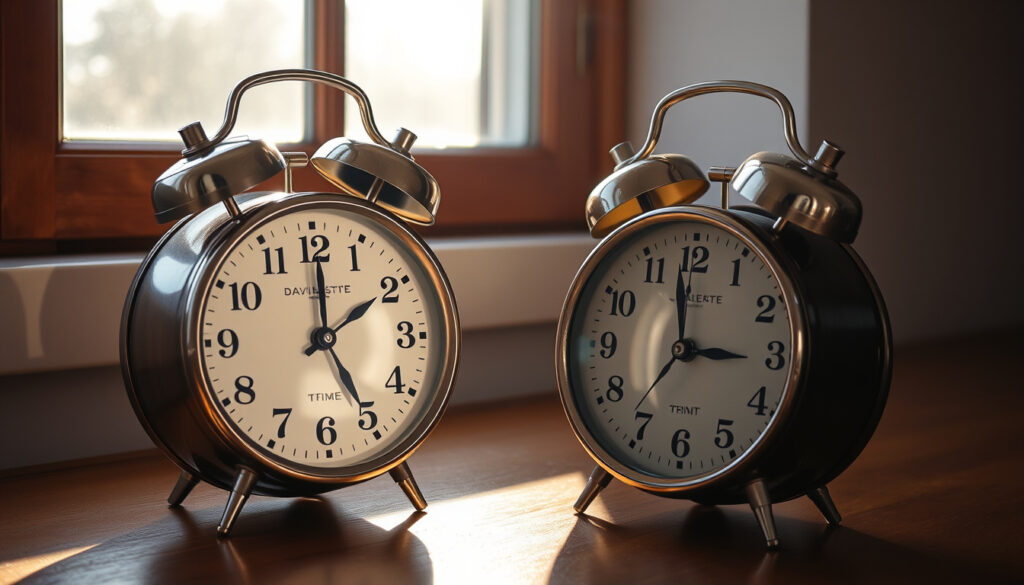
When Do the Clocks Go Forward in Ireland? 2026 Dates
Few things trip up a Sunday morning like the vague memory that the clocks changed — but not knowing which way. If you’ve ever stared at a microwave blinking the wrong hour, you’re in the right place. For 2026, Ireland’s clock changes fall on two specific Sundays, and the rules haven’t budged. Here’s exactly what you need to mark on the calendar, with official dates straight from Irish government sources.
Spring forward date 2026: March 29 ·
Time of change: 1:00 AM Irish Standard Time becomes 2:00 AM IST ·
Autumn back date 2026: October 25 ·
Time of change: 2:00 AM IST becomes 1:00 AM GMT ·
Rule: Last Sunday of March and last Sunday of October
Quick snapshot
- March 29, 2026: clocks forward — summer time begins (RTÉ)
- October 25, 2026: clocks back — winter time returns (RTÉ)
- Both changes happen on the last Sunday of their month (RTÉ)
- Mark Sunday, March 29 to spring forward (RTÉ)
- Mark Sunday, October 25 to fall back (RTÉ)
- Check smart devices — most update automatically (Wikipedia)
The pattern confirms the fixed rule for 2026.
Six key facts, one clear pattern: Ireland’s clock changes are set by a fixed rule, and both 2026 dates are locked in.
| Fact | Value |
|---|---|
| Spring change date | Last Sunday of March (March 29, 2026) (RTÉ) |
| Autumn change date | Last Sunday of October (October 25, 2026) (RTÉ) |
| Clock direction in March | Forward (1 AM → 2 AM) (RTÉ) |
| Clock direction in October | Back (2 AM → 1 AM) (RTÉ) |
| Time zone March–October | Irish Standard Time (IST, UTC+1) (Wikipedia) |
| Time zone October–March | Greenwich Mean Time (GMT, UTC+0) (Wikipedia) |
The implication: these dates are not arbitrary. Irish law and EU directive fix them to the last Sunday of March and October — a rhythm unchanged since the current rules were harmonised across member states.
When do the clocks change in Ireland?
What is the rule for the clock change dates?
- Clocks go forward on the last Sunday of March at 1:00 AM (RTÉ (Irish public broadcaster))
- Clocks go back on the last Sunday of October at 2:00 AM (RTÉ (Irish public broadcaster))
- This schedule is governed by EU Directive 2000/84/EC, which all member states must follow (RTÉ (Irish public broadcaster))
When do the clocks go forward in Spring 2026?
- Date: Sunday, March 29, 2026 (RTÉ (Irish public broadcaster))
- At 1:00 AM, clocks advance to 2:00 AM — you lose one hour of sleep (RTÉ (Irish public broadcaster))
- Ireland switches from Greenwich Mean Time (GMT, UTC+0) to Irish Standard Time (IST, UTC+1) (Wikipedia (time zone reference))
Anyone relying on a Sunday morning alarm for work or school will lose that hour early — at 1:00 AM, not dawn. Plan Saturday night’s sleep accordingly, because the change hits at the start of the day, not the end.
The catch: the EU Commission’s 2018 proposal to abolish seasonal clock changes has not been adopted. Ireland continues on the current schedule with no firm end date in sight — so expect this rhythm to hold at least until 2027.
What date in October do the clocks go back in Ireland?
Do we gain or lose an hour on Sunday in October?
- You gain one hour of sleep on the night of October 25, 2026 (RTÉ (Irish public broadcaster))
- At 2:00 AM IST, clocks fall back to 1:00 AM GMT (RTÉ (Irish public broadcaster))
- Daylight Saving Time ends; winter time begins (Wikipedia (time zone reference))
Do we get an extra hour in bed when the clocks change in October?
- Yes — because the clock jumps from 2:00 AM back to 1:00 AM, you effectively experience 1:00 AM twice (RTÉ (Irish public broadcaster))
- This only affects that specific early-morning hour — it does not shift your entire Sunday schedule (RTÉ (Irish public broadcaster))
Irish households gain the luxury of a 25-hour Sunday in October — but only if they remember it’s the early morning, not the evening, that repeats. Plan lie-ins for that date, not the night before.
The pattern: spring robs you of one key hour early on a Sunday; autumn gives it back. The net effect across a year is neutral, but the disruption to sleep rhythm in March typically takes 2-3 days to shake off.
Do the clocks go forward or back on Sunday?
How can I remember which direction to change the clocks?
- Traditional mnemonic: “Spring forward, fall back” (or “spring forward, autumn back”) (RTÉ (Irish public broadcaster))
- In March (spring), clocks go forward by one hour (RTÉ (Irish public broadcaster))
- In October (autumn), clocks go back by one hour (RTÉ (Irish public broadcaster))
What is the difference between summer time and winter time in Ireland?
- Summer time = Irish Standard Time (IST, UTC+1), used from last Sunday March to last Sunday October (Wikipedia (time zone reference))
- Winter time = Greenwich Mean Time (GMT, UTC+0), used from last Sunday October to last Sunday March (Wikipedia (time zone reference))
- The shift effectively adds one hour of evening daylight in summer (RTÉ (Irish public broadcaster))
The direction is clear with the mnemonic and understanding of summer/winter time zones.
2026 clock change timeline
- March 29, 2026 — Clocks go forward at 1:00 AM → 2:00 AM IST. Daylight saving time starts. (RTÉ (Irish public broadcaster))
- October 25, 2026 — Clocks go back at 2:00 AM → 1:00 AM GMT. Daylight saving time ends. (RTÉ (Irish public broadcaster))
The pattern: two dates, six months apart, each costing or gifting one precise hour. The EU’s stalled proposal to abolish the system means this rhythm is likely stable for at least another few years.
What’s clear and what’s not
Confirmed facts
- Clocks go forward on the last Sunday of March 2026 (March 29). (RTÉ (Irish public broadcaster))
- Clocks go back on the last Sunday of October 2026 (October 25). (RTÉ (Irish public broadcaster))
- Time change happens at 1:00 AM (spring) and 2:00 AM (autumn). (RTÉ (Irish public broadcaster))
What’s unclear
- Whether the EU will adopt the proposal to end daylight saving time before 2027; no date has been set. (RTÉ (Irish public broadcaster))
- Potential for a future change in the designated time zone for Ireland (e.g., adopting permanent summer time). (Wikipedia (time zone reference))
- EU Commission proposal to abolish seasonal clock changes remains unadopted; Ireland follows current schedule. (RTÉ)
The balance of known and unknown helps readers manage expectations.
Official guidance
Clocks go forward by one hour at 1am on the last Sunday of March. This means, at 1am the time on the clock is changed to 2am.
— Citizens Information (RTÉ)
RTÉ states that in 2026 the clocks ‘spring forward’ by one hour at 1am on 29 March 2026.
— RTÉ (RTÉ)
Both sources agree: the rule is consistent, the dates are fixed, and the only open question is whether the EU will eventually scrap the system altogether.
What to do with this
For anyone living in Ireland, the 2026 clock changes are already locked in: spring forward on March 29, fall back on October 25. There is no ambiguity in the date or direction — only in the question of how long the system will last. For Irish households, the choice is simple: set a calendar reminder for both Saturday nights before the change, and enjoy that extra hour in October while it’s still guaranteed.
For 2026, the date is set: clocks go forward on March 29 at 1 AM, with the autumn change falling on October 25.
Frequently asked questions
Why does Ireland change the clocks?
Ireland changes the clocks to maximise daylight during summer months, a practice adopted across most of the EU under Directive 2000/84/EC. The shift to Irish Standard Time (IST) in summer gives longer evening daylight. (RTÉ)
Who decides the clock change dates in Ireland?
The dates are set by EU law (Directive 2000/84/EC), which all member states must follow. The Irish government implements this through national legislation. (RTÉ)
What time zone does Ireland use when the clocks go forward?
When the clocks go forward in March, Ireland switches to Irish Standard Time (IST), which is UTC+1. This is also called summer time or daylight saving time. (Wikipedia)
Does every country in Europe change the clocks on the same day?
All EU member states change clocks on the same day: the last Sunday of March (forward) and the last Sunday of October (back). However, non-EU countries like the UK and Switzerland follow the same schedule voluntarily. (RTÉ)
Do my smart devices change the time automatically?
Most modern smartphones, computers, and internet-connected devices adjust automatically if their time zone settings are correct (set to Dublin or Ireland). Older appliances, analogue clocks, and car clocks typically require manual adjustment. (Wikipedia)
How can I help my family adjust to the time change?
For the spring change, gradually shift bedtime by 10-15 minutes earlier for 2-3 days before March 29. For the autumn change in October, the extra hour usually resolves itself. Exposure to morning sunlight helps both directions. (RTÉ)
When will the clocks stop changing in Ireland?
There is no confirmed date. The European Commission proposed abolishing seasonal clock changes in 2018, but member states have not agreed on a permanent time zone. Until a new directive is adopted, Ireland follows the current schedule with no set end date. (RTÉ)
More related posts
 Repossessed Houses for Sale in Ireland: Buy at Auction
 Where to Learn Cooking Online: Best Classes & Courses
 Apartments Close to Grand Canal Dock: Prices & Tips
 Dyson Ball Multi Floor 2 Review: Is It Worth It? (2025)
 Tuam Mother and Baby Home: History, Excavation, and Facts
 Why I Friend Leaving Netflix? UK & Ireland 2025
 SuperValu Christmas Opening Hours 2025: Full Guide for Ireland
 Shalom Brune-Franklin: Biography, Nationality, and Notable Roles