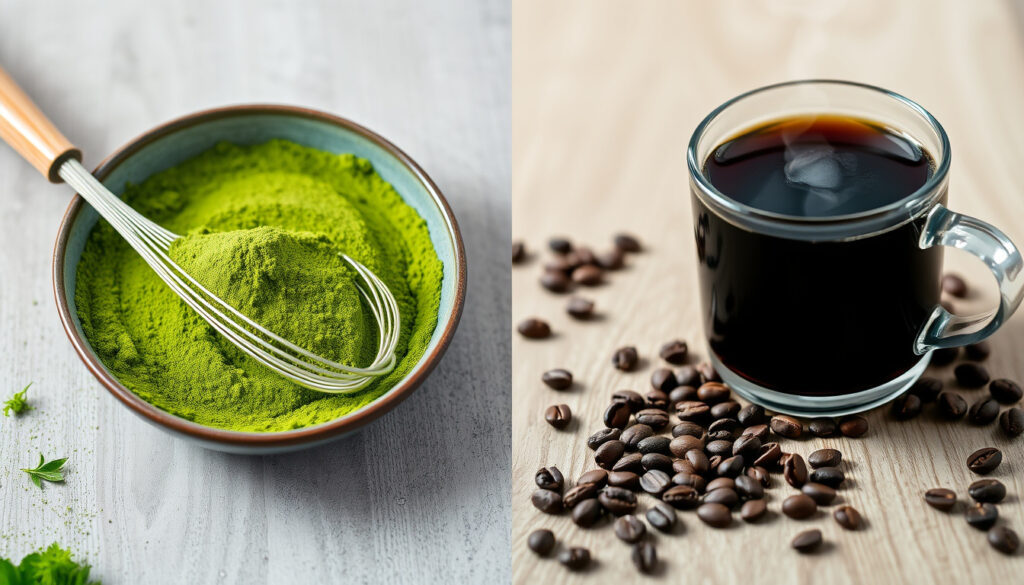
Is There Caffeine in Matcha? How It Compares to Coffee
Matcha may be sold as the calm green tea, but the caffeine is very real — and the dose depends on how many grams of leaf you actually drink. The real question isn’t whether the caffeine is there; it’s how much ends up in the cup.
Caffeine per gram of matcha powder: 19–44 mg ·
Typical matcha serving: 2–4 g (about 1/2 to 1 tsp) ·
Caffeine in a 2 g serving: about 60–70 mg ·
Caffeine in an 8 oz cup of coffee: about 95 mg ·
Caffeine in a single espresso shot: about 60–70 mg ·
Caffeine in regular green tea per gram: 11–25 mg
Quick snapshot
- Matcha is powdered green tea — the whole leaf and its caffeine go into your drink (Everyday Health (health and wellness publication)).
- Matcha contains about 19–44 mg of caffeine per gram of powder (Best Tea Bags (specialist tea retailer)).
- A 2–4 g serving is where the “calm tea” story turns into a coffee-grade dose (Steady Matcha (matcha specialty retailer)).
- Exact caffeine depends on brand, grade, serving size, and preparation — the range is wide (Mayo Clinic (clinical reference)).
- Whether L-theanine cancels jitters for every person is not settled (Everyday Health (health and wellness publication)).
- Sleep sensitivity to caffeine varies from person to person (MedlinePlus (U.S. National Library of Medicine)).
- Caffeine’s effects last roughly 5–6 hours, so a late-day matcha can follow you into sleep (MedlinePlus (U.S. National Library of Medicine)).
- A 4 pm matcha can still be in your system near bedtime. (MedlinePlus (U.S. National Library of Medicine))
- The safer window for most people: morning to early afternoon. (MedlinePlus (U.S. National Library of Medicine))
- Treat matcha as a caffeine drink when you plan your day.
- Start with a smaller serving if you are new to it.
- If you feel jittery or sleepless, the grams — not the marketing — are the first thing to cut.
Six numbers, one pattern: the final dose depends on how much leaf matter you actually consume, not on whether the drink looks like tea or coffee.
| Fact | Value | Source |
|---|---|---|
| Source | Powdered whole green tea leaves | — |
| Caffeine per gram | 19–44 mg | Best Tea Bags |
| Typical serving | 2–4 g (about 1/2 to 1 tsp) | — |
| Caffeine in 2 g serving | about 60–70 mg | Steady Matcha |
| Caffeine in coffee (8 oz) | about 95–96 mg | Mayo Clinic reference table |
| Caffeine in regular green tea per gram | 11–25 mg | Specialist tea chart (Best Tea Bags) |
Is there caffeine in matcha?
Yes — if it’s real matcha. Matcha is green tea in powdered form, and because you whisk the whole leaf into the water instead of steeping it and throwing the leaves away, the caffeine that lives naturally in the leaf makes it into your cup (Everyday Health). If your frame of reference is decaf tea or herbal blends, matcha is a different category: it is a true tea, and true tea starts with caffeinated leaves.
Is there caffeine in matcha tea?
“Matcha tea” is not a different product — it’s the same powdered green tea whisked with water. The caffeine is still there.
The only way to get a truly caffeine-free “matcha” drink is to use a product that contains no real matcha powder at all — usually by replacing the tea with a different plant base. If a café drink is made with actual matcha, you’re getting caffeine.
Is there caffeine in matcha latte?
- A matcha latte is matcha powder + milk (+ sweetener) — the milk adds creaminess, not caffeine removal.
- A latte made with 2 g of matcha carries roughly 60–70 mg of caffeine, about the same as a single espresso (Steady Matcha (matcha specialty retailer)).
What changes your dose at a café is the number of scoops of powder behind the counter, not the size of the cup. A “small” matcha latte made with two scoops can easily out-caffeine a “large” one made with one.
Is there caffeine in matcha at Starbucks?
Chain matcha drinks are still matcha drinks. Starbucks uses real matcha powder in its matcha beverages, so the caffeine is present — the exact amount depends on the size and how many scoops go in.
The same logic applies at any large coffee chain: as long as the drink is built on real matcha powder, it contains caffeine. A “matcha” drink made from a flavored base with no actual tea leaves is the only version that can be caffeine-free.
How much caffeine is in matcha vs coffee?
- Matcha, 2 g serving: about 60–70 mg of caffeine — roughly espresso territory (Steady Matcha).
- Brewed coffee, 8 oz cup: about 96 mg (Mayo Clinic (clinical reference)).
- Espresso becomes the closer comparison — a single shot lands right next to a standard 2 g matcha bowl.
So per serving, matcha usually lands below a standard cup of coffee — but closer than the “green tea means tiny caffeine” stereotype suggests. The reason matcha feels different isn’t a different drug; it’s the same caffeine arriving with a side of L-theanine and, at typical servings, a smaller total dose.
Is matcha higher in caffeine than coffee?
Per gram, matcha is strong. Per cup, a standard matcha serving runs below an 8 oz coffee — unless the powder climbs toward 4 g, the top of the typical serving range, and then the gap closes fast.
The practical test: a 2 g bowl of matcha is about 60–70 mg. A 4 g serving is roughly double that, which moves the drink past a single espresso and closer to a standard cup of coffee.
How much caffeine is in matcha vs espresso?
At standard servings, matcha and espresso are almost twins: both sit in the 60–70 mg zone.
The felt difference is packaging. Espresso gives you that dose in about an ounce; matcha spreads it across a larger, slower sip. Total caffeine is nearly the same, so if espresso makes you jittery, matcha can too.
How does matcha caffeine compare to regular green tea?
- An 8 oz cup of brewed green tea sits at about 37 mg in FDA reference values (U.S. Food and Drug Administration (federal regulator)).
- An 8 oz matcha drink can reach about 70 mg — because the whole leaf is in your cup (Everyday Health).
That gap is the whole story in two numbers: regular green tea is steeped and the leaves are discarded, so only some of the caffeine comes out. Matcha is the leaf, so you get the full accounting.
The catch: caffeine comparisons that say “matcha has less than coffee” are true only for the serving size they had in mind. Double the grams and the whole comparison flips.
Can matcha keep you awake?
- Yes — the caffeine in matcha is enough to reduce sleepiness and sharpen focus.
- The active compound is the same molecule as coffee, so the alertness is real.
- L-theanine may smooth the edge, but it does not remove the caffeine.
People who swear matcha “doesn’t count” as caffeine are usually drinking small ceremonial bowls — 1 g or less — or they’ve built up a tolerance. At 2–4 g, matcha behaves like the stimulant it is.
Does matcha speed up your metabolism?
- Caffeine is a mild metabolic stimulant — that part is well established.
- Green tea catechins may add a modest effect on top.
- “Modest” is the key word: no tea is a weight-loss tool on its own.
A small matcha habit isn’t going to replace exercise or sleep. Think of any metabolic lift as a rounding error next to the real drivers of energy balance.
How long does caffeine from matcha last?
- For many people, one dose still registers 5–6 hours later — the same window shown in the timeline above.
- A 3 pm matcha can still be circulating at 8–9 pm.
- That is why “it’s just tea” is a risky way to think about a bedtime drink.
Can matcha cause jitters like coffee?
Yes. Jitters are a caffeine reaction, not a coffee reaction — matcha delivers the same molecule.
If you feel shaky after coffee, you can feel shaky after matcha. The usual difference is dose, not chemistry: a small matcha bowl has less caffeine than a typical coffee, so the jitter threshold takes longer to reach.
The trade-off: matcha can give you coffee-like focus with a softer landing, but the alertness and the side effects are the same molecule in a different costume.
What are the cons of matcha tea?
- Too much caffeine: anxiety, shakiness, a racing heart, stomach discomfort.
- Empty-stomach matcha can trigger nausea or lightheadedness in sensitive people.
- Caffeine can stimulate digestion, which makes matcha a mild laxative for some.
- A bloated feeling after a matcha latte often comes from milk or sweetener, not the tea.
Why do I feel weird after drinking matcha tea?
Caffeine on an empty stomach is the classic cause of the “matcha makes me feel weird” feeling — nausea, lightheadedness, a fast heartbeat.
If the weird feeling is a stomachache or bloating, look at the milk and sweetener first. Matcha itself is the source of the caffeine jolt; the latte ingredients are often the source of the digestive complaint.
Does matcha act as a laxative?
It can, for some people — caffeine stimulates the digestive tract, and a morning matcha on an empty stomach can move things along faster than usual.
This is a normal caffeine effect, not a special property of matcha. Coffee drinkers know the phenomenon well; matcha simply does the same thing in a greener package.
Does matcha debloat your stomach?
- Matcha is not a debloating agent — no tea cancels bloating on demand.
- A bloated matcha latte is more likely reacting to dairy or sweeteners.
- If you want to test the cause, drink matcha plain and see what changes.
The catch: one person’s calm cup is another person’s racing heart. Dose, body weight, and whether you’ve eaten decide which side of the line you fall on.
Who should not drink matcha?
- People with caffeine sensitivity or anxiety disorders.
- People with heart-rhythm conditions.
- Pregnant and breastfeeding people, unless a clinician says otherwise.
- Anyone taking stimulant medications, certain antibiotics, or heart medication.
For healthy adults, the FDA’s guidance is clear: up to 400 mg of caffeine per day is an amount not generally associated with negative effects — roughly two to three cups of coffee, depending on strength (U.S. Food and Drug Administration).
Matcha counts against that ceiling like any other caffeine. A 2 g serving uses 60–70 mg of it; two matcha lattes plus a coffee can get a sensitive person into the red quickly.
Pregnancy changes the math. Standard guidance is to hold total caffeine below 200 mg a day, because caffeine crosses the placenta — and matcha counts fully against that limit (MedlinePlus).
Why shouldn’t you drink matcha every day?
- Daily matcha is not automatically bad — the dose is what matters.
- Multiple large servings daily can push caffeine intake too high.
- Regular high intake also builds tolerance, so the “calm” effect fades.
The risk is stacking, not the tea itself: a matcha latte in the morning, a soda at lunch, a coffee in the afternoon — that’s easy to take past 400 mg without noticing.
What should you not mix matcha with?
- There is no dangerous “matcha + food” combo on the record.
- The real caution is mixing matcha with other caffeine sources.
- Some medications interact with caffeine, so check with a pharmacist.
If you take prescription stimulants, certain antibiotics, or heart medication, caffeine can shift how those drugs behave. Matcha isn’t uniquely risky — but it is a caffeine source, and it counts.
Can matcha cause anxiety or heart palpitations?
At the right dose, matcha can absolutely trigger anxiety, a racing heart, or palpitations — especially in people who are already sensitive or on stimulants.
If you have an anxiety disorder or a heart-rhythm condition, treat matcha as a real caffeine source and talk to your clinician before making it a habit.
The measure: anyone who has trouble with coffee should treat matcha as caffeine, not as an exception with a green glow.
What is the best time to drink matcha?
- Morning to early afternoon: the best window for most people.
- Before a workout: fine for alertness, but it is not a strong pre-workout.
- Within six hours of bedtime: risky if you are caffeine-sensitive.
Should you drink matcha in the morning?
- A morning matcha works as a coffee swap for steady focus.
- The caffeine arrives with a slower sip, which some people find steadier than a quick coffee.
- If coffee makes you jittery, a smaller matcha serving may feel gentler — but it’s still caffeine.
For most people, the morning window is where matcha earns its keep: enough caffeine for focus, with a longer, more even sip than coffee.
Is matcha good before a workout?
- Matcha can increase alertness before training.
- It is not an intense pre-workout stimulant — keep expectations realistic.
- Late-afternoon matcha before evening exercise can cost you sleep.
If you train late, consider matcha earlier in the day or accept that the caffeine may linger into your recovery window.
How late can you drink matcha before bed?
Because a caffeine dose lingers about five to six hours for most adults, a reasonable curfew is to finish matcha at least six hours before bed.
A 4 pm matcha is fine for a 10:30 pm bedtime. An 8 pm matcha is a gamble with your sleep.
The practical rule: treat matcha like coffee when you plan your day — enjoy it early, mind the grams, and keep a caffeine curfew if you want to sleep well.
Matcha vs coffee vs espresso: side-by-side caffeine comparison
Three drinks, one pattern: at standard servings, matcha and espresso are near twins, and coffee is the heavyweight of the group.
| Drink | Typical serving | Caffeine | How it behaves |
|---|---|---|---|
| Matcha | 2 g powder (about 1/2 tsp) | about 60–70 mg (Steady Matcha) | Slow sip, near-espresso dose |
| Brewed coffee | 8 oz cup | about 96 mg (Mayo Clinic) | The standard “cup of coffee” baseline |
| Espresso | 1 oz shot | about 63 mg (Mayo Clinic) | Dense hit in a tiny volume |
The upshot: swap from coffee to matcha and you’re usually lowering your caffeine — but only by a little, and only if the grams stay near 2 g. Go toward 3–4 g and the word “healthier” stops doing the work.
What we know and what we don’t
Confirmed facts
- Traditional matcha contains roughly 19–44 mg of caffeine per gram — it is not a caffeine-free product (Best Tea Bags).
- The same powder can read as a gentle bowl or a coffee-strength drink — the difference is the grams you use.
- Matcha is green tea, not a herbal infusion, so its caffeine is natural and unavoidable.
What’s unclear
- Exact caffeine in any specific drink still depends on brand, grade, serving size, and preparation (Mayo Clinic).
- Whether L-theanine fully cancels jitters for every person is not settled.
- Individual sleep sensitivity to caffeine varies widely, so your personal curfew may be stricter than the person next to you.
Why this matters: the uncertainty is not a reason to dismiss matcha — it’s a reason to treat every serving as its own experiment.
What the sources say
The sharpest summaries of matcha’s caffeine story come from the sources that track caffeine for a living.
“Matcha commonly contains more caffeine than ordinary brewed green tea because the drink includes the pulverized leaf, not just a quick steep.”
— Everyday Health (health and wellness publication)
“If you’re pregnant, keep total caffeine below 200 milligrams a day — caffeine crosses the placenta, which is why the limit exists.”
— MedlinePlus (U.S. National Library of Medicine)
“400 milligrams of caffeine per day is an amount not generally associated with negative effects for most healthy adults.”
Why this matters: the people who study caffeine keep saying the same thing — the dose is the story, and matcha is caffeine.
The takeaway
Matcha’s reputation as “the calm green tea” survives only if you ignore the serving size. A 2 g bowl sits near espresso; a 4 g café latte can approach a full cup of coffee, and the caffeine stays in your system for hours. For anyone who switched to matcha to escape coffee’s edge, the choice is clear: measure your powder, watch the clock, and treat the drink as the caffeine source it actually is — or accept that the “gentle” label was never a chemical guarantee.
Frequently asked questions
Can you buy matcha with no caffeine?
Traditional matcha always contains caffeine, because it is made from the same plant as green tea. A truly caffeine-free “matcha” product has to replace the tea with another plant base, so read the label before assuming a product is caffeine-free.
Does matcha have more caffeine than black tea?
Usually, yes. Because matcha delivers the whole leaf instead of a quick steep, a standard 2 g serving (about 60–70 mg) tends to run higher than a typical cup of black tea, though exact numbers depend on the tea and brew strength.
How does matcha caffeine affect pregnancy?
Caffeine crosses the placenta, and the common guidance is to keep total intake under 200 mg per day during pregnancy. A 2 g matcha serving uses about 60–70 mg of that budget, so it counts fully toward the limit.
Is matcha safe on an empty stomach?
For most people, yes, but caffeine-sensitive drinkers can feel nauseous or lightheaded if matcha is the first thing they consume. A small snack with your matcha usually solves that.
Does matcha count toward your daily caffeine limit?
Yes. A 2 g serving is about 60–70 mg, and the FDA sets a 400 mg daily ceiling for healthy adults. One matcha plus a coffee is fine for most people; several large matchas plus energy drinks can cross the line.
Can matcha cause caffeine headaches?
It can, in both directions: too much caffeine in one sitting can trigger a headache, and so can withdrawal if you drink matcha daily and then skip a day. Matcha is caffeine, and caffeine headaches are dose-dependent.
The pattern across these answers: matcha is caffeine, and caffeine is a dose conversation — the rest is details.
Related reading
More related posts
 Cast of La verità è che non gli piaci abbastanza: Full List
 Things to Do in Clonmel: Top Attractions, Festivals & Day Trips
 Places to Visit in Dublin for Free – Verified Free Attractions
 Cafe de Paris Butter: What It Is, How to Make, Where to Buy
 Cay Beach Meloneras Bungalows: Reviews, Prices & Location
 Day Tours from Dublin: Best Train, Bus & Private Trips
 Cast of Good Will Hunting: Full List, Roles & Where Are They Now
 BMW Ireland Used Cars: Dealers, Prices & Checklist