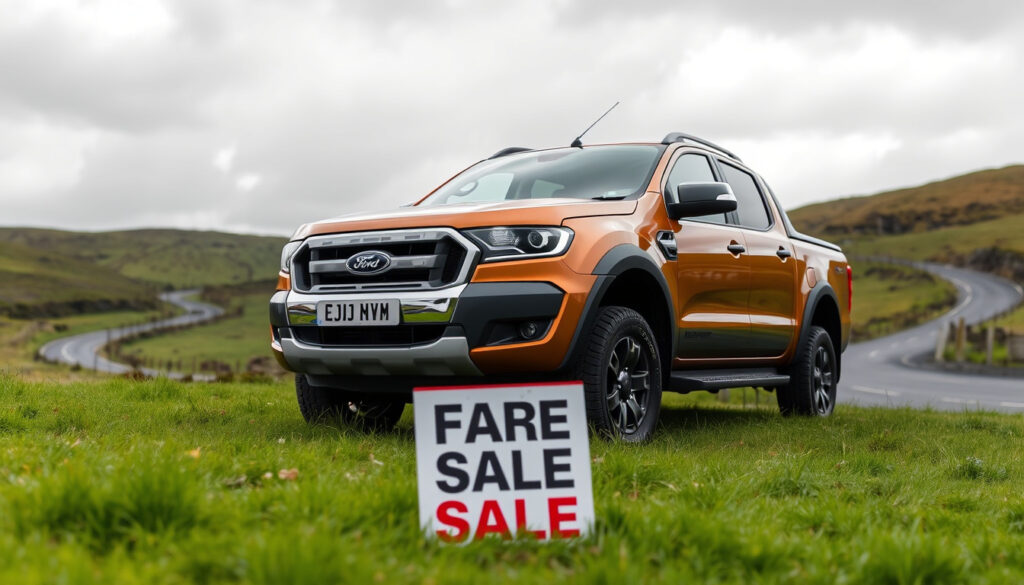
Ford Ranger for Sale in Ireland: 2025 Buyer’s Guide
Anyone who has priced a used pick-up in Ireland knows the Ford Ranger is the truck you see on every second forecourt. That popularity hides a few traps: advertised ex-VAT prices, rust on older models, and a reputation gap with the Toyota Hilux that matters before you hand over €44,474 for a 2026 XL.
Best-selling pick-up in Europe: Ford Ranger ·
Used price range (Ireland): €15,000–€60,000 ·
Model years available: 1998–present
Quick snapshot
- Ford Ireland (the official importer) calls the Ranger Europe’s best-selling pick-up.
- A J.P. McGowan Motors (Irish dealer) listing shows the Wildtrak plug-in hybrid at €51,900 plus VAT (€63,837 including VAT), with the remainder of the manufacturer warranty attached.
- A Finlay Motor Group (Irish dealer) listing prices a 2026 Ranger XL — manual, 2.0-litre diesel, two-door — at €35,995 before VAT.
- No aggregated Irish data confirms which model years fail most often.
- Owner-reported rust on 2006–2011 rear wheel arches is not quantified in the cited sources.
- Whether the Hilux’s resale premium beats the Ranger’s lower buying price over a full ownership cycle is unproven.
- The current generation is deep into its Irish lifecycle — 2026 stock is already the norm on dealer lots. (VRT.ie (Irish vehicle-tax guidance site))
- VRT.ie (Irish vehicle-tax guidance site) notes Budget 2025 reset Category B VRT rates from 1 January 2025.
- Electrification has arrived: the Wildtrak PHEV listing cited above is the proof, not a rumour. (VRT.ie (Irish vehicle-tax guidance site))
- Read Irish dealer ads line by line — ex-VAT, VAT-inclusive and on-the-road prices are different numbers. (Irish Revenue Commissioners (tax authority))
- Irish Revenue Commissioners (tax authority) guidance points to a written VRT assessment before importing or registering a Ranger.
- The range is diversifying beyond diesel, with the plug-in hybrid already in dealer stock. (Irish Revenue Commissioners (tax authority))
Six rows, one pattern: the Ranger’s brochure strengths are real, but the price you actually pay is decided by VAT, VRT and vehicle class — not by the dealer’s headline number.
| Fact | Detail |
|---|---|
| Positioning | Ford Ireland (the official importer) positions the Ranger as a commercial pick-up for load-carrying, towing and off-road work, with diesel and plug-in-hybrid configurations in the current line-up. |
| Capability | The same official material cites towing of up to 3,500 kg, a load bed that takes a standard Euro pallet between the wheel arches, and switching between two-wheel and four-wheel drive while driving. |
| Price transparency (2026 XL) | Finlay Motor Group (Irish dealer) splits the 2026 XL as €35,995 ex-VAT, €8,279 VAT and €44,474 VAT-inclusive. |
| VRT standard rate (Category B) | Society of the Irish Motor Industry (motor trade body) cites a 13.3% VRT rate, with a minimum of €125. |
| VRT reduced rate (Budget 2025) | VRT.ie (Irish vehicle-tax guidance site) cites an 8% rate for Category B vehicles up to 120g/km from 1 January 2025. |
| Commercial classification | VRT.ie (Irish vehicle-tax guidance site) notes double-cab pick-ups generally fall into Category B when commercial-vehicle conditions are met. |
Are Rangers a good truck?
The short answer is yes — with conditions. The Ranger is a genuine work vehicle that has learned to live with families, and the Irish market treats it accordingly.
Reliability and durability
- Ford’s own material frames the Ranger as a commercial vehicle, not a soft-roader; that positioning explains the chassis, ground clearance and payload focus.
- The used market is deep enough that parts and independent mechanics are easy to find across Ireland.
- The durability ceiling depends on maintenance — the dealer listings cited above include both high-spec and work-spec examples.
In practice, the Ranger’s reputation is split: fleet buyers trust the diesel workhorse, while private buyers worry about the long-term bills. Both groups are right in different ways.
The strongest move is to buy on evidence, not badge reputation: a service book that matches the mileage, and a dealer that can show the VIN’s recall status.
Performance and capability
- For tradespeople, the load bed dimension that matters is the pallet width — confirmed in the key facts table above.
- Diesel torque is the point of a pick-up, and the Ranger line-up is diesel-first; the powertrain row in the key facts table lists the current configurations.
- Four-wheel drive is switchable on the move, which is worth testing on wet grass before you commit.
The Ranger’s capability is not in question. The question is whether you need it often enough to justify the running costs of a ladder-frame diesel.
Comfort and technology
- The Wildtrak PHEV listing cited in the Quick snapshot shows where the range is heading — upmarket.
- The Raptor adds performance hardware that turns the Ranger from workhorse into toy.
- The XLT is the trim most buyers land on for the balance of comfort and cost.
Comfort is the Ranger’s quiet advantage over the Hilux in the cited market comparison: it drives more like an SUV than a tractor, and the cabin equipment follows. That comfort comes with complexity — more electronics, more to fail, and a bigger repair bill when it does.
What year of Ford Ranger to stay away from?
There is no officially confirmed ‘worst year’ in the cited data, but the used-market chatter clusters around three eras worth knowing before you shop.
2001–2003 model year issues
- Early-2000s Rangers are the cheapest way in, which is exactly why they attract the most warnings.
- The 2.3-litre petrol engine is the one most often named in owner discussions — treat it as a red flag unless the history is documented.
- No aggregated failure-rate data for these years was cited in the sources reviewed here.
A pre-2004 Ranger should be bought as a project, not a daily driver, unless the seller can show recent gearbox or clutch work.
2019 PCM recalls
- Owner discussions frequently mention a 2019-era powertrain-control-module recall campaign.
- The cited data does not confirm which Irish trucks were affected or fixed.
- The Wildtrak PHEV listing cited above still carries the manufacturer warranty — the kind of paper trail that answers recall questions.
Before paying, ask the dealer to run the VIN through Ford’s recall system. A verbal ‘should be fine’ is not a documented answer.
Rust in 2006–2011 models
- Rear wheel arches are the spot owners name most on this generation.
- Ireland’s salt, rain and humidity give rust a head start that a fresh valet hides well.
- Check the arches, the sills and the chassis crossmembers — not just the panels the seller polished.
A cheap 2006–2011 Ranger with visible arch rot is not a bargain; the welding bill can exceed the asking price before you insure it.
Owner folklore names bad years; dealer paperwork proves them. The safest model-year filter is a documented service history and a clear VIN recall status, because the ‘bad years’ in the cited data are patterns, not guarantees.
What are common Ford Ranger problems?
Reliability talk about the Ranger is really talk about three weak spots. None of them is officially quantified in the cited sources, but all three show up consistently in owner discussions.
Engine problems
- Diesel is the core of the Irish line-up, so diesel-specific complaints travel furthest.
- DPF clogging is the most repeated owner complaint for short-run use; the practical fix is a regular long drive, not an additive.
- The plug-in hybrid Wildtrak, cited in the Quick snapshot, points away from diesel for city users.
The new-shape diesel family rewards regular motorway use. If your week is all 10-minute school runs, budget for DPF trouble or buy the hybrid.
Transmission issues
- Automatic transmission shudder is a commonly reported complaint on higher-mileage examples.
- The 2026 Raptor cited earlier is an automatic, so gearbox condition matters on the new shape too.
- A proper test drive should include low-speed crawling and a cold start — that is where shudder shows up.
Manuals are less glamorous but simpler to inspect; automatics need a service history that shows fluid changes at the right intervals.
Rust and corrosion
- Rear wheel arches are the bodywork spot owners name most on older models.
- The Irish climate gives corrosion a head start that underbody treatments can slow but not stop.
- An independent inspection pays for itself the first time it finds filler under fresh paint.
Rust is the great negotiator: it can knock thousands off a price, but only if you spot it before the seller does.
For an Irish buyer, the VAT gap on the 2026 XL listing — thousands of euro between the headline price and the final line — is the sharpest warning in this guide. Read every dealer ad from the bottom up.
Which is better, Hilux or Ranger?
This is the question every Irish pick-up buyer asks, and the honest answer is that the cited data settles only part of it.
Off-road ability
- The Ranger’s on-the-fly 2WD/4WD switching is confirmed in the key facts table above.
- Ground clearance and wheel travel matter more than the badge on wet Irish farmland.
- The Raptor’s off-road hardware is a different league again — and priced like it.
Both trucks will do the work. The Ranger makes it easier to jump between tarmac and field without stopping to think about the driveline.
Reliability record
- The market comparison credits the Toyota Hilux with the stronger reliability reputation.
- The same comparison gives the Ranger the edge in comfort and equipment.
- What the cited data does not settle: which truck actually breaks less in Irish conditions.
The Hilux’s reputation is a real asset — it keeps resale values firm and gives owners confidence. The Ranger’s counterargument is a lower purchase price and a quieter cabin.
Price and resale value
- The cited market comparison says the Ranger is generally cheaper used.
- The 2026 XL listing in the Quick snapshot shows why: VAT-inclusive pricing that undercuts the equivalent Hilux perception.
- A cheaper buy usually means a softer resale curve; the Hilux premium is the mirror image.
For a five-year ownership plan, the maths is simple: if you buy the Ranger cheaper and sell it for less, the difference is smaller than the financing saving on day one.
The trade-off: if resale reputation is the priority, the Hilux wins; if everyday comfort and purchase price matter more, the Ranger takes it.
Which model of Ford Ranger is the best?
Once you know the Ranger is the right kind of truck, the next question is which trim. The Irish market currently splits into three personalities.
Ford Ranger Wildtrak
- A J.P. McGowan Motors (Irish dealer) listing shows the Wildtrak PHEV at the premium end — €51,900 plus VAT.
- The Wildtrak is the trim that closes the gap to a luxury SUV, with the load bed as a bonus.
- The manufacturer warranty still running on the listing is exactly the evidence a used buyer should demand.
The Wildtrak is the one to buy when the truck is also the family car and the image matters. It is not the cheapest way to own a Ranger, but it is the most complete.
Ford Ranger XLT
- XLT is the value pick of the range — the balance of comfort, capability and price.
- The ladder below it starts with the XL; the 2026 XL price in the Quick snapshot shows the entry point.
- Most private buyers find XLT spec is where the Ranger stops feeling like a workhorse.
If this is your first Ranger, start here. The XLT gives you the diesel capability without the Wildtrak’s luxury tax.
Ford Ranger Raptor
- A Finlay Motor Group (Irish dealer) listing shows a 2026 Raptor diesel automatic at roughly €77,921–€77,986 including VAT.
- The Raptor is the performance off-road flagship of the line-up.
- It costs nearly twice the XL — that gap is suspension, hardware and attitude.
The Raptor is for buyers who want a pick-up that drives like a rally car. It is spectacular, and it is a difficult daily driver to justify on cost alone.
The implication: the best Ranger depends on which bill you pay — Wildtrak for indulgence, XLT for sense, Raptor for fun.
If the Hilux’s reliability halo is worth money to you, pay it and stop worrying. If you would rather keep the difference in the bank, the Ranger is the rational buy — but only after a rust inspection and a written VRT check.
The model decision matters most against the market’s gold standard. Four comparisons, one pattern: the Ranger wins on price and comfort, the Hilux on reputation, and the cited data is far louder on the Ranger side.
| Point of comparison | Ford Ranger | Toyota Hilux |
|---|---|---|
| Reliability and durability | More comfort and equipment per euro; owner-reported DPF and rust concerns | The market comparison credits the Hilux with the stronger reliability reputation |
| Price and value | Generally cheaper used; the 2026 XL listing cited in the Quick snapshot anchors the price ladder | Typically commands a resale premium — the mirror of the Ranger’s cheaper entry price |
| Off-road and towing | On-the-fly 2WD/4WD switching and a pallet-wide load bed, per the key facts table above | Not covered by the cited data reviewed here |
| Tax and buying path | Written VRT assessment recommended before registration, per the Revenue guidance cited above | Same VRT regime applies by vehicle type |
Ranger pros and cons
The same evidence reads differently depending on what you are buying the truck for.
Upsides
- Strong diesel line-up, plus a plug-in hybrid option
- Serious towing ability and a pallet-friendly load bed
- On-the-fly 2WD/4WD switching
- Generally cheaper used than the Hilux
- The newest generation is already on Irish lots
Downsides
- Rear wheel arch rust on older generations
- DPF clogging reports on short-run diesels
- Automatic transmission shudder reported by owners
- Ex-VAT pricing forces careful maths on every listing
- VRT classification depends on vehicle configuration
Where the facts stand
Low-confidence research means the clear facts are narrower than the market chatter. Here is the line between them.
Confirmed facts
- Society of the Irish Motor Industry (motor trade body) says VRT is calculated on the Open Market Selling Price and depends on CO2 emissions.
- Irish Revenue Commissioners (tax authority) base VRT on the type of vehicle being registered, so a written assessment is the only safe route for an import.
- Dealer pricing regularly separates ex-VAT and VAT-inclusive figures by thousands of euro — the 2026 XL example in the Quick snapshot shows the split.
What’s unclear
- Which model years have the highest real-world failure rates.
- Whether 2006–2011 arch rust is widespread or limited to specific batches.
- Whether DPF and transmission complaints affect most diesels or a vocal minority.
- Whether the Hilux resale premium outpaces the Ranger’s lower buying price over a full Irish ownership cycle.
What the sources say
Category B vehicles are subject to a 13.3% VRT rate, with a minimum VRT of €125.
The 2026 Ranger Wildtrak plug-in hybrid is advertised at €51,900 plus VAT, with the remainder of the manufacturer warranty.
Vehicle Registration Tax depends on the type of vehicle being registered.
— Irish Revenue Commissioners (tax authority)
Bottom line: the Ford Ranger is a genuinely capable pick-up that undercuts the Hilux on price and out-comforts it on the road — but the Irish used market rewards buyers who treat dealer ads as starting points, not facts. The two risks worth paying to remove are rust and uncertainty: an independent inspection covers the first, a written VRT assessment from the Irish Revenue Commissioners covers the second. For an Irish buyer, the choice is clear: buy the best XLT or Wildtrak you can document, or pay the Hilux premium for a quieter reliability conscience.
Frequently asked questions
What is the price range for a new Ford Ranger?
Irish dealer listings cited above start at €44,474 VAT-inclusive for a 2026 Ranger XL and climb to a 2026 Raptor at roughly €77,921–€77,986, with a Wildtrak plug-in hybrid listed at €63,837. Check whether an advertised price is ex-VAT before comparing anything.
How reliable is the Ford Ranger in cold climates?
The cited data does not include a cold-climate reliability study. The practical Irish translation: short cold runs are hard on diesel DPFs, and salt accelerates rust on older body panels. Buy on service history, not on climate folklore.
Does Ford Ranger have a diesel engine?
Yes. Ford Ireland’s current material lists diesel and plug-in-hybrid configurations, and the dealer listings cited above include a 2.0-litre diesel XL and a diesel Raptor.
What is the best used Ford Ranger to buy?
For most Irish buyers, the XLT is the sweet spot. Avoid early-2000s 2.3-litre petrols, check the rear wheel arches for rust, and confirm any outstanding recall work is done before you pay.
How often does Ford Ranger need servicing?
The cited listings do not state a service interval. Require a service book that matches the mileage, and prefer a car with the manufacturer warranty still running.
What is the cargo bed size of Ford Ranger?
Ford Ireland confirms the load bed fits a standard Euro pallet between the wheel arches. Check the spec sheet for the exact model year you are buying.
Related reading
More related posts
 Shannon Airport Car Park: Rates, Best Options & Booking Guide
 Mount Merrion Community Centre: Events, Classes, Contact & More
 Blood Moon Total Lunar Eclipse Ireland – March 14 2025 Guide
 Geothermal Springs and Pools Iceland: Best + Map Guide
 Peter Mark Price List – 2024 Prices by Service and Location
 Al-Nassr vs Al Akhdoud: Head-to-Head, Results, and Key Facts
 Sesame Chicken Near Me: What It Is, Taste, and How It Compares
 Leaving Cert 2024 Timetable: Official SEC Dates