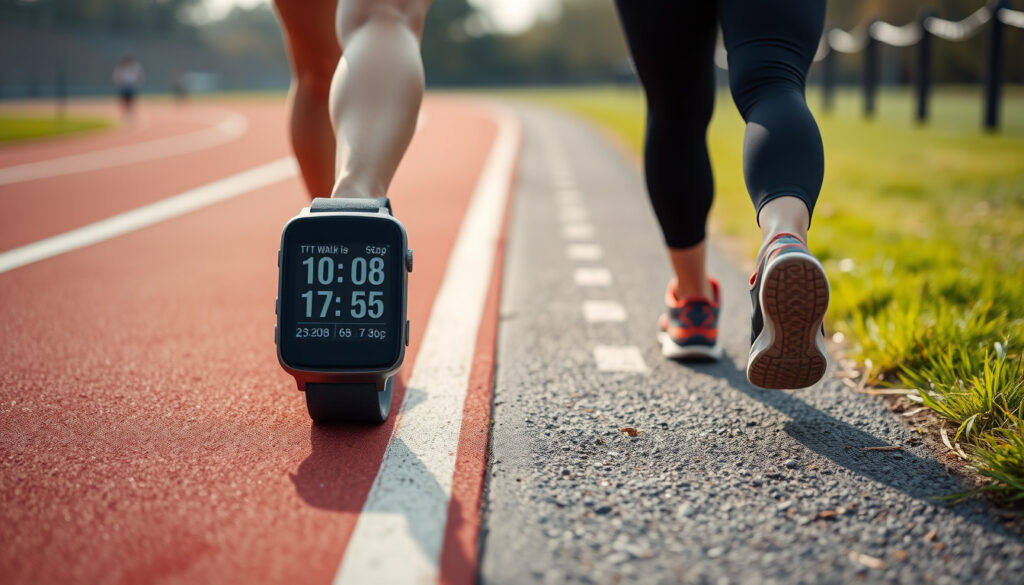
How Many Steps in 1K? Walking vs. Running Step Counts Explained
Anyone who has ever checked a fitness tracker and seen a different step count than a walking partner already knows the answer is personal. A 1 km walk can take roughly 1,250 to 1,550 steps, according to the Steps per kilometer calculator from StepsCal, and whether you land at the low or high end comes down to height, stride length, and pace — and that range shifts calorie estimates, changes what 10,000 steps really means, and should shape any walking plan built around distance.
Average steps in 1 km walking: 1,250–1,550 ·
Average steps in 1 km running: 1,000–1,300 ·
Steps in 1 km for a woman (mean): 1,493 ·
Steps in 1 km for a man (mean): 1,316
Quick snapshot
- Most adults walk 1 km in roughly 1,250–1,600 steps (FitCraft’s step-to-miles calculator)
- Average step length: 0.76 m for men, 0.67 m for women (Omni Calculator’s steps-to-km tool)
- Exactly where you fall in the range without measuring your own stride
- How individual metabolism changes the calorie cost of the same kilometer
- Pace shifts the count: ~1,408 steps/km at 5 kph vs. ~1,209 at 6.5 kph (360Calculator’s kilometers-to-steps table)
- Running lengthens the stride and drops the count — the step-length formula explains why (The Running Genie (step-to-distance calculator))
- Measure your own step length and apply steps = distance ÷ step length (TrainerStudio’s step calculator)
- Use your real steps-per-km to convert 10,000 steps into your true distance (TrainerStudio’s step calculator)
Six figures, one pattern: the “average” step count is a range shaped by who is walking and how fast — not a fixed number your body must hit.
| Metric | Value |
|---|---|
| Average steps per km | 1,300–1,500 |
| Steps per km for women | ~1,493 |
| Steps per km for men | ~1,316 |
| 10,000 steps to km | ~7.6 km (men) / ~6.7 km (women) |
| Calories burned per km walking | 30–60 |
| Walking to lose 5 kg per month | ~5–7 km daily + diet deficit |
The pattern: the heavier you are, the faster you move, and the shorter your legs, the more the numbers move. Treat any single “steps per km” figure as a starting point, not a verdict.
How many steps is a 1 km walk?
For most adults, the honest answer is between 1,250 and 1,550 steps, with the exact number set by your stride. FitCraft’s conversion tool puts the typical walking band at roughly 1,250 to 1,600 steps per kilometer (FitCraft’s step-to-miles calculator), and the most-cited average is about 1,312 steps for an adult of average height at a moderate pace, according to How many steps in a kilometer from GetSteps.app.
That number moves in two directions: pace and body. A 5 kph stroll and a 6.5 kph brisk walk sit at opposite ends of the same kilometer, and the pace table below shows just how far apart they are.
Average steps per km by pace
- Moderate walking (5 kph): ~1,408 steps/km (360Calculator)
- Brisk walking (6.5 kph): ~1,209 steps/km (360Calculator)
- Running: ~1,000–1,300 steps/km, because a longer stride covers more ground per step
The pattern is speed: faster movement lengthens the stride, so each kilometer needs fewer steps. The running band of 1,000–1,300 steps per km follows the same logic — longer stride, lower count.
Steps per km for women vs. men
- Woman, average step length 0.67 m: ~1,493 steps/km (Omni Calculator’s steps-to-km tool)
- Man, average step length 0.76 m: ~1,316 steps/km (Omni Calculator’s steps-to-km tool)
- Steps per km = 1,000 ÷ step length in meters (TrainerStudio’s step calculator)
The gender gap is really a height gap. The step lengths above produce roughly 180 more steps per kilometer for a woman, and height drives most of the difference: walking step length scales with leg length at about 41.5% of height, according to Walk With Me (steps-to-km guide).
Why step count varies per km
- 150 cm walker: ~1,610 steps/km
- 160 cm walker: ~1,510 steps/km
- 170 cm walker: ~1,420 steps/km
Those height-based estimates come from Rundida’s step-distance table (Rundida’s step-distance table), which assumes a stride of about 41.5% of height. StepsCal’s calculator lands on the same pattern, listing ~1,421 steps for a 170 cm walker and ~1,510 for a 160 cm walker (StepsCal), and The Running Genie shows why stride assumptions matter: a 0.75 m step produces ~1,333 steps per km, while a 0.65 m step produces ~1,538 (The Running Genie).
Your personal step count is set by your legs, not your fitness tracker. Two people walking the same kilometer can easily differ by 300 steps because height changes stride — and that gap compounds over every kilometer you log.
The implication: if you are taller than average, you will always register fewer steps on the same route than a shorter walking partner — and that is normal, not a tracker malfunction.
The implication: personalized data turns step counting into a reliable planning tool.
How many km are 10,000 steps?
Ten thousand steps is the most famous fitness target on the planet, yet the distance it covers changes from person to person. Using the average step lengths cited above, a 10,000-step day works out to roughly 7.6 km for a man and 6.7 km for a woman.
Converting steps to km: formula
Formula: distance in km = steps × step length in meters ÷ 1,000
TrainerStudio’s step calculator gives the conversion directly: distance in km = steps × step length in meters ÷ 1,000, plus the reverse version, steps = distance in meters ÷ step length (TrainerStudio’s step calculator). A woman with a 0.67 m step covers 10,000 × 0.67 ÷ 1,000 = 6.7 km; a man with a 0.76 m step covers 7.6 km. GetSteps.app’s shortcut — 1,000 steps ≈ 0.75 km — points the same way and is close enough for daily tracking (GetSteps.app’s step-distance calculator).
10,000 steps to km for men and women
- Man (0.76 m step): ~7.6 km
- Woman (0.67 m step): ~6.7 km
- Mixed heights and paces: ~6.7–8 km
That 1.3 km band is the honest answer to how far 10,000 steps actually takes you. At one end, a shorter woman with a 0.67 m stride covers 6.7 km; at the other, a taller walker whose stride approaches 0.8 m reaches close to 8 km — the same step count, more than a kilometer apart in real distance. Walk With Me’s height-based rule, stride ≈ 41.5% of height, explains the spread (Walk With Me (steps-to-km guide)).
What this means: if your tracker says 10,000 steps, do not assume you walked 8 km. Multiply your own step length into the formula and you will get a number you can actually plan meals and routes around.
How many calories will a 1 km walk burn?
A kilometer of walking burns fewer calories than most people hope and more than sitting burns. The commonly repeated estimate is 30 to 60 calories per km, with body weight and pace deciding where you land — the range echoed in GetSteps.app’s walking guide.
Calories per km by weight and pace
- 70 kg walker, moderate pace: ~35 calories/km
- 90 kg walker: ~45 calories/km
- Running the same km: roughly double the walking burn
The heavier you are, the more energy every kilometer costs, because moving more mass takes more work. That is why a 90 kg walker can expect roughly 45 calories per km while a 70 kg walker burns closer to 35. Running roughly doubles the per-kilometer cost, which is why the same distance produces a bigger calorie burn at speed.
Burning fat vs. muscle during walking
A kilometer of walking buys you roughly 35–45 calories — about one small biscuit. That is why distance-based walking plans fail without a diet adjustment: the walking deficit alone is too small to move the scale.
Walking at a moderate pace sits in the fat-burning zone for most people. The common worry that walking burns muscle is mostly misplaced: at moderate intensity the body prefers fat as fuel, and muscle loss stays minimal unless your calorie deficit is extreme.
The trade-off: a 1 km walk is a solid health habit and a weak weight-loss lever. To make it a fat-loss lever, you need more distance, a faster pace, or a diet that cooperates.
If your goal is 700 calories in one hour, walking is the wrong tool. At the 6.5 kph brisk pace that 360Calculator’s kilometers-to-steps table clocks at ~1,209 steps/km, a 70 kg walker still ends the hour well short of 700 — running, cycling, or swimming are the honest ways to get there.
Steady-state walking burns a higher share of fat as fuel, while high-intensity intervals burn more total calories in less time. For fat loss, total deficit matters more than fuel mix; for fitness, both have a place. The 700-calorie benchmark belongs to the high-intensity column.
How can I burn 700 calories in 1 hour?
- Running at 8 km/h for 60 minutes: ~600–700 calories for a 70 kg person
- Cycling at a brisk pace: comparable to running, with less joint impact
- Swimming or rowing: ~500–700 calories/hour depending on effort
The running estimate comes from the same calorie logic as walking: running roughly doubles the per-kilometer cost, so covering 8 km in an hour lands near 600–700 calories. That is why every “burn 700 calories” routine is built around running, intervals, or a bike — not a stroll.
The pattern: walking is the best fat-burning base exercise most people can do daily, and running is the upgrade when time is short and the goal is a bigger deficit in sixty minutes.
The implication: match your exercise choice to your calorie target.
Is walking 1 km a day enough to lose weight?
Short answer: no, not by itself. A single daily kilometer creates a weekly deficit of roughly 245 calories for a 70 kg walker — less than one-tenth of a kilogram of fat. Walking 1 km a day is a good baseline for health, but it is not a weight-loss program.
Walking distance for weight loss target
- Maintain weight: 5–7 km of walking most days covers a modest diet slip
- Lose ~0.5 kg per week: walk 5–7 km daily plus a 500-calorie daily diet cut
- Lose 5 kg in a month: walk 5–7 km daily plus a sustained 500–1,000 calorie deficit
To lose 5 kg in a month, the arithmetic is straightforward: 5 kg of fat equals roughly 35,000 calories, which works out to a deficit of about 1,000 calories per day. Walking 5–7 km supplies 175 to 315 of those calories; the rest has to come from food. FitCraft’s step-to-miles data (FitCraft’s step-to-miles calculator) makes the same point from the distance side: your step count matters less than the distance you actually cover.
How much walking to lose 5 kg in a month
Daily walking target: 5–7 km · Daily calorie deficit: 500–1,000 kcal · Walking’s share: ~175–315 kcal
The number to remember is 5–7 km per day, not 10,000 steps. At average walking speeds, 5–7 km takes roughly 60 to 90 minutes and, combined with a consistent daily deficit, is the walking volume that makes a 5 kg monthly loss mathematically possible. The walking alone does not do it; the deficit is the engine, and the walking is the accelerator.
How much walking to lose 10 kg
- Fat to lose: ~70,000 calories
- Daily deficit needed: 500–1,000 calories
- Realistic timeframe: 3–5 months with 5–7 km daily plus diet
The same math, applied over a longer window. Keeping the 5–7 km daily walking habit plus a 500–1,000 calorie deficit produces about 0.5–1 kg per week, which puts 10 kg at roughly 3 to 5 months. There is no shortcut in the numbers: every kilogram needs its 7,000-plus calories of deficit, whether it comes from walking, diet, or both.
Why this matters: people fail at walking plans when they expect the walk alone to do the work. The walking creates the deficit; the diet decides whether the deficit actually happens.
The implication: pair distance targets with diet adjustments.
Does walking burn fat or muscle?
Walking is one of the few exercises where the common intuition is right: it burns fat, and it spares muscle. At moderate intensity, the body prefers fat as fuel, and walking does not significantly break down muscle unless your calorie deficit is extreme.
Walking and muscle preservation
- Moderate walking: minimal muscle loss, steady fat burn
- Extreme calorie deficit plus walking: muscle becomes vulnerable
- Walking plus strength training: the standard formula for losing fat while keeping muscle
The muscle risk is real only when the deficit is severe and protein intake is low. In a normal walking program — even one aimed at losing 5–10 kg — walking does not “eat” muscle; it preserves it better than aggressive dieting does. Adding two strength sessions a week makes the preservation effect stronger.
Walking and fat burning: steady state vs. HIIT
If your goal is 700 calories in one hour, walking is the wrong tool. At the 6.5 kph brisk pace that 360Calculator’s kilometers-to-steps table clocks at ~1,209 steps/km, a 70 kg walker still ends the hour well short of 700 — running, cycling, or swimming are the honest ways to get there.
Steady-state walking burns a higher share of fat as fuel, while high-intensity intervals burn more total calories in less time. For fat loss, total deficit matters more than fuel mix; for fitness, both have a place. The 700-calorie benchmark belongs to the high-intensity column.
How can I burn 700 calories in 1 hour?
- Running at 8 km/h for 60 minutes: ~600–700 calories for a 70 kg person
- Cycling at a brisk pace: comparable to running, with less joint impact
- Swimming or rowing: ~500–700 calories/hour depending on effort
The running estimate comes from the same calorie logic as walking: running roughly doubles the per-kilometer cost, so covering 8 km in an hour lands near 600–700 calories. That is why every “burn 700 calories” routine is built around running, intervals, or a bike — not a stroll.
The pattern: walking is the best fat-burning base exercise most people can do daily, and running is the upgrade when time is short and the goal is a bigger deficit in sixty minutes.
The implication: understand your exercise’s calorie ceiling.
How to calculate your steps per km yourself
Generic averages are a starting point, not a finish line. Here is how to get a steps-per-km number that is actually yours, in under 15 minutes.
The two formulas you need
- Steps per km = 1,000 ÷ step length in meters (The Running Genie (step-to-distance calculator))
- Distance in km = steps × step length in meters ÷ 1,000 (the reverse formula from TrainerStudio, covered above)
The first formula is the core conversion behind most step calculators, and it explains why a 0.65 m step produces ~1,538 steps per km while a 0.75 m step produces ~1,333. The second formula converts your step count back into distance, which is what you need for calorie and weight-loss planning.
How to find your real number
- Walk a measured 100 m at your normal pace, counting your steps.
- Divide 100 by your step count to get your step length in meters.
- Divide 1,000 by that step length to get your personal steps per km.
This 15-minute field test beats every generic chart because it measures the two variables calculators can only guess: your leg length and your natural stride. Do the test again at a brisk pace and you will see the count drop, exactly as the pace tables above predict.
The payoff: once you know your real steps per km, every conversion in this article — 10,000 steps to distance, calories per km, weekly walking targets — becomes your number, not a stranger’s average.
What we know vs. what’s still unclear
The research base here is thinner than it looks: most steps-per-km figures come from consumer calculators, not clinical gait studies, so treat the ranges as guidance, not gospel.
Confirmed facts
- 1 km of walking yields roughly 1,250–1,550 steps for most adults (StepsCal’s steps-per-kilometer calculator)
- Average step lengths cluster around 0.76 m for men and 0.67 m for women (Omni Calculator, cited above)
- Walking at moderate intensity burns fat preferentially and spares muscle
What’s still unclear
- Exactly where you fall in the 1,250–1,550 range without measuring your own stride
- How individual metabolism shifts the calorie cost of the same kilometer
- The optimal walking schedule for fat loss without diet changes
The takeaway: the tools get you close, but only a self-measured stride length turns “close” into “accurate for you.”
What the calculators themselves say
“Walking step length is about 41.4% to 41.5% of height.”
— Walk With Me (steps-to-km guide)
That single rule explains most of the spread in this article: height sets the stride, and the stride sets the step count.
“At 170 cm, a kilometer takes about 1,420 steps; at 160 cm, about 1,510; at 150 cm, about 1,610.”
— Rundida (step-distance table)
Two different calculators, the same conclusion: measure the stride, and the step count follows.
Every number in this article points back to the same conclusion: your individual stride length is the hidden variable behind every step-count target, calorie estimate, and weight-loss plan. For anyone setting daily goals on a fitness tracker, the implication is clear: measure your own step length and set targets in distance, or keep trusting a generic default that can be off by 300 steps per kilometer — and a third of your calorie math along with it.
Related reading: How many steps in a kilometer · Steps per kilometer calculator
Frequently asked questions
How many steps is 30 minutes of walking?
At a moderate 5 kph pace, 30 minutes covers about 2.5 km. Using the pace figures cited above (~1,408 steps/km at 5 kph), that works out to roughly 3,500 steps. Brisk walking pushes the distance to about 3 km and the count toward 3,600–4,000.
What is the average step length in meters?
The most commonly cited averages are 0.76 m for men and 0.67 m for women (Omni Calculator, cited above). Your own step length depends mainly on height; the rule of thumb cited above puts walking step length at roughly 41.5% of height.
How many calories does walking 5 km burn?
Using the 30–60 calories per km range above, 5 km of walking burns roughly 150–300 calories — with a 70 kg walker near the lower end (~175 calories) and a 90 kg walker near the upper end (~225 calories).
Is walking better than running for fat loss?
Walking burns a higher share of fat as fuel and is easier to do daily, but running burns roughly double the calories per kilometer, so it creates a bigger deficit in less time. The best choice is the one you can sustain consistently — a daily walk beats a weekly run for most people.
How many minutes of walking per day is healthy?
General health guidance points to about 150 minutes of moderate activity per week, which is roughly 30 minutes a day, five days a week. That translates to about 2.5 km and 3,500 steps per session at the pace figures cited above.
Can walking alone help you lose belly fat?
Walking can help reduce overall body fat, but spot reduction is a myth — you cannot choose to lose belly fat specifically. Fat loss happens across the body when you sustain a calorie deficit, and walking is a reliable way to support that deficit.
More related posts
 Man City vs Crystal Palace Timeline: Key Matches & Viewing Guide
 An Post Money Contact: Phone, WhatsApp, Email & Live Chat
 Shalom Brune-Franklin: Biography, Nationality, and Notable Roles
 Gaiety Theatre Dublin Guide: History, Events & Tickets
 Golden Retriever Puppies Ireland: Price, Health & Breeder Guide
 Sienna Spiro Die on This Hill: Meaning, Release & Facts
 Call of the Wild: Bans, Controversies & Film Facts
 Spotting in Early Pregnancy: What’s Normal, What’s Not