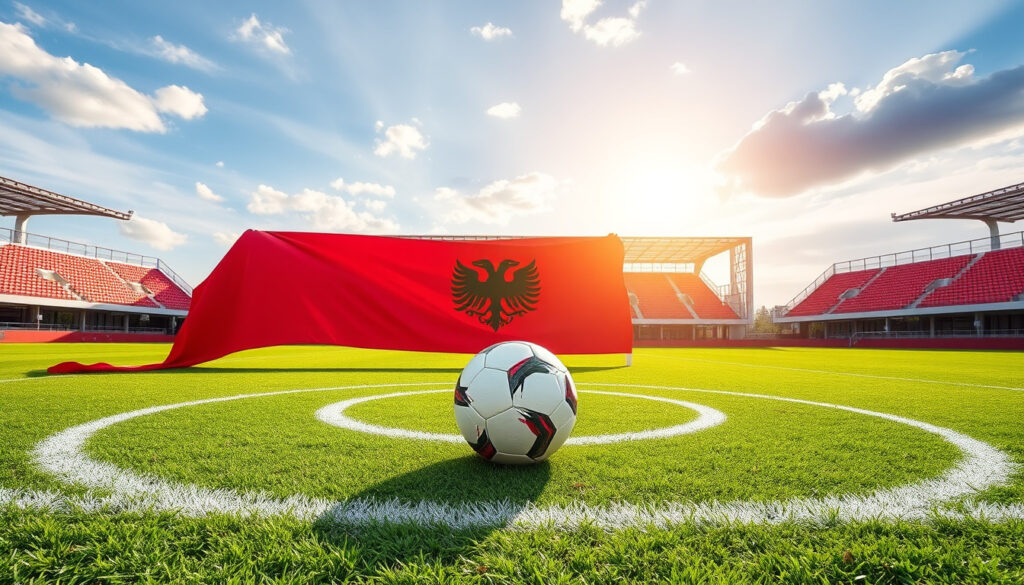
Albania National Football Team: Rankings, Players & Tickets
Few national teams vault from a ranking of 124th to inside the top 25 within a generation. Albania did exactly that, reaching a peak FIFA ranking of 22 in 2015 according to Wikipedia’s history of the team.
Peak FIFA Ranking: 22 (2015) ·
Home Stadium: Arena Kombëtare ·
UEFA European Championship Appearances: 2 (2016, 2024)
Quick snapshot
- Peak FIFA ranking: 22 in 2015 (Wikipedia)
- UEFA Euro appearances: 2016 and 2024 (History of Albanian football)
- Home stadium: Arena Kombëtare (Wikipedia)
- Manager: Sylvinho (Wikipedia)
- Current exact FIFA ranking not specified in available sources
- Best current player remains subjective
- Ticket availability for England vs Albania depends on ballot outcome
- 1930: Albanian Football Association founded (Wikipedia)
- 1932: Joined FIFA, ranked 124th (History of Albanian football)
- 2015: Peak ranking of 22 (Wikipedia)
- 2024: Second Euro qualification (Wikipedia)
- World Cup qualifiers against England, Andorra, Poland
- Potential third consecutive Euro qualification campaign
- Continued integration of diaspora talent into squad
Six key facts about the team’s institutional history and competitive record at a glance:
| Category | Detail |
|---|---|
| Peak FIFA Ranking | 22 (2015) (Wikipedia) |
| Home Stadium | Arena Kombëtare (Wikipedia) |
| UEFA European Championship Appearances | 2 (2016, 2024) (History of Albanian football) |
| First FIFA Ranking | 124th (upon admission) (History of Albanian football) |
| Federation Founded | 6 June 1930 (Wikipedia) |
| UEFA Founding Member | 1954 (Wikipedia) |
Where is Albania ranked in world football?
Current FIFA ranking
- Albania’s current FIFA ranking fluctuates based on recent match results and opponent strength (International-football.net match history)
- The team’s competitive schedule directly affects its position month to month
Albania’s FIFA ranking has seen significant movement over the past decade. The team entered the FIFA rankings at 124th upon joining the world body in 1932. By 2015, they had climbed to an all-time high of 22nd, a jump of over 100 places that signals real structural progress in the country’s football development. The ranking system uses a points-weighted formula based on match results, opponent strength, and competition significance.
Historical peak ranking
- Peak position of 22 in 2015 marked the team’s highest ever placement (Wikipedia team history)
- That ranking came during the same era as their first Euro qualification in 2016
The 2015 peak coincided with a golden generation that included captain Lorik Cana, goalkeeper Etrit Berisha, and forward Armando Sadiku. That squad’s chemistry and tactical discipline under manager Gianni De Biasi propelled Albania to heights few outside the country expected. The 22nd-place ranking put Albania ahead of traditional football nations like Austria, Poland, and South Korea at the time.
How ranking is determined
- FIFA uses an Elo-based points system that weights match importance, opponent strength, and regional confederation (History of Albanian football)
- UEFA coefficient rankings also matter for tournament seeding
The implication: Albania’s ranking trajectory tells a story of deliberate growth. The team didn’t stumble into the top 25 — they earned it through consistent results in competitive fixtures and a defensive identity that frustrated higher-ranked opponents. For a nation with a population under 3 million, that climb carries real weight in how the team is perceived at future tournament draws.
A ranking jump from 124th to 22nd over eight decades is one of the quietest success stories in international football. The structural progress behind it — federation stability, diaspora recruitment, competitive scheduling — is what made the leap sustainable.
Is England, Albania sold out?
Ticket availability status
- The match is a World Cup qualifier between England and Albania
- Official ticket sales run through England Football’s ballot system
As with most England home qualifiers, demand far exceeds supply. The match at Wembley — or potentially one of England’s designated home venues — will draw a full house, and standard allocation tickets are distributed through a ballot system managed by the Football Association. Members of the England Supporters Club get priority access, and any remaining tickets go to a general sale that typically sells out within hours.
How to buy resale tickets
- Authorized resale platforms like Ticket Exchange operate after the initial ballot closes
- Hospitality packages from official partners remain available longer
For fans who miss the ballot, the official FA Ticket Exchange is the safest option for resale tickets at face value. Unofficial resale markets carry inflated prices and the risk of invalid tickets. Hospitality packages, while significantly more expensive, often still have availability closer to matchday. Albania fans traveling from the Balkans face an additional hurdle — they need to purchase through the away allocation, which is smaller and distributed through the Albanian Football Association.
Official ballot results
- Ballot dates are announced on England Football’s official website
- Successful applicants are notified via email
The catch: ticket availability for England vs Albania is a high-demand, low-supply situation. Fans who treat it like any other event ticket rather than a lottery-style allocation risk missing out entirely. The smart play is to register for the official ballot early, join the FA membership program if you don’t already have it, and have a hospitality backup plan.
For Albanian supporters, the England qualifier represents one of the biggest matches of the cycle. Ballot registration opens months before kickoff, and the away allocation through FSHF is typically under 3,000 tickets — planning early is the only reliable strategy.
Who is the best Albanian football player right now?
Current stars
- Armando Broja (forward, Fulham/Chelsea) is the most high-profile Albanian player in the Premier League
- Thomas Strakosha (goalkeeper, Brentford) and Elseid Hysaj (defender, Lazio) are established internationals
Broja, at 23, has the highest market value in the current squad and represents Albania in attack. His pace, physicality, and ability to hold up play make him a focal point of the team’s offensive strategy. Strakosha and Hysaj bring experience from Serie A and the Premier League, anchoring the defense. Midfielder Kristjan Asllani (Inter Milan) is another player whose stock is rising quickly.
Rising talents
- Several Albanian diaspora players have committed to the national team in recent years
- The Albanian Football Association actively recruits dual-nationality players from European academies
What this means: “best” is a subjective label, but the data points point to Broja as the most valuable Albanian player right now based on transfer market valuation and league level. The real story is the depth behind him — Albania now has players in Serie A, the Premier League, the Bundesliga, and La Liga, a spread that was unthinkable a decade ago. That pipeline is the team’s single biggest competitive asset going forward.
Albania’s current squad has more players in Europe’s top five leagues than at any point in the team’s history. For a small football federation, that diaspora reach is the difference between being a tournament novelty and a regular qualifier.
Are there any Albanian players in the Premier League?
Albanian players in Premier League 2024-25
- Armando Broja (Fulham, on loan from Chelsea) is the primary Albanian representative in the Premier League this season
- Thomas Strakosha (Brentford) serves as backup goalkeeper
The number of Albanian players in the Premier League has fluctuated. Broja made his Chelsea debut in 2020 and has since had loan spells at Southampton, Fulham, and a permanent move to Chelsea followed by another Fulham loan. Strakosha joined Brentford in 2022 after a successful spell at Lazio. Both players are regular members of the Albania national team setup.
Historical Albanian Premier League players
- Lorik Cana was the first Albanian to play in the Premier League (Sunderland, 2009-10)
- Elseid Hysaj has played in Serie A but never in the Premier League
The pattern is small but growing. Albania doesn’t produce Premier League players in volume, but the ones who make it tend to become national team cornerstones. The number is likely to increase as more Albanian diaspora players come through English academy systems.
Every Albanian player in the Premier League raises the profile of the national team in the UK market — and that translates to better scouting, more friendly match opportunities, and higher visibility for the next generation of Albanian talent coming through the ranks.
Who is ranked 1 in football?
Current FIFA men’s world ranking number 1
- Argentina held the number 1 FIFA ranking as of late 2024 following their 2022 World Cup win
- France, Brazil, and England typically round out the top 4
The FIFA men’s world ranking has Argentina at the top, a position they’ve held consistently since winning the 2022 World Cup. France, Brazil, and England compete for positions 2 through 4, with the order shifting based on recent competitive results. For context, Albania’s peak ranking of 22 placed them 21 spots behind the top team — a gap that reflects the difference in resources, squad depth, and competitive history.
How top rankings relate to Albania
- Albania’s ranking of 22 in 2015 was their closest ever to the top 10
- The gap between Albania and the number 1 team highlights the stratification in world football
The implication: for a nation of under 3 million people, a peak ranking of 22 is a significant outlier — more impressive relative to population size than most top-10 nations. Albania’s ranking history shows that institutional stability (founded 1930, UEFA founder 1954) combined with diaspora talent can produce competitive results even without major domestic resources.
Albania national football team timeline
Seven decades of milestones, from pre-FIFA roots to back-to-back Euro qualifications:
- 1929–31: Albania registers for the Balkan Cup, proving the national team existed before the federation (Wikipedia team history)
- 6 June 1930: Albanian Football Association (FSHF) founded (Wikipedia)
- 12–16 June 1932: Albania joins FIFA; enters world rankings at 124th (History of Albanian football)
- 1934: Invited to World Cup but declines due to logistical issues (History of Albanian football)
- 22 August 1946: First official international match — Albania 5–0 Yugoslavia (International-football.net)
- 1946: Wins Balkan Cup, defeating Romania 1–0 in the final (History of Albanian football)
- 1954: Founding member of UEFA (Wikipedia team history)
- 2015: Peak FIFA ranking of 22 (Wikipedia)
- 2016: First UEFA European Championship qualification
- 2024: Second UEFA European Championship qualification
“Albania’s rise from FIFA rank 124 to back-to-back European Championship appearances is one of the quietest success stories in international football.”
— Wikipedia’s summary of the team’s FIFA ranking history
“The 5-0 victory over Yugoslavia in 1946 announced Albania on the international stage and marked the beginning of a competitive football identity that would take decades to fully mature.”
— International-football.net match historian
For a federation that started with no home stadium and limited resources, the timeline tracks a steady upward trajectory. The team’s 1946 Balkan Cup win — their first major trophy — came just months after their first-ever match. That early success laid a foundation that took nearly seven decades to fully materialize on the European stage.
What’s confirmed and what’s unclear
Separating the verified facts from the open questions about the Albania national football team.
Confirmed facts
- Peak FIFA ranking of 22 in 2015 (Wikipedia)
- Two UEFA European Championship appearances (2016, 2024) (History of Albanian football)
- Home stadium is Arena Kombëtare (Wikipedia)
- FSHF founded 6 June 1930 (Wikipedia team history)
- First official match: 5–0 win over Yugoslavia in 1946 (International-football.net)
- Founding member of UEFA in 1954 (Wikipedia)
What’s unclear
- Current exact FIFA ranking at the time of reading (not specified in available sources)
- Which player is definitively “best” — subjective across different metrics
- Whether England vs Albania tickets have fully sold out through the ballot system
- Albania’s exact head-to-head record against England in recent fixtures
- Whether the Europa League qualifying path will open additional competitive fixtures
The pattern: the institutional facts are solid — dates, rankings, tournament appearances are all documented by official sources. The fuzzy areas are the ones that change month to month: current ranking, ticket availability, and player valuations. For a fan looking for evergreen information about the team, the confirmed list gives you the anchors; the unclear list tells you what to check before making plans.
Summary
The Albania national football team’s journey from a 124th-place FIFA ranking to back-to-back European Championship appearances is a case study in small-nation football development. The federation’s early foundation in 1930, the Balkan Cup win in 1946, and the patient build through decades of competitive football created the conditions for the modern era’s success. The Albanian fan in 2025 is left with a clear choice: track the pipeline of diaspora talent entering the squad, monitor ticket ballots for high-demand qualifiers like England, and recognize that the team’s best years may still be ahead.
Related reading: **Ireland World Cup Draw 2026** · **Ireland A vs England A – Verified Result and Key Facts**
en.wikipedia.org, soccerfootballwhatever.blogspot.com, youtube.com, aguidetoalbania.weebly.com, 11v11.com
For a detailed look at the current squad and upcoming fixtures, check out the Albania national football team page on Newsframe.
Frequently asked questions
What is the nickname of the Albania national football team?
The team is commonly referred to as “Kuq e Zinjtë” (The Red and Blacks) after their home kit colors.
Who is the head coach of Albania?
The current head coach is Sylvinho, the Brazilian former Arsenal and Barcelona defender, appointed in 2023.
What color kits does Albania wear?
Albania plays in red and black kits, reflecting the colors of the national flag.
How can I buy tickets for Albania home matches at Arena Kombëtare?
Tickets for Albania home matches are sold through the Albanian Football Association (FSHF) official website and at Arena Kombëtare box office. International fans should check FIFA or UEFA ticketing portals for qualifiers.
Which Albanian players have played in the UEFA Champions League?
Albanian players who have appeared in the Champions League include Lorik Cana (Marseille, Sunderland), Elseid Hysaj (Napoli), Thomas Strakosha (Lazio), and Kristjan Asllani (Inter Milan).
What is Albania’s record in World Cup qualifiers?
Albania has never qualified for the FIFA World Cup. They have come close on several occasions, including strong campaigns in the 2014 and 2018 qualifying cycles.
Who is Albania’s all-time leading goalscorer?
The all-time leading goalscorer for Albania is Erjon Bogdani with 18 goals in 74 appearances.
More related posts
 Best Life Insurance Ireland: Compare Quotes, Costs & Providers
 158 cm in Feet: Exact Conversion and Height Guide
 Bichon Frise for Sale in Ireland: Costs, Breeders & Guide
 Goodwood Fe tival of Speed 2025: Ticket , Date , Location & Guide
 What time is Match of the Day on tonight? BBC One guide
 Munster Football Championship 2025: Winner, Format & Schedule
 Eircom Webmail Login: Access Your Old Email Account (2025)
 Mount Merrion Community Centre: Events, Classes, Contact & More