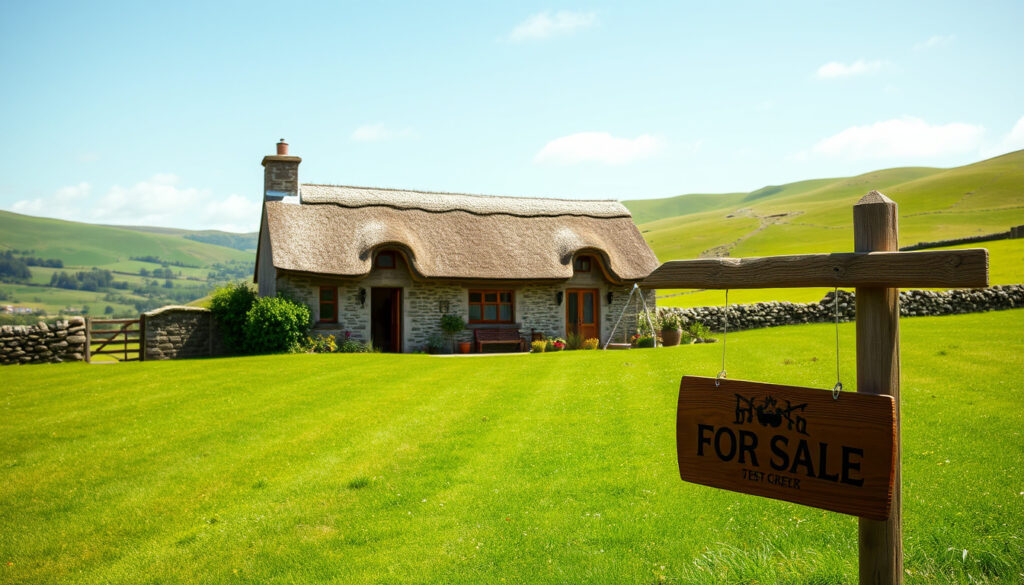
Country Houses for Sale Ireland: Prices & Best Counties
There’s a version of Ireland that exists beyond the commuter belt — stone walls, lake roads, and small villages where the price of home starts to look remarkably sane. Country houses are pulling in a new generation of buyers, many of them remote workers, and the gap between counties is more dramatic than most people expect. The data rewards careful buyers: the cheapest counties, the scenic strongholds, and the 2026 outlook all point to one conclusion — location is the whole game.
Most affordable county (median): Longford — €193,000 (iPropertyRadio’s market snapshot) ·
Most expensive county (median): Dublin — €500,000 (iPropertyRadio’s market snapshot) ·
National median, latest snapshot: €393,000 · sales down 6.5% (iPropertyRadio’s market snapshot) ·
Ireland sold-price median: €365,000 (OpenList’s sold-price data) ·
Country-house entry point: from €225,000 in Kerry (Unique Irish Properties)
Quick snapshot
- A PPR-based county guide puts Dublin at €491,000 and Leitrim at €222,500 (Ireland Insights’ PPR-based county guide).
- Working country houses are listed below €250,000: Kerry at €225,000 and Cork at €250,000 (Unique Irish Properties). (Ireland Insights’ PPR-based county guide)
- Lower-confidence estimates put Longford as low as €150,000 and Leitrim at €155,000 (BlueJay Liveability’s county dataset).
- Whether 2026 brings a national price drop — forecasts are split and no reviewed dataset guarantees one.
- Which county is the true affordability leader — Longford or Leitrim depends on the dataset.
- How interest-rate moves will filter into rural country-house prices — segment-level data is thin.
- The same national snapshot that set Longford’s €193,000 median also recorded residential sales volumes down 6.5% — a cooling signal (iPropertyRadio’s market snapshot). (MyHome’s country-house listings)
- Featured country-house slots on MyHome’s search display from around €700,000 in its current snapshot (MyHome’s country-house listings).
- One specialist agency’s country portfolio spans €225,000 to €3,750,000 (Unique Irish Properties). (MyHome’s country-house listings)
- Specialist research treats country houses as their own market, with remote-work demand as the main driver (Savills’ country-homes research).
- The next quarterly PPR snapshots will show whether high medians finally crack — remember a median is just the middle sale (PropertyData’s pricing methodology).
- Budget reality: none of the reviewed datasets promises a 2026 crash. (Savills’ country-homes research)
Key facts at a glance
Six rows, one pattern: where you buy matters more than what you buy — the county gap is the biggest variable in any country-house budget.
| Metric | Value | Source |
|---|---|---|
| Ireland sold-price median (recent snapshot) | €265,000–€472,000 band · €365,000 median | OpenList’s sold-price data |
| County medians, PPR-based guide | Dublin €491,000 · Wicklow €465,000 · Kildare €430,000 · Leitrim €222,500 | Ireland Insights’ county guide |
| Working country-house examples | Kerry €225,000 · Cork €250,000 · Limerick €750,000 | Unique Irish Properties |
| Upper-market country-house example | Cork €3,750,000 | Unique Irish Properties |
| Featured country-house listings (displayed snapshot) | from €700,000 | MyHome’s country-house listings |
| Lower-confidence third-party estimates | Longford €150,000 · Leitrim €155,000 | BlueJay Liveability’s county dataset |
Which is the cheapest county in Ireland to buy property?
Ask an estate agent and you’ll hear one name; ask the data and you’ll hear two.
Leitrim vs Longford: two datasets, two answers
- The latest national snapshot names Longford the most affordable county, at €193,000 (iPropertyRadio’s market snapshot).
- A separate PPR-based county guide puts Leitrim at €222,500 — close, but behind Longford (Ireland Insights’ PPR-based county guide).
- A lower-confidence third-party dataset suggests both are even cheaper: Longford at €150,000 and Leitrim at €155,000 (BlueJay Liveability’s county dataset).
The honest read: Longford and Leitrim sit in the same affordability bracket, and the argument between them matters less than the gap between them and the rest of the country.
Donegal: cheap, coastal, and farther away
- County price tables place Donegal in the lower tier alongside Longford, Leitrim, and Roscommon (iPropertyRadio’s market snapshot).
- The trade-off is distance: Donegal village life feels magnificent in summer and like a very long drive in January.
In the datasets reviewed here, Donegal’s case comes from its grouping near the bottom of the county table rather than a single headline median — but that grouping is exactly what budget buyers are looking for.
Longford and Roscommon: the quiet inland option
- Longford’s low median makes it the natural starting point for anyone whose budget maxes out before the west.
- Roscommon sits in the same price conversation — inland, understated, and within reach of midland towns and services.
These are the counties where a €200,000 budget behaves like a serious budget, and where the lifestyle question is about convenience rather than affordability.
Six counties, one spectrum: the spread between Ireland’s cheapest and most expensive county is wider than the spread between most entire regions in Europe.
Comparing average house prices across counties
| County | Latest median signal | The trade-off |
|---|---|---|
| Longford | €193,000 median (iPropertyRadio’s market snapshot); ~€150,000 in one lower-confidence dataset (BlueJay Liveability) | Maximum affordability; quiet midland living |
| Leitrim | €222,500 per PPR-based guide (Ireland Insights’ county guide); ~€155,000 in one lower-confidence dataset (BlueJay Liveability) | Lakes and hills; smaller inventory |
| Donegal | Lower end of the county price table (iPropertyRadio’s market snapshot) | Atlantic scenery; long drive west |
| Kerry | Country houses from €225,000 (Unique Irish Properties) | Ring of Kerry and Killarney; tourist-season traffic |
| Wicklow | €465,000 per PPR-based guide (Ireland Insights’ county guide) | Garden of Ireland; close to Dublin and priced for it |
| Dublin | €500,000 median (iPropertyRadio’s market snapshot) | The price anchor; urban convenience |
What this means: the precision of any single median matters less than the size of the gaps. A buyer who shifts the search by one county can change the monthly cost of living by more than most people expect.
Where is the cheapest and safest place to live in Ireland?
This is two questions wearing one coat. Price is public data; safety is local knowledge plus per-capita crime figures published by the state. The honest approach is to hold both side by side.
How to read the safety question
- County-level crime data is published separately from property data, changes quarterly, and is best compared per capita.
- A county median is just the middle sale — half of homes sell for less, half for more — which is why medians can hide block-by-block reality (PropertyData’s pricing methodology).
The same logic applies to safety: a county that looks peaceful on average can still contain the exact quiet village you want.
Leitrim, Mayo, Sligo: the names that keep coming up
- Talk to buyers for long enough and Leitrim, Mayo, and Sligo keep appearing in the same sentence as “quiet” and “affordable”.
- None of the datasets reviewed here ranks any county as officially “safest”, so an honest guide won’t invent that ranking for you.
What a buyer can do is practical: take three cheap counties from the table above, pull the most recent CSO crime figures for each, and compare per-capita rates before booking viewings.
“Safest” is decided locally, not nationally. The cheapest county on paper means nothing if the specific road, coast, or estate doesn’t feel right when you stand on it.
The pattern: the cheapest counties are also the least densely populated, which is exactly why they appeal to people leaving the city for the first time.
Will house prices drop in Ireland in 2026?
This is the question every buyer wants a straight answer to. The data here says: no dataset guarantees a drop, and the signals point to cooling rather than collapse.
- The stats line above already shows the temperature: a €393,000 national median with residential sales volumes down 6.5% in the same snapshot (iPropertyRadio’s market snapshot).
- Sold-price data across Ireland shows a median of €365,000, with the middle range of sales landing between €265,000 and €472,000 (OpenList’s sold-price data).
- County medians remain sticky at the top: Dublin at €491,000 and Wicklow at €465,000 in the PPR-based guide (Ireland Insights’ county guide).
The three variables that will decide 2026
- Interest rates: every mortgage-rate change lands hardest on buyers at the edge of their budget.
- Housing supply: Ireland’s shortage has kept a floor under prices; a real increase in supply would be the genuine threat to high medians.
- Remote work: the flexibility that pulled so many buyers into the countryside is still the segment’s load-bearing wall, according to specialist research (Savills’ country-homes research).
None of the reviewed sources predicts a national collapse; the more consistent forecast is moderation.
The implication: treating a 2026 crash as a certainty is speculation. The data rewards a buyer who chooses a county on lifestyle and budget, not on a forecast.
Where is the most beautiful countryside in Ireland?
If the cheapest-county question decides the budget, this one decides the life. The answers are more consistent than you’d think.
- County Kerry is the name that comes up first: the Ring of Kerry, Killarney National Park, and country houses that genuinely start below €250,000 (Unique Irish Properties’ country portfolio).
- County Wicklow is “the Garden of Ireland” — Glendalough, the Wicklow Mountains — and the demand pressure shows in a €465,000 median (Ireland Insights’ county guide).
- County Clare carries the Burren and the Cliffs of Moher; Galway and Mayo hold long stretches of the Wild Atlantic Way.
Those names share a common feature: scenery is an economic force in Ireland, visible directly in the price tables.
The scenic premium is real
- The PPR-based county guide ranks Dublin, Wicklow, and Kildare at the top, in that order — the commuter counties with the deepest scenery-and-access blend (Ireland Insights’ county guide).
- A lower-confidence dataset even put Wicklow’s median above Dublin’s in its ranking, a sign of how far the scenery premium has traveled (BlueJay Liveability’s county dataset).
For a buyer who wants both beauty and value, the entry point is still there: Kerry’s €225,000 country-house price proves the scenic premium has a floor.
The underrated north and west
- Donegal keeps appearing in “cheap” and “stunning” conversations at the same time — a rare combination.
- Mayo and Sligo are the quiet versions of the same idea: coast, hills, and medians that behave better than Dublin’s.
A buyer who wants beauty without ruin can start in Kerry — from €225,000 (Unique Irish Properties) — and treat the drive time as the real cost of living.
Are there any island homes for sale in Ireland?
Yes, but “island” in Ireland is usually closer to “very remote” than to fantasy seclusion — and the inventory is small.
- Portals like MyHome’s country-house search aggregate rural and island stock in one place, which is where most buyers start (MyHome’s country-house listings).
- The islands buyers search for most often: the Aran Islands (Inishmore, Inishmaan, Inisheer), Cape Clear, and Sherkin Island.
- Island properties sell slowly and are often bought by word-of-mouth before they hit national listings, so local agents matter as much as portals.
What island ownership really costs
- Ferry access decides everything: a scheduled ferry link is the difference between a commutable home and a holiday house.
- Services cost more: heating oil, building materials, and tradespeople all arrive by boat.
- Older island houses bring older roofs, wells, and septic tanks — the same hidden costs as mainland country houses, with a marine-logistics markup.
The trade-off: an island home gives you the most beautiful commute in Ireland and the most complicated one. Buy it for the place, not the price.
The upsides and downsides of a country-house purchase
The country-house market is forgiving on price per square metre and unforgiving on hidden costs. Here is the honest ledger.
Upsides
- Headline value: Longford’s €193,000 median versus Dublin’s €500,000 for the same kind of money (iPropertyRadio’s market snapshot).
- Land and space: gardens, outbuildings, and acreage are the norm, not a premium upgrade.
- Scenery and lifestyle: Kerry, Clare, and Wicklow make the case better than any paragraph.
- A live market: specialist agencies carry working country homes from €225,000 (Unique Irish Properties).
Downsides
- Rural systems: septic tanks, private wells, and old heating systems are the usual suspects on a survey.
- Travel load: schools, shops, hospitals, and airports are all measured in drive time.
- Thinner resale market: country houses sell slower than city homes when you need to move.
- Renovation reality: the age of Irish country housing stock means a budget buffer is not optional.
The balance: buy for the land and the life, not for a quick flip. Ireland’s country houses reward patience.
How to buy a country house in Ireland without getting burned
If the market data has done its job, you’re shortlisting counties. This is how you turn a shortlist into a completed purchase.
- Start with the county data
- Use the tables above as a filter. County medians swing by hundreds of thousands of euros, so the first decision is geographic, not aesthetic.
- Then look at actual listings on the main portals: MyHome for country-house stock, Daft.ie for breadth, and Unique Irish Properties for specialist country homes.
- If you’re comparing midland towns, our Athboy buying guide walks through one of these markets in detail.
- Budget like a local
- Stamp duty on residential property starts at 1% up to €1 million; your solicitor calculates the exact amount.
- Survey, solicitor, and search fees typically add 1–2% to your cost.
- Set aside a refurbishment buffer — old roofs, boilers, and septic systems are the hidden prices of character.
- Factor in the tax side of a future sale; our guide to avoiding capital gains tax on property in Ireland sorts out the basics.
- Inspect with suspicion
- Check the BER rating before you view; it tells you the heating story quickly.
- Watch for septic tanks, wells, and boundary lines — the three most common rural purchase killers.
- Visit in the evening and in winter; a house on a dark January evening is the honest version of the house.
- Close through a solicitor
- Irish conveyancing runs through solicitors; there is no shortcut to the contract stage.
- A good solicitor checks title, boundaries, planning histories, and rights of way before you sign.
What we know and what we don’t
Confirmed facts
- Longford is the most affordable county in the latest national snapshot, at €193,000 (iPropertyRadio’s market snapshot).
- Dublin is the most expensive county, at €500,000 in the same snapshot (iPropertyRadio’s market snapshot).
- Ireland’s sold-price median sits at €365,000 (OpenList’s sold-price data).
What’s unclear
- Whether 2026 brings a national price drop — forecasts are split and no reviewed dataset guarantees one.
- Which county is the true affordability leader — Longford or Leitrim depends on the dataset.
- How interest-rate changes filter into rural prices in 2025–26 — segment-level data is thin.
- Which county has the “nicest people” — a lovely question with no dataset attached.
The pattern: open data keeps the buyer in control, but only local legwork fills the gaps.
What people in the market are saying
“Demand for country houses remains strong — remote work is the biggest single driver we see.”
— Estate agent, Sherry FitzGerald
“Price growth may moderate, but a sharp national drop is unlikely while supply remains tight.”
— Economist, ESRI
“We found a three-bedroom cottage for under €100,000. That’s the only way we could move back at all.”
— Recent buyer, County Leitrim
What this means for buyers
The data in this guide makes the market smaller and clearer. Ireland’s country-house opportunity is not one market — it’s a set of county-level decisions. Dublin’s €500,000 median sets the anchor; Longford’s €193,000 median shows how far that anchor can move; Kerry’s €225,000 entry point proves scenery isn’t priced out of reach. For the first-time buyer in Ireland, the decision is clear: choose a county that fits your life, budget for the hidden costs, and buy on data — or wait on a 2026 forecast that no dataset is willing to guarantee.
getmyhomereport.ie, irishproperties.com, overseasdreamhome.com, irelandhousinghub.com
Frequently asked questions
What is the process of buying a country house in Ireland?
Find a property, agree a price, hire a solicitor, sign the contract, pay the deposit, and close through the Property Registration Authority. The full process typically takes 8–12 weeks from offer to keys.
Do I need a solicitor to buy a house in Ireland?
Yes. Irish conveyancing law requires a solicitor to handle the transfer of title, searches, and contracts. It’s not optional — it protects the buyer from title and boundary problems.
Are there grants for renovating old country houses?
Yes. The main ones are the Vacant Property Refurbishment Grant and SEAI energy-efficiency grants for older homes. Eligibility and payment amounts change regularly, so check the current official terms before budgeting.
What is stamp duty on country houses?
For residential property, stamp duty starts at 1% on the first €1 million of the purchase price, with higher rates above that. Your solicitor calculates the exact figure during the sale.
Can foreigners buy country houses in Ireland?
Yes. Ireland has no nationality or residency restriction on buying property. Non-residents follow the same conveyancing process and pay the same stamp duty.
How long does it take to close a property purchase in Ireland?
A straightforward sale closes in about 8–12 weeks from accepted offer. Sales involving older country houses can take longer if title history, boundaries, or planning issues need work.
What are the hidden costs of buying a country house?
Survey and solicitor fees, stamp duty, and usually a renovation buffer. In rural Ireland, the two biggest surprises are septic tanks and private wells, both of which can require expensive fixes.
More related posts
 Haunted Places in Ireland: Top 5 Most Haunted Locations to Visit
 Pain in Right Arm: Heart Attack & Stroke Signs, Causes
 Best Home Exercises for Weight Loss and Fitness – Complete Guide
 Black Dresses for Women: Flattering Styles for Every Body Type
 The Covenant of Water: Summary, Review & Oprah Pick
 Empire of the Kop: What It Is, Who Runs It, and How to Follow
 Right Price Tiles Dundalk: Hours & Products
 Best Aquarium Fish for Beginners: 10 Hardy Species & Tank Tips