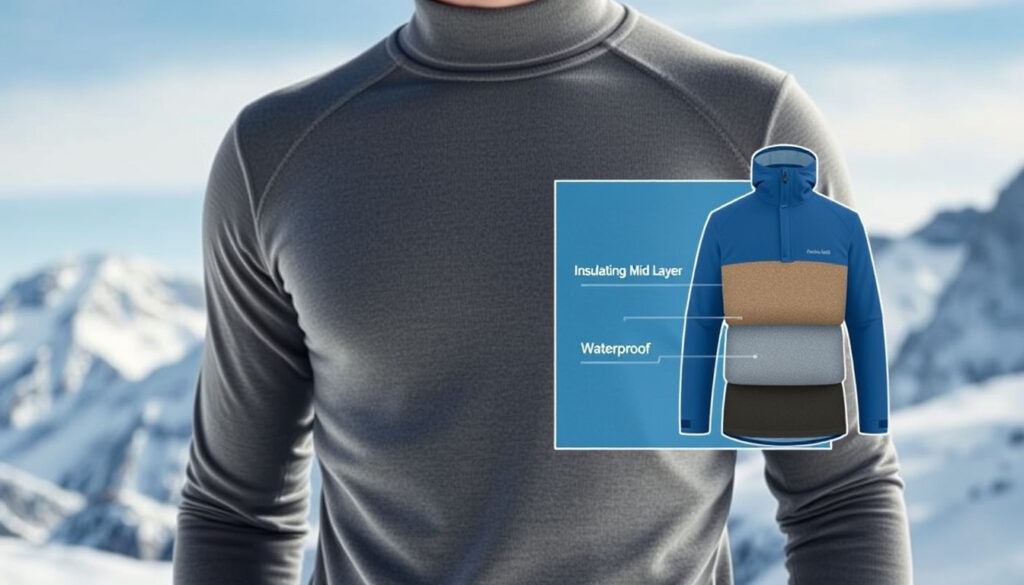
What Is Base Layer Clothing? Purpose, Materials & 3-Layer Rule
Anyone who’s pulled on a cotton T-shirt for a winter hike and spent the next hour shivering already knows: the layer closest to your skin does the heavy lifting. Called a base layer, it works by moving sweat away from your body, which MedlinePlus (U.S. National Library of Medicine) describes as its core job for staying comfortable during activity.
Moisture wicking: Pulls sweat away from skin ·
Insulation: Traps a thin layer of heat ·
Ideal temp range: 50°F (10°C) and below ·
Common fabrics: Merino wool, polyester
Quick snapshot
- A base layer is the innermost clothing layer, designed to move perspiration away from the skin (MedlinePlus). (Mayo Clinic Sports Medicine)
- The three-layer system pairs it with an insulating mid layer and a weather-protective outer layer (Mayo Clinic Sports Medicine).
- Exactly when you need a base layer depends on wind, humidity, exertion, and personal comfort, not a single thermometer reading (National Weather Service).
- Mayo Clinic Sports Medicine cites wind chill below -18°F (-28°C) as a condition where frostbite can occur on exposed skin in 30 minutes or less (Mayo Clinic Sports Medicine).
- Adjust your layers for activity: strenuous exertion may mean removing layers to avoid sweating (National Weather Service).
Four numbers frame the whole base-layer story, from its job to the materials that do it best:
| Attribute | Detail |
|---|---|
| Primary purpose | Moisture management and warmth (MedlinePlus) |
| Common materials | Merino wool, polyester, polypropylene (MedlinePlus) |
| Weight options | Lightweight, midweight, heavyweight |
| When to wear | Cold weather, high exertion, first layer |
| Fit | Close-fitting, comfortable, nonrestrictive (MedlinePlus) |
| Cotton rule | Avoid cotton in cold, wet, or active conditions (MedlinePlus) |
| Mid layer | Insulates by trapping air (National Weather Service) |
| Outer layer | Blocks wind and precipitation while breathing |
| Hypothermia threshold | Core body temperature below 95°F (35°C) (National Weather Service Duluth) |
What’s the difference between a base layer and thermals?
Anyone shopping for winter gear has seen “base layer” and “thermals” used as synonyms. The truth is almost that simple: thermal underwear is a common market term for a base layer designed for cold climates. The functional emphasis is slightly different, though. Base layers put moisture management first, while traditional thermals lean toward insulation.
What materials are used in thermal bases?
- Polyester and polypropylene are moisture-wicking mainstays (MedlinePlus).
- Lightweight merino wool also works as a moisture-managing inner layer (MedlinePlus).
- Cotton is the outlier: it absorbs sweat and stays wet against the skin (MedlinePlus).
How do weight and fit differ?
- Lightweight: best for high-exertion days like running or snowshoeing.
- Midweight: the do-it-all option for most winter activities.
- Heavyweight: for low-exertion days in deep cold.
Fit matters more than the label. A base layer should be close-fitting enough to contact the skin while remaining comfortable and nonrestrictive (MedlinePlus).
The trade-off: a baggy base layer won’t wick efficiently because it isn’t touching the skin; a too-tight one will chafe. Fit is what turns fabric into a functional “second skin.”
What is the purpose of wearing base layers?
Strip away the marketing and a base layer has one job: keep your skin dry so you don’t freeze when sweat evaporates. Everything else—odor control, softness, stretch—is a bonus.
Moisture management
- It moves perspiration away from the skin to regulate comfort during activity (MedlinePlus).
- The result is that you stay drier, which prevents the post-exertion chill.
Temperature regulation
- Base layers trap a thin layer of heat right next to the skin.
- Several loose-fitting layers can insulate by trapping air between garments (National Weather Service).
Comfort against skin
- Close-fitting but comfortable and nonrestrictive (MedlinePlus).
- Merino wool resists odor, which is why it dominates multiday trips (The North Face UK).
The implication: a base layer isn’t a thicker sweater. It’s the control layer that decides whether your sweat cools you down or gets evaporated before it can.
At what temperature should you wear a base layer?
If you want a single number, 50°F (10°C) is the conventional rule of thumb. But the National Weather Service warns against treating any clothing rating as a universal threshold: wind, humidity, exertion, fit, wetness, and your own physiology all shift the safety line.
General temperature thresholds
- Many outdoor gear guides suggest a base layer when temperatures drop below 50°F (10°C).
- Mayo Clinic Sports Medicine cites wind chill below -18°F (-28°C) as a condition where frostbite can occur on exposed skin in 30 minutes or less (Mayo Clinic Sports Medicine).
- Hypothermia sets in when core body temperature falls below 95°F (35°C) (National Weather Service Duluth).
Activity level considerations
- Strenuous exertion may require removing layers to prevent sweating (National Weather Service).
- Loose layers trap air for insulation, so don’t suffocate yourself inside three tight shirts (National Weather Service).
A 50°F day on a sunny trail is not the same as 50°F in a steady wind. Watch the wind, not just the thermometer, before you decide to skip the base layer.
Why this matters: dressing by a single number can leave you soaked or shivering. Let the conditions and your exertion set the schedule.
Do I wear anything under the base layer?
The short answer: yes, if you want to. A base layer is designed to sit against your skin, but that doesn’t mean you can’t wear underwear beneath it.
Underwear and base layers
- Most base layers are worn directly against the skin by design (MedlinePlus).
- If you do wear underwear underneath, make sure it is also moisture-wicking; cotton underneath defeats the whole system.
Can you wear base layer alone?
- Yes, on a mild day a base layer works as a standalone shirt.
- It’s designed as the first piece of a multi-layer system, not as a replacement for a jacket.
The catch: whatever you put underneath still matters. A cotton bra or pair of briefs under a merino base can leave you just as damp as wearing a cotton T-shirt.
What is the 3 layer rule for winter?
The three-layer system is less a law than a strategy: every layer has one verb. The base moves sweat, the mid holds heat, the shell stops the storm.
Base layer
- Moisture management: moves sweat off the skin (MedlinePlus).
- Materials: merino, polyester, polypropylene (Mayo Clinic Sports Medicine).
- Fit: close but nonrestrictive.
Mid layer
- Insulation: traps air to reduce heat loss (National Weather Service).
- Materials: fleece, wool, microfiber insulation, or down (MedlinePlus).
Outer layer
- Protection: blocks wind, rain, and snow (MedlinePlus).
- Breathability matters: a waterproof shell that doesn’t breathe can trap sweat and cause chilling (MedlinePlus).
If the outer shell is fully waterproof but lets no vapor out, you’ll soak through the mid layer from the inside. Breathability is a feature, not a fine print.
The pattern: each layer has one verb. Skip a verb and the system fails.
One comparison sums up most shopping decisions: a dedicated base layer versus classic thermal underwear. They often share a drawer, but they’re built for different beatings:
| Base layer | Thermal underwear | |
|---|---|---|
| Primary focus | Moisture management first, insulation second | Insulation first, moisture as a feature |
| Common materials | Merino, polyester, polypropylene (MedlinePlus) | Often cotton or wool blends |
| Fit | Close-fitting to contact skin | Can be looser or waffle knit |
| Best for | High-exertion, backcountry, everyday winter wear | Around-town, low-activity warmth |
Thermals flannel around town are fine. For sweat-heavy activities, a moisture-managing base layer is the difference between dry and drenched.
Two fabrics lead the conversation — merino and synthetics — and each has a clear trade-off:
| Material | Moisture wicking | Drying speed | Odor resistance | Durability | Best use |
|---|---|---|---|---|---|
| Polyester | Excellent | Fast | Moderate | High | Aerobic sports (MedlinePlus; The North Face UK) |
| Polypropylene | Excellent | Fast | Moderate | High | High-sweat sports (MedlinePlus) |
| Merino wool | Good | Slower | High | Lower | Multiday trips (The North Face UK) |
| Merino-synthetic blend | Good | Moderate | High | Better than pure merino | Everyday balance (The North Face UK) |
| Nylon (in blends) | Adds stretch and durability | — | — | High | Blend fiber (The North Face UK) |
| Cotton | Poor | Slow | Low | High | Avoid for cold or active use (MedlinePlus) |
For most people, the winning move isn’t synthetic or merino — it’s a mix. Synthetic dries fastest, merino controls odor, and a blend gives you both without babying the fabric.
Upsides
- Moves sweat off your skin so you don’t chill mid-activity (MedlinePlus).
- Adds a thin layer of insulation without bulk (National Weather Service).
- Extends the comfort range of your outerwear.
Downsides
- Cheap cotton versions do the opposite of the job (MedlinePlus).
- High-end merino is pricey and less abrasion-resistant (The North Face UK).
- No single universal temperature number tells you when to wear one (National Weather Service).
How to layer up properly
- Start with a snug, moisture-wicking base layer that touches the skin without squeezing (MedlinePlus).
- Add an insulating middle layer — fleece, wool, or down — to trap air (MedlinePlus).
- Finish with a wind- and water-resistant shell that can still breathe (MedlinePlus).
- Adjust as you move: unzip, vent, or peel a layer before you break a sweat (National Weather Service).
Confirmed facts
- A base layer is the innermost clothing layer, worn next to skin (MedlinePlus).
What’s unclear
- The exact temperature threshold for needing a base layer varies with wind, exertion, and physiology (National Weather Service).
- Whether synthetic or merino is “better” depends on the use case (The North Face UK).
- Cotton is unsuitable for cold, wet, or active conditions (MedlinePlus).
The sequence matters as much as the fabrics.
What the sources say
A base layer is the innermost clothing layer designed to move perspiration away from the skin and help regulate comfort during activity.
MedlinePlus (U.S. National Library of Medicine)
Synthetic base layers generally dry faster and wick moisture more effectively than merino.
The North Face UK (outdoor gear manufacturer)
Several loose-fitting layers can insulate by trapping air between garments.
National Weather Service (winter safety guidance)
Here’s the shortest version worth remembering: a base layer exists to keep you dry, and dry skin stays warm far longer than wet skin. For anyone heading into a cold trailhead, the decision is clear: spend on a moisture-wicking first layer in merino, synthetic, or a blend, or accept a hike that ends with shivers and a damp shirt.
Frequently asked questions
What is a base layer clothing made of?
Base layers are typically made from merino wool, polyester, polypropylene, or blends of these. Cotton is not recommended for cold or active use because it absorbs moisture and stays wet against the skin (MedlinePlus; The North Face UK).
What are common mistakes people make when layering for winter?
The most common mistake is wearing cotton next to the skin. Other mistakes include over-layering for high-exertion activities and using a waterproof but nonbreathable shell that traps sweat and makes you chill (MedlinePlus).
What is a good layered outfit for winter?
A moisture-managing base layer (merino or synthetic), an insulating mid layer like fleece or down, and a breathable, windproof outer shell (Mayo Clinic Sports Medicine).
Is a base layer enough by itself?
In mild conditions, yes. A base layer can be worn as a standalone shirt, but it is designed to be the first layer in a system, with a mid layer for warmth and a shell for protection.
What is the standard temperature guideline for base layers?
Many brands suggest wearing a base layer when temperatures drop below 50°F (10°C). But wind, humidity, exertion, and personal physiology mean there is no single universal threshold (National Weather Service).
Related reading
If you’re building a winter wardrobe from scratch, these guides help work out sizing and shopping details:
More related posts
 The Auld Triangle Pub – Locations Menus History Ireland
 Irish Public Holidays 2026: Republic and Northern Ireland Dates
 Shane Lowry Tee Time Today – Round 3 Open Championship Schedule
 European Tour Leaderboard Today – Live Scores & Standings
 Tipperary Crystal Christmas Decorations: Sparkle & Alphabet
 RB Salzburg vs Real Madrid Lineups: 2025 Starting 11 & Scorers
 Next Castlebar Opening Hours | Lannagh Road Store Times